


Walk into most flower shops and the displays look fine. Buckets are full, the front table has a nice arrangement, the cooler is stocked. And yet walk-in conversion sits lower than it should, average order value barely moves month to month, and a chunk of what's on display quietly ages out and gets composted.
The problem isn't taste. Most florists have excellent taste. The problem is that displays get treated as decoration instead of as a system — one that's supposed to move perishable inventory at a specific pace while nudging customers toward higher-value purchases. When those two jobs aren't wired together — sell fast enough to avoid waste, sell high enough to hit margin — the shop leaks money from both ends.
A real floral shop merchandising system connects three things most shops manage separately: the floorplan you set by season, the focal displays that pull people in and lift ticket size, and the replenishment cadence that keeps everything fresh without overbuying. Miss any of those connections and you get gorgeous displays that don't convert, or high turnover on low-margin stems while premium product sits untouched behind glass.
Why displays stop converting (and it's rarely the flowers)
A shop refreshes its front display every Monday, puts real effort into it, and still watches most walk-ins buy the same $45 mixed bouquet they always buy. The display is beautiful. It's also invisible as a selling tool.
That happens because displays get built for photos, not for decisions. A customer walking in on a Tuesday afternoon isn't looking for inspiration — they're trying to answer a question: what do I buy, for whom, and how much should I spend? If the display doesn't help them answer that fast, they default to the cheapest safe option.
-
No price anchoring. When the front display shows one arrangement with no visible price ladder, customers assume "expensive" and mentally trade down. A visible good/better/best trio does more for AOV than any single stunning piece.
-
The focal point sells the wrong thing. The most eye-catching display is often the shop's showcase design — labor-heavy, low-margin, hard to reproduce. It impresses. It doesn't convert, because almost nobody wants to pay what it actually costs.
-
Seasonal drift. The floorplan gets set in spring and never really changes. By late summer the layout is fighting the buying occasion instead of matching it.
-
Freshness mismatch. The stems on prominent display are sometimes the ones closest to aging out — put up front to "move them" — which quietly trains repeat customers to distrust your front table.
That last one is the sneaky problem. Merchandising and perishability are the same issue in most shops, but they're managed by different instincts. The designer wants the display to look full and lush. The owner wants old stock gone. Nobody's asking which arrangement should be front-and-center based on both margin and turnover at the same time.
The three layers that have to work together
Think of it as three layers stacked on top of each other. Each one has a different clock and a different job.
Never miss a bloom or a delivery.
Blomsly helps you manage orders, track stock, and schedule deliveries effortlessly.
- Unified order management
- Real-time inventory tracking
- Delivery scheduling & notifications
No credit card required
Layer 1 — Seasonal floorplan (changes every 6–10 weeks). This is the slow layer. It decides zones: where the grab-and-go sits, where the occasion-driven product lives, where the premium showcase goes, and how the customer physically flows from door to register. The floorplan should shift with the buying calendar — sympathy-heavy in some stretches, romance-heavy around Valentine's, casual and bright through summer.
Layer 2 — Focal displays (changes weekly, sometimes twice). This is the persuasion layer. The two or three spots a customer's eye lands on first. Their job is to anchor price, showcase a repeatable design, and make the next $20–$30 of spend feel obvious. Focal displays are where AOV is won or lost.
Layer 3 — Replenishment cadence (changes daily). This is the freshness layer. It governs what gets pulled, restocked, marked down, or moved based on where each SKU sits in its life. Invisible to the customer, but it decides whether the other two layers are showing fresh, sellable product or slow-aging inventory dressed up nicely.
When these three run on separate brains, you get contradictions. The floorplan says "premium up front," the focal display shows a discountable clearance mix, and the replenishment cadence quietly puts three-day-old hydrangea in the hero spot because someone needed to move it. The customer feels the incoherence even if they can't name it.
How the layers connect in practice
Every morning, whoever opens does a cooler-and-floor pass. They're reading two things at once: what's fresh and what's featured. If a stem class is entering its final sellable window, it gets flagged — not for the trash, but for a decision. Does it go into a marked-down grab-and-go bundle? Does it get worked into a mid-tier arrangement where its shorter vase life is acceptable? Or does it get pulled from any focal role entirely?
That morning flag then feeds the focal display. The rule is simple but almost nobody enforces it: your hero display never features product that's aging out. The hero spot sells your best margin at your freshest quality. Aging product gets a value zone — a clearly separate area where "today's special" lives and customers understand the trade.
The point is that a decision made in the cooler at 8am — this bunch of roses has two days left — should automatically change what a customer sees at the front table at 11am. In most shops that link is a person's memory, and memory doesn't scale.
Below is a simplified view of how a morning decision flows through the system:
-
Open and do a full cooler pass
-
Flag any stem class entering its final 1–2 day window
-
Decide
value zone bundle, mid-tier arrangement, or pulled from display entirely
-
Confirm the hero focal display only features fresh, full-margin product
-
Adjust floor zones if buying occasion or floorplan period calls for it
It's not complicated. The problem is that without a shared routine, each opener makes slightly different calls, and those differences compound across shifts.
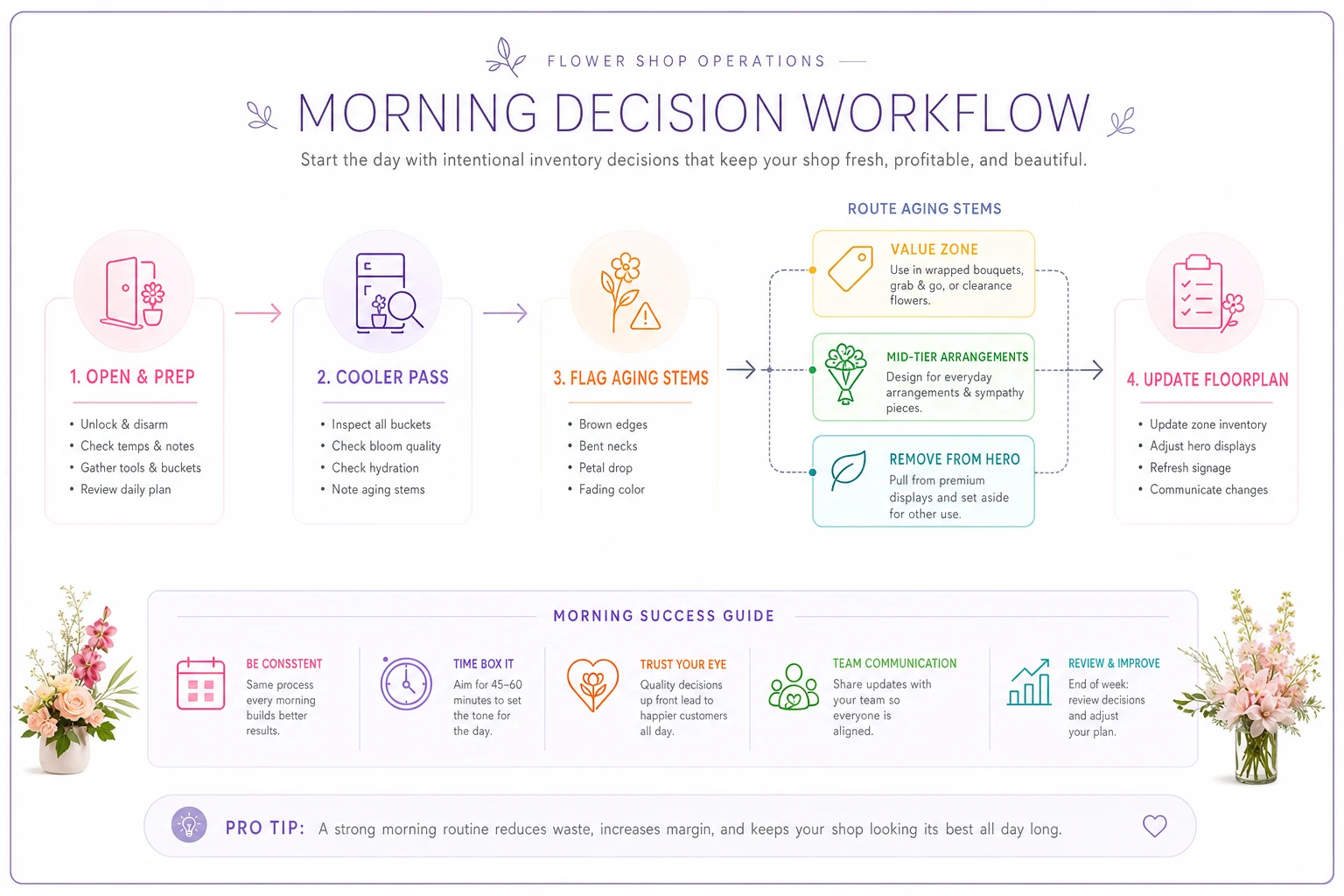
This simple visual maps the cooler pass to the focal display and floorplan adjustments so teams can follow the same routine.
What breaks as the shop grows
A one- or two-person shop can hold all of this in their head. The owner knows what came in Tuesday, knows what's tired, knows what's up front and why. Then you add staff, a second designer, a weekend crew who wasn't there when the delivery landed. Now the knowledge is fragmented, and the merchandising system breaks in predictable ways:
| Shop size | How merchandising is managed | Where it breaks |
|---|---|---|
| 1–2 people | Owner's memory + daily instinct | Works — until owner is out sick or on delivery |
| 3–5 people | Verbal handoffs, sticky notes | Focal displays get inconsistent; freshness flags get lost between shifts |
| 6+ / multi-location | Partial systems, some spreadsheets | No shared standard; each person merchandises differently; markdown timing is guesswork |
The failure at 3–5 people is the one that costs the most and gets noticed the least. A weekend hire doesn't know the Monday delivery is your freshest, so they build the Saturday focal display from whatever's convenient — which is usually the oldest stock. Repeat that for a few months and your busiest sales days are running your least fresh product in the most visible spot.
At multi-location scale, the problem becomes consistency. One store's front table lifts AOV nicely; the other's doesn't, and nobody can say why because there's no shared standard for what a focal display is supposed to accomplish. The floorplan that works in a walk-up neighborhood location fails in a strip-mall one, but without documentation you can't diagnose it — you just have two shops performing differently with no clear reason.
This is the point where the mental model has to become an actual written system. Not because systems are inherently better, but because coordination across people needs a shared reference that memory can't provide. Florists at this stage often lean on their operational software to hold freshness data and merchandising rules in one place — so the cooler status, markdown timing, and display plan aren't living in three different heads.
Building the freshness-aware display, step by step
Here's a concrete way to stand this up without over-engineering it.
-
Classify your SKUs by turnover behavior. Fast movers, slow movers, and premium or showcase. You probably know these instinctively — write them down. This determines who's allowed in the hero spot and who lives in the value zone.
-
Set your focal price ladder. Pick a good/better/best trio for the current season. The "better" option is the one you're actually steering toward — it should look like the obvious smart pick relative to its price. This trio, not a single showpiece, becomes your primary focal display.
-
Define the value zone. A physical, clearly separated area for product entering its final window. Signage matters — "today's special" reads as a deal, not as leftovers. This zone protects the credibility of your hero spot.
-
Write the morning freshness-to-floor rule. One sentence
anything flagged in its final window moves to the value zone or into a mid-tier build, never the hero display. Post it where openers see it.
-
Set floorplan review cadence. Every 6–10 weeks, or when the buying occasion shifts. Adjust zone sizes, not just decoration.
-
Track the two numbers that matter. Walk-in conversion and average order value. If your focal display is working, AOV moves. If your freshness cadence is working, waste drops. You want both trending together.
Post the one-sentence freshness-to-floor rule where openers see it to keep decisions consistent across shifts.
The reason to track AOV and conversion side by side: it's easy to lift one by hurting the other. Aggressive markdowns lift conversion but crush AOV. A premium-only front table lifts AOV but tanks conversion. The focal ladder exists to move both at once, which is the whole point.
A real scenario
A three-person neighborhood shop — decent foot traffic, solid online presence for occasion orders — had steady walk-in volume but flat AOV hovering around $48. Their front display rotated weekly and looked genuinely good, but it was always a single statement arrangement with no price shown. Waste was running higher than they liked, somewhere around 12–15% of perishable purchases getting composted.
Two changes. First, they replaced the single showpiece with a visible good/better/best trio — roughly $45, $70, and $115 — with the $70 tier styled to look like the obvious smart pick. Second, they created a small value zone near the register for product in its final two days, priced to move as grab-and-go bundles.
Over the next couple of months, AOV drifted up into the high $50s. Not dramatic, but consistent, and it held. The value zone did something they didn't expect: it cleared aging stock fast enough that overall waste dropped closer to 8–9%, which meant they stopped over-ordering just to be safe. The freshest product now genuinely lived in the hero spot, and repeat customers noticed the front table felt more reliable.
Nothing here was a revolution. It was just wiring three decisions together that used to be made separately.
When this system makes sense — and when it doesn't
When it's worth building: You have more than one or two people touching the floor, you're seeing waste you can't fully explain, or your AOV has been flat while traffic is fine. Those are signs the merchandising decisions are inconsistent across shifts.
When it's probably overkill: A true solo operation with tight control and low waste. If you're the only person who ever builds a display and you already run lean, formalizing this adds process without much payoff. Document the basics for the day you hire, but don't over-build.
Who should not start here: If your product pages and online conversion are the actual weak point, fix that first — storefront merchandising won't rescue a channel that's losing sales before the customer even arrives. It's worth reviewing how occasion-focused product templates and a stronger photo checklist convert before pouring energy into the physical floor. And if the real issue is that sales are scattered and unpredictable across channels, the omnichannel channel-allocation approach is a better first move than reworking displays.
Where merchandising quietly feeds the rest of the business
The freshness-aware display isn't a standalone win. When it works, it changes your ordering — a value zone that reliably clears aging stock means you can order tighter without fear of running out. It changes your customer relationships too, because a front table that's consistently fresh builds the kind of trust that brings people back.
That trust compounds into the repeat behavior covered in the customer lifecycle playbook, where a reliable in-store experience is what turns a one-time buyer into a standing order. The merchandising system sits in the middle of all of it: pulling from inventory decisions, feeding AOV, shaping how customers perceive the shop before they've said a word. Get the three layers talking to each other — floorplan, focal display, replenishment — and the displays stop being decoration and start doing the job they were always supposed to do.
The merchandising system sits in the middle of all of it: pulling from inventory decisions, feeding AOV, shaping how customers perceive the shop before they've said a word. Get the three layers talking to each other — floorplan, focal display, replenishment — and the displays stop being decoration and start doing the job they were always supposed to do.
Ready to grow your flower shop business?
Join 500+ flower shops using Blomsly to save time, reduce errors, and delight customers with fresh blooms.