

Most flower shops treat customer relationships like they're running a corner store in 1952—wait for people to walk in, hope they remember birthdays, pray they come back. Meanwhile, your competition quietly builds automated systems that turn wedding clients into subscription customers and Mother's Day shoppers into year-round buyers.
The painful reality? A typical local flower shop captures maybe 15% of potential customer lifetime value. Not because the flowers aren't beautiful or the service isn't personal, but because there's no systematic approach to customer lifecycle management. You're leaving thousands in monthly revenue on the table simply because you haven't built the operational infrastructure to nurture relationships at scale.
The broken promise of "personal service"
Every flower shop owner talks about personal service. But when you're juggling walk-ins, wedding consultations, delivery schedules, and inventory management, that personal touch becomes whatever you can remember in the moment. Sarah's anniversary? Forgotten. The Johnsons who spent $800 on their daughter's wedding? They haven't heard from you since. That corporate account that orders monthly? They're one forgotten delivery away from switching vendors.
The breakdown happens because flower shops confuse being friendly with having a customer lifecycle strategy. Being nice when someone walks in isn't a system. Remembering regular customers' names isn't scalable. What worked when you had 50 customers falls apart at 500, and completely collapses at 5,000.
Most shops handle the Valentine's rush by barely keeping up with orders, then watch sales drop 70% the following week. Those Valentine's customers? Gone until next year. Maybe. The couple who bought wedding flowers? They'll find someone else for their anniversary. The grieving family who ordered funeral arrangements? You'll never know they need sympathy flowers every year on that date.
This isn't about lacking care or dedication—it's about lacking systems. When your entire customer relationship strategy depends on memory and manual follow-up, you're essentially running your business on hope.
Understanding purchase patterns destroys the "random sales" myth
Flower purchases follow predictable patterns, but most shops treat every sale like a random event. Once you map actual customer behavior, the opportunity becomes obvious.
Never miss a bloom or a delivery.
Blomsly helps you manage orders, track stock, and schedule deliveries effortlessly.
- Unified order management
- Real-time inventory tracking
- Delivery scheduling & notifications
No credit card required
Consider the typical customer lifecycle in a flower shop:
Discovery purchases (first-time buyers) These split into occasion-driven (holidays, funerals) and impulse buyers (saw your shop, liked the window display). About 70% never return without follow-up. The ones who do return typically wait 6-8 months.
Relationship builders (2-3 purchases per year) Usually driven by major occasions—Valentine's, Mother's Day, anniversaries. They know you exist but haven't formed a habit. With the right nudges, 30% can move to regular buyers within a year.
Regular customers (4-8 purchases per year) They've incorporated you into their gift-giving routine. These customers generate 3x the revenue of relationship builders but represent only 15% of most customer bases. They're also the most likely to refer others.
VIP customers (monthly or subscription) The golden segment. They either subscribe to regular deliveries or consistently order for business/personal needs. One VIP customer typically equals the revenue of 10-12 occasional buyers.
Without tracking these segments, you're flying blind. You treat the couple buying their first anniversary bouquet the same as the business ordering weekly lobby arrangements. You send the same generic "Happy Valentine's Day" email to someone who spent $30 once and someone who spends $200 monthly.
The subscription opportunity everyone misses
Subscription flowers should be easy money. People love fresh flowers. They forget to buy them. Subscription solves both problems. Yet most shops either don't offer subscriptions or manage them through a nightmare of spreadsheets and manual reminders.
The math is compelling: Convert just 20 customers to a $60 monthly subscription, and you've added $14,400 in predictable annual revenue. That's before considering reduced acquisition costs, lower transaction fees, and better inventory planning.
But shops fail because they think subscription means "deliver the same bouquet every month." That's not a subscription service, it's a recurring chore. Successful subscription programs require:
Variety planning: Rotating seasonal flowers, color themes, and arrangements keeps subscribers engaged. Document what each customer received to avoid repetition.
Flexible scheduling: Not everyone wants weekly delivery. Offer weekly, bi-weekly, and monthly options. Allow pauses for vacations without canceling.
Upgrade opportunities: Start customers with a basic subscription, then offer holiday upgrades, add-on gifts, or special occasion arrangements.
Retention mechanics: First-month discounts, loyalty perks after 6 months, anniversary bonuses. The cost of keeping a subscriber is fraction of acquiring a new customer.
Offer a discounted trial month to reduce friction and let customers experience the value before committing.
A properly managed subscription program transforms your business model. Instead of hoping for walk-ins, you start each month with guaranteed revenue. Instead of guessing inventory needs, you know exactly what to order. Instead of competing on price for one-time sales, you build relationships worth thousands over time.
Birthday and occasion automation that actually drives sales
Every flower shop knows birthdays and anniversaries drive sales. Few have systems to capitalize on this knowledge. Most shops either do nothing or send generic "Don't forget!" emails that get ignored.
Effective occasion automation requires three components:
First, data collection that doesn't feel creepy. When someone orders flowers, ask one simple question: "Would you like us to remind you next year?" For delivery orders, capture the recipient's birthday during checkout. For wedding clients, automatically note their anniversary date.
Second, multi-touch sequences that build urgency. A single reminder email three days before a birthday has maybe a 5% conversion rate. A sequence starting two weeks out, with escalating urgency and personalized suggestions, can hit 25-30%.
Here's a sequence that works:
-
14 days before
"Tom's birthday is coming up - want to make it special?"
-
7 days before
"One week until Tom's birthday + here's what he loved last year"
-
3 days before
"Final reminder + 10% off if you order today"
-
Day of (if no purchase)
"Same-day delivery still available until 2 PM"
Third, personalization beyond just names. Track what they've ordered before, typical price points, delivery vs pickup preference. When someone consistently orders $75 arrangements, don't push $35 bouquets. When they always choose roses, lead with rose options.
The automation extends beyond individual occasions. Set up triggers for:
-
Major holidays (segment by past holiday purchasers)
-
Seasonal shifts (spring flowers to winter customers)
-
Local events (graduation season, prom, local festivals)
-
Relationship milestones (6 months since last order, 1 year anniversary as customer)
One shop I worked with increased occasion-based sales by 340% simply by implementing systematic reminder sequences. They went from hoping customers remembered birthdays to actively facilitating those purchases.
VIP customer identification and treatment frameworks
Most shops treat their best customers exactly like everyone else. Maybe they get a smile and a "Hey, good to see you again!" But operationally? Same service, same prices, same communication as someone buying their first $20 bouquet.
VIP customers—typically 5-8% of your customer base—often generate 40-50% of revenue. They deserve and expect special treatment. More importantly, proper VIP management increases their lifetime value by 2-3x.
Start with identification. VIPs aren't just big spenders. Look for:
-
Frequency (monthly or more)
-
Consistency (regular orders over 6+ months)
-
Variety (orders for multiple occasions/recipients)
-
Advocacy (refers others, leaves reviews, tags you on social media)
| Customer Segment | Annual Spend | Purchase Frequency | Typical Behavior | Revenue Impact |
|---|---|---|---|---|
| Occasional | $50-150 | 1-2 times | Holiday only | 15% of revenue |
| Regular | $200-500 | 4-6 times | Occasions + impulse | 35% of revenue |
| VIP | $1,000+ | Monthly+ | Subscription/corporate | 45% of revenue |
| Super VIP | $3,000+ | Weekly | Multiple locations/needs | 5% of revenue |
Once identified, VIP treatment should be systematic, not random. Create operational rules:
Pricing: Automatic 10-15% discount or inclusive delivery. Don't make them ask.
Access: Early access to seasonal flowers, holiday pre-orders, limited arrangements.
Communication: Direct line to a manager, text ordering options, personalized check-ins.
Perks: Free delivery upgrades, complimentary vase with every third order, birthday flowers on the house.
Recovery: When something goes wrong (and it will), VIP recovery should be immediate and generous. Regular customer gets a 20% discount next time? VIP gets full refund plus replacement.
The goal isn't just keeping VIPs happy—it's expanding their purchase occasions. Your $200/month corporate client might also need personal flowers if you make it easy. The subscription customer might add gift subscriptions for family if you suggest it at the right time.
Building systematic follow-up rules (not just hoping)
Follow-up is where most flower shops completely fail. A customer spends $150 on an arrangement, walks out, and you never proactively contact them again. You wouldn't run any other relationship this way, yet shops do it thousands of times per year.
Systematic follow-up requires rules, not inspiration. Build triggers based on purchase behavior:
First-time buyers: Thank you message within 24 hours, delivery confirmation if applicable, satisfaction check at 3 days, special offer at 14 days, occasion reminder at 45 days.
Occasion purchasers: Thank you, then nothing for 30 days (let them enjoy the occasion), followed by suggestions for upcoming holidays or seasons, then gentle re-engagement offers if they don't purchase within 90 days.
Sympathy/funeral orders: Gentle thank you, no sales messaging for 60 days, then subtle "thinking of you" message near the one-year mark with option to send memorial flowers.
Wedding/event clients: Immediate follow-up for feedback, anniversary reminder setup, suggestion for thank-you arrangements, periodic check-ins for other family events.
Lapsed customers: Different messages based on their history. High-value lapsed customers get personal outreach. Moderate spenders get "we miss you" offers. Low-value lapsed get included in general promotional campaigns.
The key is making follow-up automatic, not optional. When you're swamped with Valentine's orders, you won't remember to thank customers. When it's slow in March, you won't think to reach out to February buyers. Systems handle this regardless of how busy or distracted you are.
Here's a simple follow-up workflow to visualize.
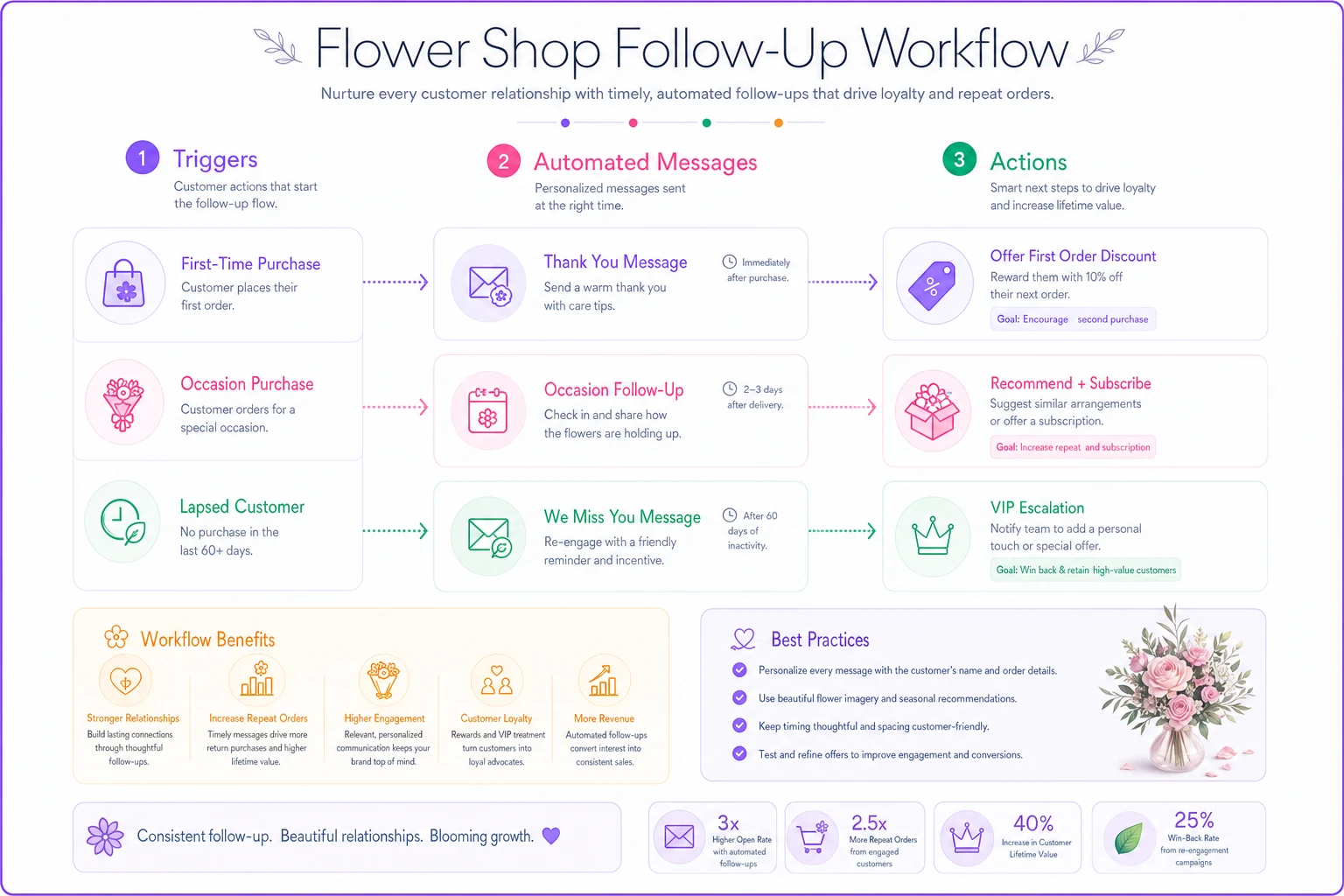
Use this to map triggers to messages and assign owners for each recovery or escalation step.
Practical KPIs that actually matter for small shops
Most flower shops track vanity metrics—total sales, number of orders, maybe average order value. These tell you what happened but not why or what to do next. Customer lifecycle KPIs focus on relationship health and growth potential.
Customer Acquisition Cost (CAC): Include everything—advertising, discounts, time spent on social media. Most shops find their CAC is $30-50 when calculated honestly. If a customer only makes one $40 purchase, you're losing money.
Purchase Frequency: Average purchases per customer per year. Below 2.0 means you're essentially running a series of one-time transactions. Above 4.0 means you've built genuine relationships.
Lifecycle Value at 90 days: How much does a new customer spend in their first three months? This early indicator predicts long-term value better than first purchase amount.
Reactivation Rate: Percentage of lapsed customers (no purchase in 6+ months) who make another purchase after re-engagement campaigns. Below 10% means your reactivation approach needs work.
Subscription Churn: Monthly subscription cancellation rate. Above 10% monthly suggests problems with variety, value, or service. Below 5% means you've found a sustainable model.
VIP Concentration: Percentage of revenue from top 10% of customers. Healthy shops see 40-60%. Below 30% means you're too dependent on occasional buyers. Above 70% creates dangerous concentration risk.
Occasion Capture Rate: Of customers who've given you occasion dates, what percentage actually purchase for those occasions? Below 20% means your reminders aren't working.
Track these monthly, but analyze quarterly. Look for trends, not daily fluctuations. When purchase frequency drops, dig into which segment is declining. When VIP concentration increases, ensure you're still acquiring new customers.
When lifecycle management creates more problems
Not every shop should implement comprehensive lifecycle management. If you're a boutique focused on ultra-high-end design with 50 clients spending $500+ per arrangement, personal relationship management might work better than systematic automation.
Lifecycle management can backfire when:
-
Your customer base genuinely values exclusivity and personal touch over convenience. Automated birthday reminders might cheapen your brand if you've positioned yourself as a personal concierge service.
-
You lack the operational capacity to fulfill increased demand. If successful campaigns would overwhelm your current setup, fix operations first.
-
Your market is primarily walk-in or immediate-need based (hospital gift shop, airport location, tourist area). Investing in lifecycle management for customers you'll never see again wastes resources.
-
Your average order value is too low to justify acquisition costs. If most purchases are $15-25 impulse buys, the math might not support elaborate retention programs.
The solution isn't abandoning lifecycle thinking entirely, but rather right-sizing your approach. Maybe you focus only on VIP identification and treatment. Maybe you implement just birthday reminders for high-value customers. Maybe you test a simple subscription program before building complex automation.
Integration between lifecycle stages and operational capacity
You launch a successful Mother's Day campaign, acquisition triples, but then you can't fulfill orders properly. Bad reviews tank your reputation. New customers never return. You spent money to damage your business.
Lifecycle management must align with operational reality. Before implementing any growth program, audit your capacity:
Can your current team handle 30% more orders without quality suffering? What about 50%? Where's the breaking point?
Does your POS system capture customer data automatically, or does someone need to manually enter information? Manual processes break at scale.
Can you track individual customer preferences and history, or does that information live in someone's head? Memory-based systems can't scale.
Do you have inventory management that predicts needs based on customer segments, or do you guess based on last year? Predictable customer behavior should drive predictable inventory.
Start with foundations: customer data capture, basic segmentation, simple automated follow-ups. Only after these work smoothly should you layer on complex lifecycle programs.
The compound effect of systematic relationship building
A customer makes their first purchase—$45 birthday arrangement. Without lifecycle management, there's an 85% chance you never see them again. With systematic follow-up, they order again for Mother's Day. Birthday reminders prompt another purchase. They subscribe to monthly deliveries for their office. Year one: $45. Year two: $340. Year three: $720.
This isn't theoretical—it's what happens when you stop treating customers like transactions and start managing relationships systematically.
The compound effect accelerates over time. Early lifecycle management might increase revenue 20-30% in year one. But as customer relationships deepen, as referrals increase, as your reputation for reliability spreads, year two sees 40-50% growth. Year three might double your original baseline.
More importantly, your business becomes predictable. Instead of wondering if this Valentine's Day will be good, you know exactly how many customers will likely order based on past behavior. Instead of guessing inventory for Mother's Day, you can predict demand within 10% accuracy. Instead of desperately marketing during slow periods, you have steady subscription revenue and automated occasion reminders driving consistent sales.
The transformation from hoping customers return to systematically ensuring they do changes everything about how you operate. You stop being reactive and start being strategic. You stop competing on price and start competing on relationship value. You stop worrying about this month's revenue and start building next year's.
Moving from random acts of marketing to systematic growth
Most flower shops market when they're desperate or when they remember. Slow Tuesday? Post on Facebook. Valentine's approaching? Panic and buy ads. This reactive approach guarantees inconsistent results and wasted money.
Customer lifecycle management replaces random marketing with systematic growth. Every customer interaction becomes an opportunity to deepen the relationship. Every purchase triggers the next engagement. Every segment receives relevant, timely communication.
The shift requires discipline but not complexity. Start with one segment—maybe customers who've purchased twice. Build one simple sequence—perhaps a thank you, a seasonal suggestion, and an occasion reminder. Measure results. Refine. Expand.
Within six months, you can have basic lifecycle automation covering your entire customer base. First-time buyers get welcomed properly. Regular customers receive relevant offers. VIPs feel valued. Lapsed customers get reactivated. Each program builds on the others, creating compound momentum.
The alternative is continuing to treat every customer interaction as isolated, every sale as final, every relationship as accidental. That worked when flower shops had geographic monopolies and customers had limited options. Today, with online competitors and grocery store flowers and subscription services delivered to doorsteps, relationships are your only sustainable advantage.
Those relationships won't manage themselves. They require systems, discipline, and operational infrastructure. But once built, they become a machine that turns single purchases into lifetime customers, occasional buyers into subscribers, and your flower shop into a predictable, growing business. The shops thriving today aren't the ones with the prettiest flowers or the best locations. They're the ones who've figured out that customer lifecycle management isn't a nice-to-have marketing tactic—it's the operational foundation of modern retail.
Ready to grow your flower shop business?
Join 500+ flower shops using Blomsly to save time, reduce errors, and delight customers with fresh blooms.