


Your cooler has 40 red roses. A corporate client needs 24 for tomorrow's event. Your subscription customers expect 15 stems across their weekly deliveries. The website shows "available" for dozen-rose arrangements. And someone just walked in asking for two dozen.
This plays out in flower shops constantly, and most handle it by scrambling. The walk-in customer gets told to wait while you "check the back." The corporate order gets confirmed without checking subscription commitments. By Thursday, you're calling suppliers for emergency stock at premium prices, eating into margins you can't afford to lose.
The problem isn't inventory management — it's channel allocation. Most florists run multiple sales channels without clear rules for who gets priority when stock runs low. Every channel pulls from the same pool without coordination. The result is disappointed customers, stressed staff, and profit leaking through operational chaos.
Why channel conflict destroys florist margins
Running a successful florist omnichannel strategy means understanding that each channel has fundamentally different economics. Walk-ins generate immediate cash but are unpredictable. Web orders come with delivery costs. Subscriptions provide recurring revenue but lock up inventory. Corporate accounts offer volume but demand reliability.
When these channels aren't properly managed, they cannibalize each other. A shop I worked with in Austin had their web orders consuming around 70% of premium inventory while generating only 35% of gross profit. Walk-in customers — who spent more per stem and required no delivery — were consistently finding empty coolers by noon. The owner assumed the fix was ordering more inventory, but that just increased waste without touching the underlying allocation problem.
The breakdown happens gradually. First you start disappointing one channel to serve another. Then you begin over-ordering to avoid stockouts, which increases waste. Eventually you're juggling angry corporate clients, canceled subscriptions, and negative reviews, all while working harder for less profit.
What makes this particularly painful for florists is perishable inventory. You can't order extra roses "just in case" without accepting real waste. Reserve too much for corporate orders that don't materialize? Those roses hit the compost bin. Under-reserve for subscriptions? You're buying replacement stems at last-minute prices.
Building channel-specific P&L visibility
Most flower shops track overall revenue and costs but have zero visibility into channel-level profitability. They know total sales and total expenses, but can't answer: which channel generates the highest profit per stem? What's the real cost of serving subscription customers versus walk-ins?
Never miss a bloom or a delivery.
Blomsly helps you manage orders, track stock, and schedule deliveries effortlessly.
- Unified order management
- Real-time inventory tracking
- Delivery scheduling & notifications
No credit card required
| Channel | Avg Order Value | Direct Costs | Hidden Costs | True Margin |
|---|---|---|---|---|
| Walk-in | $65 | Stems: $22 | Labor: $8 | 54% |
| Web | $78 | Stems: $26, Delivery: $12 | Platform fees: $5, Failed delivery: $3 | 31% |
| Subscription | $45 | Stems: $15 | Customization: $6, Admin: $4 | 44% |
| Corporate | $220 | Stems: $88 | Account mgmt: $15, Terms cost: $8 | 41% |
The hidden costs are what kill profitability. Web orders look attractive with higher average values, but after factoring in delivery, platform fees, and failed delivery attempts, they often land at the bottom margin-wise.
A shop in Denver built a simple weekly P&L tracker by channel and discovered their "premier" corporate accounts — the ones they bent over backward to serve — were actually their least profitable channel once you factored in payment terms, account management time, and last-minute change requests. Meanwhile, walk-in customers they regularly turned away during busy periods were generating nearly double the profit per transaction.
Without this visibility, you're making allocation decisions blind. You might prioritize a $200 corporate order over five $60 walk-in sales, not realizing the walk-ins would generate more total profit with less operational complexity.
Inventory reservation rules that actually work
Once you understand channel profitability, you need reservation rules that protect your most valuable revenue streams while maintaining reasonable service across all channels. This doesn't mean always serving your highest-margin channel first — it means making intelligent trade-offs based on real economics and customer lifetime value.
The basic framework:
Tier 1 Priority (Protected Inventory):
-
Confirmed corporate events with penalties
-
Subscription fulfillment for retention tiers
-
Pre-ordered funeral/wedding arrangements
Tier 2 Priority (Flexible Allocation):
-
Walk-in premium arrangements
-
Same-day web orders above $75
-
Corporate standing orders
Tier 3 Priority (Overflow Only):
-
Web orders under $50
-
Last-minute add-ons
-
Deeply discounted promotions
The key is building buffer zones between tiers. A shop in Portland implemented a "70-20-10" rule: 70% of premium inventory allocated to Tier 1, 20% to Tier 2, with 10% float for unexpected opportunities. This stopped them from selling out to low-margin web orders while keeping flexibility for high-value walk-ins.
Static rules break during peak periods, though. Valentine's week operates on completely different economics than a random Tuesday in September. You need dynamic allocation that adjusts based on demand patterns, inventory lifecycles, and seasonal factors.
One approach that works well during peak periods is time-based allocation. Reserve morning inventory for walk-ins and corporate pickups, then release unsold stock to web orders after 2 PM. You capture maximum value from high-margin spontaneous purchases while still serving online customers. It's a simple rule, but it makes a real difference.
Here's a simple workflow for implementing reservation rules and time-based release in your shop.
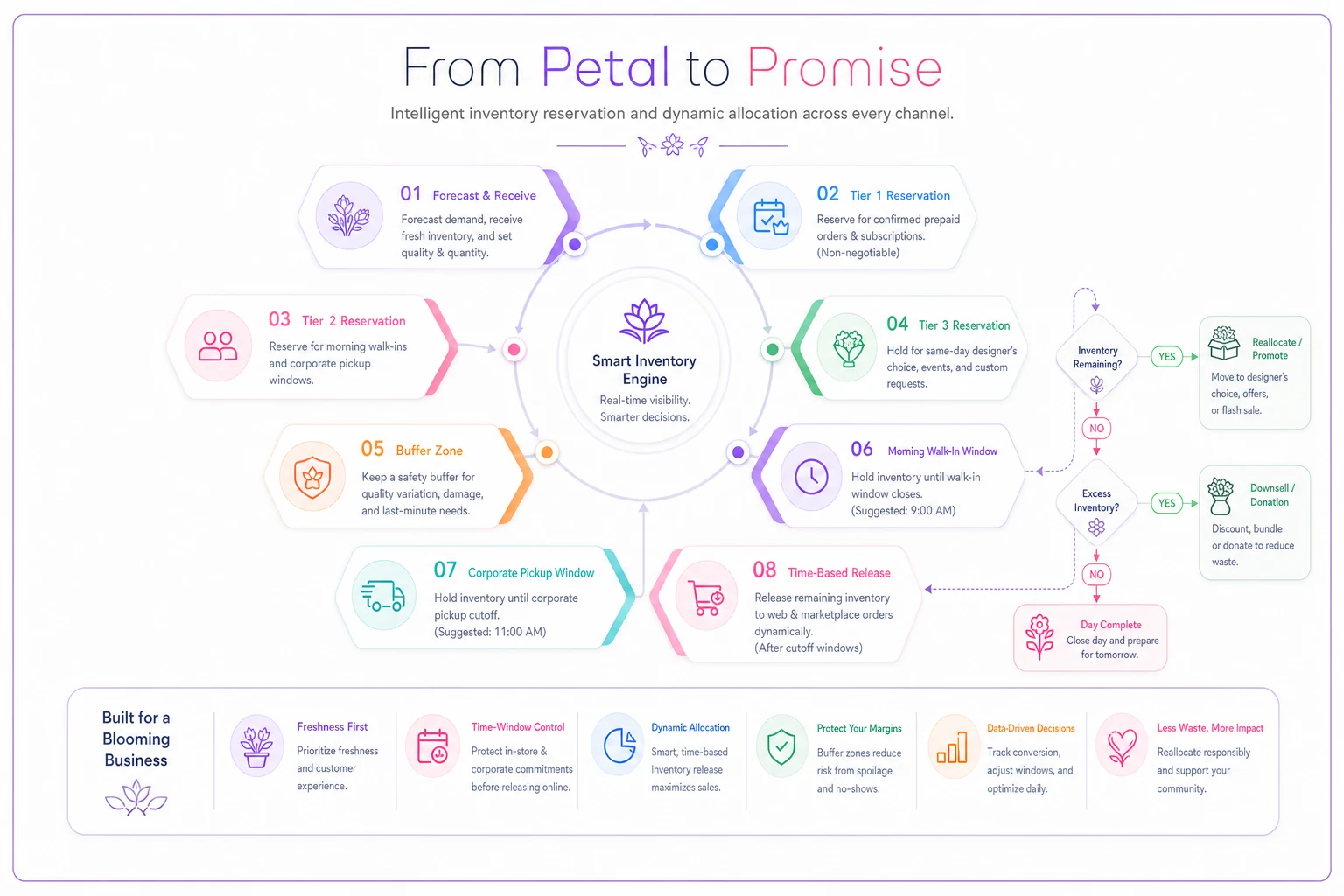
Use this kind of step-by-step process to move from static percentage rules to dynamic, time-aware allocation during peak periods.
KPI dashboards that drive better channel decisions
Tracking the right metrics transforms channel allocation from guesswork into something you can actually manage. Most florists drown in vanity metrics — total orders, total revenue, follower counts — while missing the operational indicators that actually matter.
Here's what your channel dashboard should track:
Revenue Quality Metrics:
-
Profit per stem by channel
-
Channel contribution margin
-
Customer acquisition cost by source
-
Average reorder frequency by channel
Operational Efficiency Metrics:
-
Fulfillment time by channel
-
Remake/complaint rate by channel
-
Delivery success rate
-
Inventory turnover by channel
Allocation Performance Metrics:
-
Stockout frequency by channel
-
Emergency purchase frequency
-
Reservation accuracy (reserved vs. actual)
-
Channel conflict incidents
A Seattle florist built a simple weekly dashboard tracking just five metrics: profit per stem by channel, stockout incidents, emergency purchases, customer complaints by channel, and channel mix percentage. Within three months, they shifted their mix to increase walk-in allocation by 15%, cut emergency purchases by around 60%, and improved overall margins by eight percentage points.
The dashboard also revealed patterns they'd never noticed. Corporate orders spiked on Mondays but concentrated on basic arrangements. By pre-building those on Sunday nights, they freed up Monday morning capacity for higher-margin walk-in customers. Web orders peaked during lunch hours, but fulfillment complexity was lowest for orders placed after 6 PM, when customers tended to choose simpler arrangements.
Real channel allocation in practice
Here's how this actually plays out during a typical week at a shop doing around $8,000 in weekly revenue across channels.
Monday morning inventory count: 200 roses, 150 mixed stems, 100 greens. Based on historical patterns and forward orders, you allocate:
-
Corporate (confirmed)
60 roses, 40 mixed stems
-
Subscriptions (Tuesday delivery)
40 roses, 35 mixed stems
-
Walk-in reserve
70 roses, 50 mixed stems
-
Web reserve
30 roses, 25 mixed stems
By noon, walk-in traffic exceeds expectations. You've sold through 50 roses from walk-in allocation. Web orders are tracking 40% below Monday average. You release 15 roses from web reserve to walk-in availability.
Tuesday morning, a corporate client calls with an emergency order for 30 roses. Your Tier 1 allocation is committed, but web reservations show availability. You check the margin impact: the corporate order at rush pricing generates $190 profit, while the reserved web capacity typically produces around $80 profit for the same stems. You reallocate and flag the web channel for "limited availability" messaging.
Thursday, subscription prep reveals quality issues with 20 reserved roses. Your buffer inventory covers the immediate need, but you're now exposed for Friday walk-ins. You adjust the website to show "next-day delivery only" for rose arrangements and increase markup on remaining walk-in inventory to protect margin on limited stock.
None of these decisions are perfect. But each one is informed rather than reactive, and that's the actual goal.
Investment priorities based on channel performance
Your channel data should drive investment decisions. Most florists spread resources evenly across channels or chase whatever seems trendy. Strategic investment means doubling down on profitable channels while fixing or cutting the losers.
A shop in Dallas analyzed six months of channel performance and made some hard calls. Their data showed walk-ins generated 45% of profit from only 30% of revenue. Web orders created 60% of operational headaches for 20% of profit. Subscriptions showed the highest retention but had plateaued in growth. Corporate delivered volume but with irregular cash flow.
-
Expanded walk-in capacity with better cooler displays and express checkout
-
Reduced web order complexity by limiting customization options
-
Introduced subscription tiers to improve customer lifetime value
-
Dropped two high-maintenance corporate accounts
Overall revenue dropped 5%, but profit increased 22%. Operational stress went down noticeably. Staff could actually focus on serving profitable channels well rather than juggling everything poorly.
Warning signs your channel allocation is broken
These patterns indicate real problems worth paying attention to.
Financial Warnings:
-
Emergency purchases exceeding 15% of inventory cost
-
Channel margins varying by more than 30 percentage points
-
Increasing average order value but declining total profit
Operational Warnings:
-
Different channels showing different availability for the same items
-
Staff regularly pulling from one channel's allocation to serve another
Customer Warnings:
-
Complaints about availability concentrated in specific channels
-
Subscription cancellations citing inconsistent fulfillment
-
Corporate clients requesting dedicated inventory guarantees
When multiple warnings stack up, the system needs fundamental restructuring, not incremental fixes. One shop ignored these signals for months and eventually lost their largest corporate account while walk-in traffic dropped around 30% due to a reputation for being "always sold out of the good stuff."
Technology and automation in channel management
Managing multiple channels with real-time inventory and different allocation rules is genuinely hard to do with spreadsheets alone. The coordination complexity adds up fast, and at some point manual tracking just can't keep pace.
AI-powered operational platforms now help flower shops run more sophisticated channel allocation without it consuming hours of manual work every day. These systems track real-time inventory across channels, enforce reservation rules automatically, and adjust allocations based on demand patterns. When a corporate emergency order comes in, the system immediately shows the impact on other channels and flags where reallocation makes sense — instead of someone having to catch it manually.
A shop in Phoenix cut their daily channel management time from around three hours to 30 minutes while improving allocation accuracy by roughly 40%. The technology matters less than what it frees your team up to do: actually serving customers and building relationships instead of updating spreadsheets all afternoon.
Making channel allocation work in your shop
Start with visibility. Before implementing complex allocation rules or investing in new systems, understand your actual channel economics. Track profit per stem, not just revenue. Include all costs — delivery, labor, payment processing, customer service time. The numbers will probably surprise you.
Next, establish basic reservation rules. Don't try to perfect the system immediately. Start with simple percentage allocations and adjust based on real results. A shop doing $5,000 weekly might start with 40% walk-in, 30% web, 20% subscription, 10% buffer. Track what actually sells and adjust weekly.
Build feedback loops between channels and operations. When delivery routing changes affect web order profitability, adjust allocation accordingly. When subscription customization requests creep up, factor that time into channel P&L calculations.
Make channel allocation decisions visible to your team. When staff understand why walk-ins get priority during certain hours, or why a large corporate order might get declined, they make better real-time decisions without coming to you every time. Post your channel priority matrix where everyone can see it. Talk through channel performance in team meetings. It sounds basic, but shops that do this consistently handle channel conflicts better than shops that don't.
Post a simple, color-coded channel priority board by the prep area so staff can make allocation calls without interrupting a manager during peak service times.
Perfect allocation doesn't exist. Markets shift, customer preferences change, and special circumstances come up constantly. The goal isn't optimization in some theoretical sense — it's making informed trade-offs instead of reactive scrambles.
The shops doing this well aren't trying to be everything to everyone. They know each channel's economics, protect their most profitable revenue streams, and use operational discipline to prevent channel conflicts. They've stopped treating multiple sales channels as separate businesses and started managing them as one integrated revenue system.
Your cooler will still have 40 roses with competing demands. But with proper channel allocation, you'll know exactly which customer gets them, why that decision makes financial sense, and how to prevent the scramble next time.
Ready to grow your flower shop business?
Join 500+ flower shops using Blomsly to save time, reduce errors, and delight customers with fresh blooms.