



Running a flower shop means managing hundreds of tiny expiration dates while customers expect perfect blooms on demand. You discover this pretty quickly once you're past the honeymoon phase of owning your own shop.
Most flower shop owners think the hard part is arranging beautiful bouquets, then reality hits
Running a flower shop means managing hundreds of tiny expiration dates while customers expect perfect blooms on demand. You discover this pretty quickly once you're past the honeymoon phase of owning your own shop.
Most flower shops juggle between 80 and 200 different SKUs at any time. Not just roses and tulips, but specific varieties, colors, stem lengths, plus all the hard goods like vases, ribbons, foam, wire, and preservatives. Each category follows completely different rules for ordering, storage, and turnover.
Traditional retail inventory systems fall apart when you try to apply them to flowers. A clothing store can hold a shirt for six months without much concern. Your white roses have maybe 5 days from delivery before they're unsellable. Garden roses might last 3 days. That eucalyptus? Could go 2 weeks if stored properly.
Why standard inventory management fails spectacularly with flowers
The fundamental problem is that flower shops operate with three distinct inventory behaviors happening simultaneously, and most shops try to manage them all the same way.
Never miss a bloom or a delivery.
Blomsly helps you manage orders, track stock, and schedule deliveries effortlessly.
- Unified order management
- Real-time inventory tracking
- Delivery scheduling & notifications
No credit card required
First, you have ultra-perishable daily movers - roses, lilies, carnations. These need to turn every 3-5 days or you're throwing money in the compost. Then you have semi-perishable specialty items - proteas, orchids, preserved materials. These might last weeks but cost significantly more per stem. Finally, non-perishable accessories and hard goods that follow traditional retail patterns.
When shops try to apply uniform ordering rules across these categories, they end up with constant stockouts of popular flowers while simultaneously throwing away specialty items that sat too long. One shop I worked with was tossing nearly $1,400 worth of product monthly while also turning away wedding consultations because they couldn't guarantee specific flower availability.
Flower demand is both highly predictable and completely random. Valentine's Day, Mother's Day, and prom season are obvious. But then you get a random Tuesday where three funeral orders come in requiring white roses, and suddenly your entire white rose inventory for the week is gone before noon. Or a bride walks in wanting 200 stems of café au lait dahlias for next month, and you have to decide whether to pre-order something that specific.
Most shops respond to this chaos by either over-ordering everything (killing margins through waste) or under-ordering everything (losing sales and reputation). Neither approach works once you're doing more than about $30k monthly in revenue.
The classification framework that actually works
The most effective approach breaks inventory into five distinct perishability classes, each with its own management rules:
Class A: Ultra-Perishable (3-5 day maximum) Your everyday flowers - standard roses, carnations, mums, alstroemeria. They arrive multiple times per week, move fast, and have minimal holding power. For these items, you're essentially running a just-in-time operation. Order quantities should cover no more than 3 days of expected sales, with safety stock calculated at 0.5 days of average daily movement.
Class B: Moderate-Perishable (5-8 days) Premium roses, lilies, gerberas, and most tropical flowers. These cost more per stem but also hold slightly longer. Here you can extend ordering cycles to twice weekly, with safety stock at 1 day of average movement. These items can buffer between delivery cycles without significant quality loss.
Class C: Semi-Perishable (8-14 days) Specialty items like orchids, anthuriums, proteas, and most greenery fall here. These are ordered weekly or bi-weekly depending on volume. Safety stock extends to 3 days of average movement since replacement lead times are longer and customer orders are often specific.
Class D: Extended-Life (14-30 days) Preserved flowers, dried materials, branches, and hardy greens. These follow more traditional retail patterns with monthly ordering cycles and safety stock at 1 week of average movement.
Class E: Non-Perishable Vases, ribbons, foam, wire, tools, and other hard goods. Standard retail inventory rules apply - order when you hit reorder points, maintain 2-4 weeks of safety stock based on lead times.
Differentiated lead times that prevent both waste and stockouts
The biggest operational shift is moving away from uniform weekly ordering to differentiated cycles based on perishability class and actual movement data.
For Class A items, you need standing orders with your wholesaler for Monday, Wednesday, and Friday delivery. These orders should be template-based but adjustable. Start with 70% of your average daily movement for that day of the week, then adjust up or down based on the next 3 days' known orders. Monday orders are typically highest (covering weekend events), Wednesday orders are moderate, and Friday orders are smallest unless there's a holiday weekend.
Class B items work best with Tuesday and Friday deliveries. This creates overlap with your Class A deliveries, which is intentional - it lets you adjust quantities based on what actually came in and what's already moving. If your Class A roses came in looking subpar on Monday, you can bump up your Class B premium roses for Tuesday.
The trick with Class C specialty items is establishing a weekly cycle but staggering it across suppliers. If you're working with three specialty wholesalers, set them up for Monday, Wednesday, and Thursday deliveries. This spreads out your cash flow and gives you multiple opportunities to grab specific items for custom orders without holding excessive inventory.
For Class D and E, monthly ordering synchronized with your accounting cycle makes sense. Place these orders in the last week of each month for delivery in the first week of the next month. This helps with cash flow management and reduces the mental overhead of constant reordering.
Safety stock formulas that reflect real flower shop operations
Traditional safety stock calculations assume consistent lead times and predictable demand. Flower shops have neither. You need formulas that account for demand spikes and quality variations.
For Class A items: Safety Stock = (Peak daily demand × Supply uncertainty factor) × Lead time in days The supply uncertainty factor typically runs 1.3-1.5 for everyday flowers. So if you normally sell 20 red roses daily but peak at 35, with a 1-day lead time and 1.4 uncertainty factor, you'd maintain 49 stems as safety stock (35 × 1.4 × 1).
For Class B items: Safety Stock = (Average weekly demand × 0.3) + Known upcoming orders The 0.3 multiplier gives you roughly 2 days of coverage. Add any specific orders already booked for the next week.
For Class C items: Safety Stock = Maximum single order quantity you'd accept If you'd take an order for 50 bird of paradise, keep 50 in stock. This seems excessive but specialty items are what differentiate you from grocery stores.
The reporting cadence that reveals problems before they become disasters
Most flower shops check inventory when something runs out. By then it's too late. You need three different reporting rhythms running simultaneously.
Daily reporting should be dead simple - just three numbers every morning: yesterday's waste dollar value, current Class A inventory days on hand, and upcoming 3-day order commitments. This takes maybe 5 minutes to compile but immediately shows if you're heading toward a problem. Track these on a simple spreadsheet or whiteboard. When waste exceeds 5% of yesterday's sales or Class A coverage drops below 2 days, you need immediate action.
Weekly reporting happens every Sunday evening and focuses on velocity and profitability by category. Look at:
-
Top 10 movers by units and by profit
-
Bottom 10 movers that are still in stock
-
Items ordered but not sold in the past week
-
Special orders filled vs. special orders declined
This weekly review shapes your ordering for the coming week. If white roses moved 3x normal volume, you adjust standing orders up. If those expensive garden roses didn't move at all, you skip them next week.
Monthly reporting is where patterns emerge. Calculate:
| Metric | Target | Action if Outside Range |
|---|---|---|
| Overall waste percentage | 3-5% | Above 5%: reduce order quantities. Below 3%: likely losing sales |
| Class A inventory turns | 60-75x annually | Below 60: over-ordering. Above 75: stockouts likely |
| Class B inventory turns | 35-45x annually | Adjust order frequency if outside range |
| Class C inventory turns | 20-30x annually | Review SKU selection if below 20 |
| Special order fulfillment rate | >85% | Below 85%: need better supplier relationships or higher safety stock |
When waste exceeds 5% of yesterday's sales or Class A coverage drops below 2 days, you need immediate action.
When the system breaks down and what happens next
This framework works smoothly until you hit about $60k in monthly revenue. Beyond that point, manual tracking becomes impossible and you start making expensive mistakes.
The first breakdown is usually in special orders. Someone takes a wedding order for 100 coral peonies without checking if they're even available that season. Or available but at 3x the price you quoted. Without real-time visibility into what specific varieties cost and when they're available, you're gambling on every custom order.
The second breakdown happens in waste tracking. At higher volumes, you're processing too many stems to manually count what gets tossed. Shops start estimating waste, which means they're not really tracking it at all. When you can't measure waste accurately, you can't identify which SKUs are consistently problematic.
The third breakdown is in ordering accuracy. Standing orders work great until you have multiple events on the same day requiring the same flowers. Your standard 30 red roses becomes 180 for three events, but the standing order still shows 30. These misses damage your reputation and relationships with event planners.
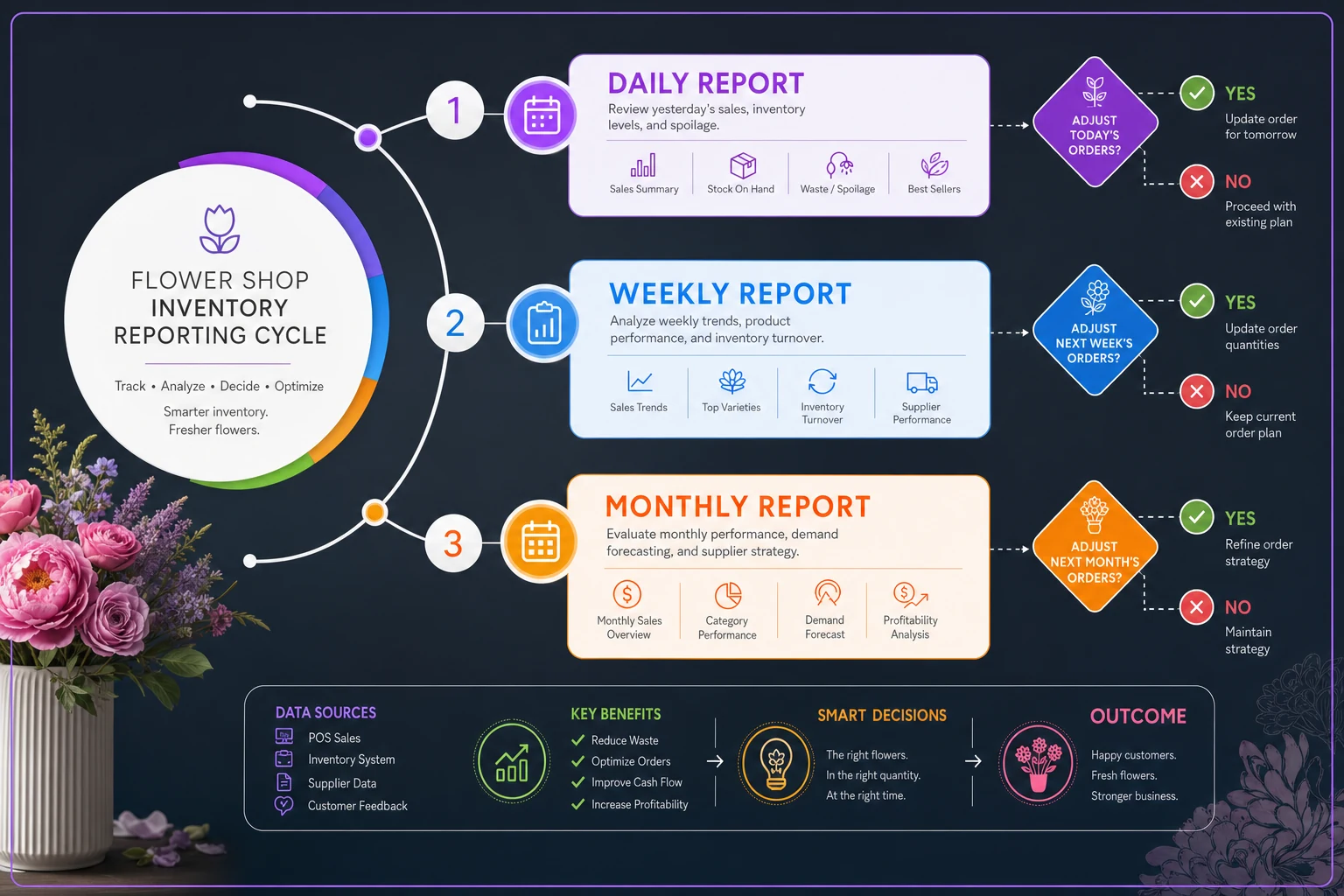
This flow highlights where daily checks, weekly reviews, and monthly analysis intersect with decision points for adjusting orders and addressing waste.
Building systems that scale with growth
The evolution typically follows this pattern:
-
Under $30k/month Manual tracking with spreadsheets works fine. One person can mentally track inventory, and mistakes are small enough to absorb.
-
$30k-60k/month You need structured systems but can still manage with spreadsheets and disciplined processes. This is where the classification framework and reporting cadence become critical.
-
$60k-100k/month Manual systems start failing. You need actual inventory management software, but most retail systems don't handle perishability well. Many shops get stuck here - they know they need better systems but can't find solutions designed for their specific needs.
-
Over $100k/month You need automated ordering, predictive analytics for seasonal patterns, and integration between POS, inventory, and supplier systems. At this scale, being off by even 5% on ordering means thousands in monthly waste or lost sales.
The shops that successfully scale past $100k monthly have all built custom hybrid systems - usually a combination of floral-specific software for ordering and inventory, integrated with broader business management platforms for accounting and customer management. They're using historical data to predict demand patterns, automatically adjusting safety stock levels based on upcoming events, and maintaining real-time availability for their sales team.
The practical reality of implementation
Starting tomorrow, here's what actually works:
Begin by classifying just your top 20 SKUs by revenue. Don't try to classify everything at once - that's a recipe for abandoning the entire system. Take your biggest movers and assign them to classes. Set up standing orders for just those items.
Begin by classifying just your top 20 SKUs by revenue.
Week two, add your next 20 SKUs. Week three, another 20. By the end of a month, you'll have your top 80 SKUs classified and on appropriate ordering cycles. That probably represents 85% of your revenue anyway.
For safety stock, start conservative. It's better to have slightly too much for a few weeks while you dial in the right levels than to run out and lose sales. Track your waste percentage daily. When it consistently exceeds 5%, reduce your safety stock levels by 10%. When you have stockouts, increase by 10%.
The reporting cadence is non-negotiable. Every morning, before the shop opens, someone needs to record yesterday's waste, current inventory coverage, and upcoming orders. This takes 5 minutes. Every Sunday, spend 30 minutes on the weekly review. Every month, spend 2 hours on the full analysis. Shops that skip this reporting inevitably slide back into chaos.
Why most flower shops never implement systematic inventory management
Most shop owners got into flowers because they love design and creativity, not spreadsheets and systems. Building out a proper perishable floral inventory system feels overwhelming when you're already working 60-hour weeks just keeping the shop running.
There's also a belief that every day in a flower shop is too unique to systematize. "Every wedding is different, every funeral is unique, how can you create standard processes?" But that's exactly why you need systems - to handle the routine stuff efficiently so you can focus on the unique, creative work that actually drives profit and reputation.
The shops that thrive long-term are the ones that accept they're running a logistics business that happens to involve flowers. They build systems for the operational side so they can spend more time on the creative side. They use data to make better purchasing decisions so they have more capital for premium products. They reduce waste systematically so they can afford better designers.
A properly managed perishable floral inventory system isn't about turning your flower shop into a soulless corporation. It's about building a foundation stable enough to support creative ambitions. When you're not constantly fighting fires, counting dead flowers, or apologizing for stockouts, you can focus on what made you want to open a flower shop in the first place - creating beautiful arrangements that make people's special moments more memorable.
These frameworks aren't theoretical. They're pulled from observing what actually works in real flower shops doing $300k to $2M annually. The shops implementing these systems see waste drop from 8-10% to 3-5%, while special order fulfillment rises above 90%. More importantly, the owners spend less time on inventory management despite having better control.
Some shops have taken this further by implementing AI-powered operational software that automatically tracks inventory levels, predicts demand based on historical patterns and upcoming events, and even generates suggested orders based on the classification framework. These platforms essentially codify all the rules and patterns described here, then execute them automatically while flagging exceptions for human review.
But even without advanced automation, the basic framework of classification, differentiated lead times, calculated safety stock, and disciplined reporting will transform how a flower shop operates. The difference between a struggling flower shop and a thriving one isn't usually about location, design talent, or even marketing. It's about whether they've built systems that let them deliver consistent quality while maintaining reasonable margins.
Perishable inventory management isn't the exciting part of running a flower shop, but it's the foundation everything else depends on.
Perishable inventory management isn't the exciting part of running a flower shop, but it's the foundation everything else depends on.
Ready to grow your flower shop business?
Join 500+ flower shops using Blomsly to save time, reduce errors, and delight customers with fresh blooms.