


Every February, I watch flower shops either print money or completely melt down. Same thing happens during Mother's Day, graduation season, and December holidays. The difference? Some shops have built repeatable operational playbooks that turn chaos into clockwork.
Most florists treat peak seasons like unique events that require heroic effort each time. They scramble to hire temps, negotiate with suppliers at the last minute, and pray their regular staff doesn't burn out. Meanwhile, the smart operators run the same proven playbook they've refined over multiple seasons—prebuilt SKU recipes, tiered staffing models, supplier backup plans, and batching rules that actually work when order volume triples overnight.
The math behind peak-season chaos
Valentine's Day generates around 35% of annual revenue for many flower shops. Mother's Day adds another 25%. That means 60% of yearly income flows through maybe 20 days of actual operations. Screw up those days, and you're playing catch-up all year.
Here's what typically breaks during these peaks: Your regular team of 4 full-timers suddenly needs to handle 8x normal order volume. You hire temps who've never touched a stem cutter. Your wholesale supplier runs out of red roses by February 12th. Your delivery driver quits on February 13th. Your point-of-sale system crashes from order overload. And somewhere in this mess, you're trying to maintain quality while fielding angry calls about late deliveries.
The shops that consistently nail peak seasons don't rely on luck or overtime heroics. They run systematic playbooks built from operational reality, not wishful thinking.
Building your staffing roster: skills, not just bodies
Most florists approach peak staffing backwards. They calculate how many extra hands they need, then scramble to fill spots. Better operators build tiered rosters based on skill requirements and task complexity.
Never miss a bloom or a delivery.
Blomsly helps you manage orders, track stock, and schedule deliveries effortlessly.
- Unified order management
- Real-time inventory tracking
- Delivery scheduling & notifications
No credit card required
Start by mapping your workflow into three skill tiers. Tier 1 handles basic prep—stripping roses, cutting stems, organizing coolers. Nearly anyone can learn this in 30 minutes. Tier 2 manages intermediate tasks—assembling standard bouquets from recipes, processing phone orders, quality checking arrangements. These people need maybe 2-3 hours of training. Tier 3 covers complex work—custom designs, wedding consultations, problem-solving weird orders. This requires actual floristry skills.
-
2 Tier 3 designers (your regulars)
-
4 Tier 2 assemblers (returning seasonal staff)
-
6 Tier 1 prep workers (new temps)
You don't need 12 experienced florists. You need the right mix across skill levels, with clear task separation. Your expensive designers shouldn't strip roses while orders pile up.
Pay returning seasonal staff $2-3/hour more than new temps—it's cheaper than retraining.
Build your roster starting in December for February peaks. Keep a bench of 20-30 qualified candidates who've worked previous seasons. Pay returning seasonal staff $2-3/hour more than new temps—it's cheaper than retraining. Schedule everyone for 6-hour shifts during peak week, not 10-hour marathons that lead to mistakes and walkouts.
Prebuilt SKU recipes that eliminate decision fatigue
Custom arrangements kill efficiency during peak periods. While customers think they want unique designs, data shows 85% of Valentine's orders fall into 5-6 standard categories. Smart shops prebuild these as templated SKUs with exact recipes.
Here's what a prebuilt Valentine's SKU recipe looks like:
| SKU | Components |
|---|---|
| "Classic Romance" - $75 retail | - 12 red roses (50cm Freedom variety) - 3 stems white waxflower - 5 stems Israeli ruscus - 1 bunch baby's breath (split across 3 uses) - Standard red vase (5" opening) - 1 packet flower food - Assembly time: 4 minutes - Materials cost: $31 - Margin: 58.6% |
Document everything: stem counts, specific varieties, vase types, even which direction roses should face. Include photos from multiple angles. Print laminated recipe cards for assembly stations. This turns arrangement creation from an art into a manufacturing process.
This illustrates the prebuild workflow so teams can follow steps from inventory to assembly to cooler storage.
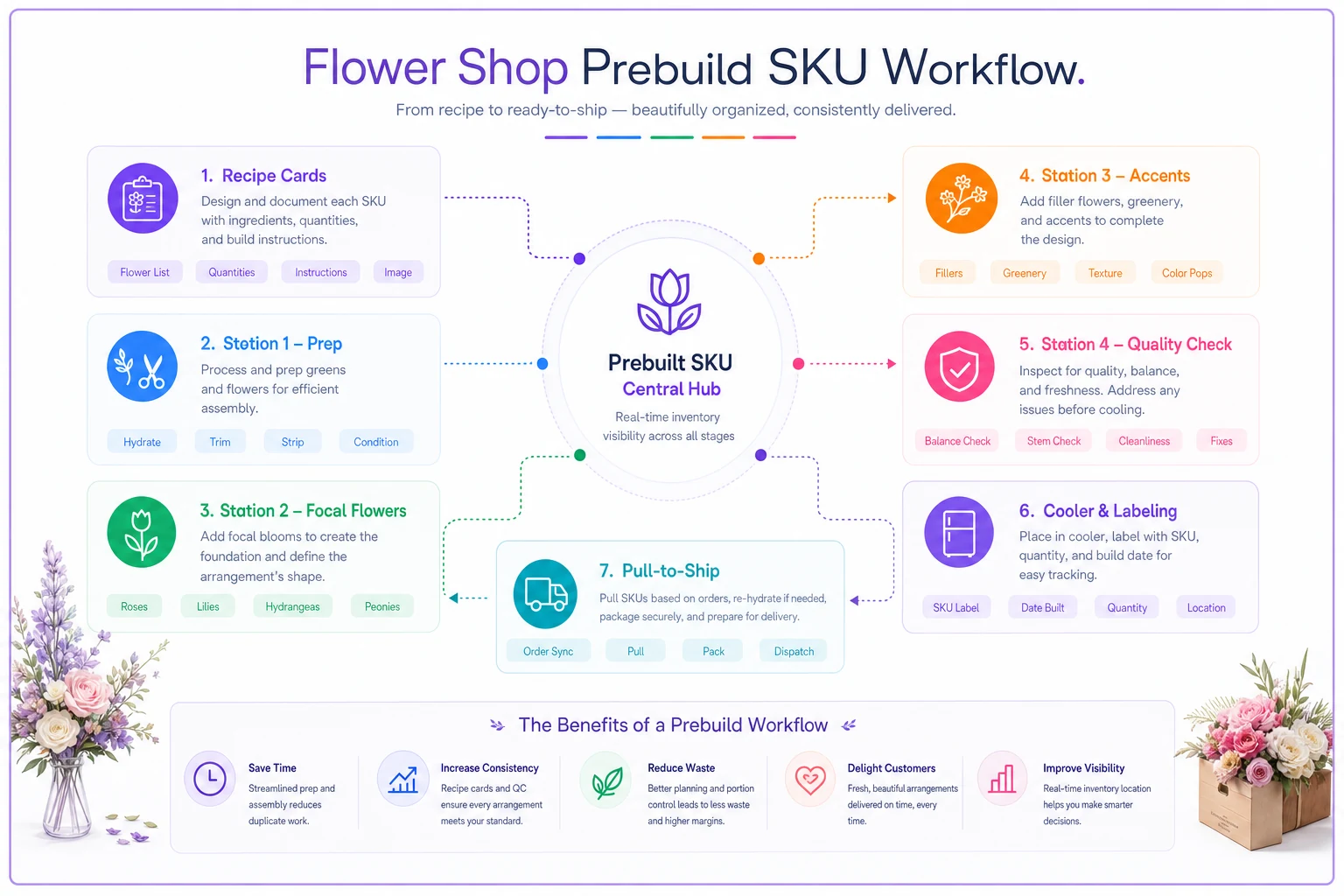
During Valentine's week, prebuild 70% of your inventory using these recipes. Start assembly three days before the 14th—roses last 5-7 days properly stored. Wrap finished arrangements in cellophane and store in coolers with clear labels. When orders flood in, you're pulling from inventory, not starting from scratch.
Track which SKUs sell fastest and adjust ratios yearly. If "Classic Romance" outsells "Modern Love" 3:1, prebuild accordingly. This isn't limiting creativity—it's acknowledging operational reality when you need to push out 50 arrangements per hour.
Supplier pre-ordering rules that prevent disaster
Nothing destroys peak season faster than running out of red roses on February 13th. Yet most florists still place orders based on last year's sales plus a guess. The shops that never run dry use structured pre-ordering rules with built-in contingencies.
For major holidays, follow the 60-30-10 ordering rule. Place 60% of your estimated order 8 weeks before the holiday. This locks in availability and usually gets better pricing. Order another 30% at 4 weeks out, adjusting based on early sales patterns. Keep 10% of your budget for spot purchases the week before.
-
Primary wholesale (60% of orders)
-
Secondary wholesale (30% of orders)
-
Local grocery/retail backup (10% emergency supply)
Pre-negotiate terms with all three. Get pricing commitments in writing by January 1st for Valentine's Day. Include specific variety substitution rules—if Freedom roses aren't available, what's the approved replacement? Set maximum prices you'll pay for emergency inventory. Some shops foolishly pay $4/stem for last-minute roses that normally cost $0.90.
Create a supply tracking spreadsheet that monitors confirmed orders, delivery dates, and backup options. Update it daily during peak week. When your primary supplier calls saying they're 30% short on white roses, you already know your secondary has 15 bunches available.
Batching rules that maintain quality at 3x volume
Regular operations might process 20-30 orders daily with a natural workflow. Peak season dumps 100+ orders on you. Without batching rules, your operation turns into expensive chaos.
Smart batching starts with order categorization. Don't process orders as they arrive—group them by delivery zone, arrangement type, and pickup time. A typical Valentine's Day might batch like this:
| Batch | Contents |
|---|---|
| Morning Production Batch (4am-10am) | - All February 14th morning deliveries - All complicated custom orders - All $100+ arrangements |
| Afternoon Assembly Batch (10am-4pm) | - Standard SKU arrangements for afternoon delivery - All pickup orders for 2pm-6pm window - Tomorrow's pre-orders |
| Evening Prep Batch (4pm-close) | - Stem processing for next day - Cooler organization - Supply staging for morning crew |
Within each batch, create assembly lines. Station 1 preps containers and greens. Station 2 adds focal flowers. Station 3 handles accents and wrapping. Station 4 does quality control and tagging. This assembly approach produces 3x more arrangements than individual designers working separately.
Batching only works with clear handoff rules. Every arrangement needs a paper trail—order number, delivery address, special instructions. Use colored stickers for delivery zones. Red dots for north side, blue for south, green for pickups. When your driver grabs 20 arrangements at once, they're already organized by route.
Set maximum batch sizes based on cooler capacity and delivery windows. Processing 50 arrangements at once sounds efficient until they sit in your cooler for 6 hours wilting. Better to run smaller batches that move straight to delivery.
Contingency plans for predictable failures
Peak seasons expose every operational weakness. But the failures are surprisingly predictable. The shops that survive have documented contingency plans for common disasters.
Designer no-shows: Always schedule 130% of needed staff for peak days. If everyone shows, great—send someone home early. When someone inevitably calls in sick, you're covered. Keep a list of florists from nearby shops who'll work hourly in emergencies. Pay them contractor rates if needed—it's cheaper than missed orders.
Delivery vehicle breakdown: Pre-arrange backup with a local courier service or even Uber/DoorDash drivers for emergency deliveries. Some shops partner with competing florists for mutual delivery backup—you help them on Valentine's, they help you on Mother's Day.
POS system crash: Keep paper order forms printed and ready. Train staff on manual credit card imprinters (yes, they still exist). Maintain a backup Square reader on someone's phone. Process everything manually if needed, then reconcile later.
Supply shortage: Beyond backup suppliers, maintain "arrangement flexibility" rules. If you're out of red roses, what can designers substitute? White roses with red ribbon? Pink roses with baby's breath? Get customer approval in advance—add a checkbox on order forms saying "allow similar substitution if needed."
Power outage/cooler failure: Know exactly where the nearest walk-in cooler is that you could rent space in—funeral homes, grocery stores, even restaurants. Keep the owner's cell number saved. Have a generator rental company on speed dial. Your entire inventory depends on refrigeration.
Document these contingencies in a physical binder, not just digitally. When systems fail, paper still works. Include contact numbers, decision trees, and spending authority. Who can approve emergency purchases up to $500? Up to $2000? When chaos hits, you can't wait for owner approval on every decision.
Margin optimization during peak demand
Peak seasons offer rare pricing power. Customers expect to pay more for Valentine's roses. Most florists either underprice from fear or overprice and kill demand. The sweet spot comes from structured pricing tiers based on timing and availability.
Implement early-bird pricing to smooth demand. Orders placed by February 1st get regular pricing. February 2-7 adds 15%. February 8-12 adds 25%. February 13-14 adds 40%. This isn't gouging—it's operational reality. Last-minute orders cost more to fulfill.
Your prebuilt SKUs should ladder across price points: $45, $65, $85, $125, $175. This captures different customer segments without custom design time. The $45 arrangement might have 6 roses, the $175 has 24, but both use the same basic recipe scaled up. Your materials cost percentage stays constant while absolute margin dollars increase.
Track your true peak season costs including overtime, temp workers, expedited shipping, and waste from overproduction. Most shops discover their actual Valentine's week margin is 15-20% lower than they think. Price accordingly. A shop doing $40k in Valentine's week revenue might see only $14k in actual profit after all peak-related costs.
Technology integration and workflow automation
Manual processes that work fine at normal volume completely break during peaks. The right operational software prevents the typical peak-season meltdown.
Order management becomes critical when you're processing 10x normal volume. AI-powered platforms can automatically sort orders by delivery zone, flag missing information, and even suggest arrangement substitutions based on inventory levels. Instead of manually checking each order, your system alerts you to problems—"17 orders requesting purple roses but only 12 bunches in inventory."
Staff scheduling gets complex with temps and shifting schedules. Good workforce management software lets you create schedule templates for peak weeks, track actual vs planned hours, and automatically calculate overtime. Some platforms even handle temp onboarding—digital paperwork, training videos, and skill assessments before they arrive.
Inventory tracking at peak volumes needs real-time updates. Every stem that moves should decrement from available inventory. When you hit reorder points, the system triggers supplier orders automatically. This prevents the 3pm realization that you're out of baby's breath.
Route optimization becomes essential when delivery volume triples. AI routing algorithms consider delivery windows, traffic patterns, and driver capacity. They'll also reoptimize on the fly when orders get added or canceled. Your driver gets turn-by-turn navigation that actually makes sense, not just address order.
The shops running modern operational software report 30-40% efficiency gains during peak seasons. That's not from working harder—it's from eliminating the friction that makes peak seasons feel impossible.
Learning from peak-season data
Most florists collapse after Valentine's Day and don't look back until next year. Better operators run detailed post-mortems within a week while memory is fresh.
-
Which SKUs sold out vs sat in coolers
-
Actual vs projected staffing needs
-
Supplier performance and pricing accuracy
-
Delivery completion rates and delays
-
Customer complaints and their causes
-
Product waste and damage rates
-
True hourly profit after all costs
Compare this against your playbook assumptions. Did the 60-30-10 ordering rule work? Were your batching sizes right? Did contingency plans actually help when problems hit? This isn't about blame—it's about refining the playbook for next peak.
Build a "never again" list of specific problems to solve. Maybe you need a better cooler organization system. Maybe your recipe cards need updating. Maybe certain suppliers proved unreliable. Each peak season should make the next one smoother.
The compound effect of operational maturity
Shops using structured peak-season playbooks report interesting changes over time. The first year feels like barely controlled chaos even with the playbook. Year two runs noticeably smoother. By year three, Valentine's week becomes almost boring—everything just works.
This operational maturity creates compound advantages. You retain more seasonal staff because the work isn't nightmarish. Suppliers give you priority because you order early and pay reliably. Customers trust you for important occasions because you consistently deliver. Your team stops dreading peak seasons and starts seeing them as profit opportunities.
The average flower shop sees peak seasons as survival tests. They gear up for battle, hope for the best, and collapse afterward. But shops running systematic playbooks treat peaks as multiplicative events—chances to make 3x revenue at 2.5x cost, banking profit that funds the quiet months.
Building your custom playbook
Every shop needs its own playbook based on local market conditions, customer base, and operational constraints. Start documenting your approach now, not two weeks before the next holiday.
Begin with the framework outlined here, then customize based on your reality. Maybe you're in a college town where graduation matters more than Valentine's. Maybe your customers prefer plants to cut flowers. Maybe you're downtown where delivery is harder but foot traffic is higher. Your playbook should reflect your specific operational context.
Test elements during smaller peaks before major holidays. If you're trying new batching rules, test them during Sweetest Day or Administrative Professionals Week. Iron out problems when stakes are lower.
Share the playbook with your entire team, not just managers. When everyone understands the system, they can help improve it. Your drivers might suggest better route groupings. Your designers might optimize recipe cards. Your temps from last year might recommend training improvements.
The goal isn't perfection—it's systematic improvement. Each peak season should run slightly better than the last. Small optimizations compound over time. Eventually, you'll handle 300 Valentine's arrangements with the same operational calm as 30 regular orders.
Peak seasons will always bring intensity. But with the right playbook, they stop being chaos and start being predictable profit engines. The only question is whether you'll build that playbook now or scramble through another Valentine's Day wondering why everything feels so hard.
Ready to grow your flower shop business?
Join 500+ flower shops using Blomsly to save time, reduce errors, and delight customers with fresh blooms.