


Most floral shops don't lose good designers because of money. They lose them because the money has no logic to it. One person got a raise because they asked at the right time. Another has been there three years and makes fifty cents more than someone hired last spring. Nobody wrote any of it down, and now the whole pay structure is a pile of one-off decisions that nobody can really defend out loud.
That's the quiet problem underneath turnover in shops with two to eight people. It's not that owners are cheap. It's that compensation got built reactively — raise by raise — until there's no visible connection between what someone earns and what they actually produce. And in a business where labor is often your second-biggest cost after flowers, a pay structure that floats free of productivity will slowly eat your margin while also failing to keep the people you most want to keep.
So this is less about "being nicer to staff" and more about building a people strategy that ties labor cost to output in a way everyone can see. Pay bands, career ladders, and a few lightweight review templates — not because you want to run like a corporation, but because clarity is what keeps a small team stable through peak seasons, slow Januaries, and the inevitable moment when your best designer gets an offer from the shop across town.
Why pay gets messy in small floral teams
The core issue is that floral work mixes three very different kinds of labor, and most shops pay for all of them with the same vague "designer" label.
You've got production work (stripping, processing, prepping, cooler organization), assembly work (building recipes to a standard), and judgment work (custom consults, wedding design, substitutions on the fly, handling the Saturday rush without burning the place down). These require different skills and carry different value. But when everyone's just "a florist," pay tends to cluster around whatever the market rate feels like that month, with tenure bumps stacked on top.
What breaks first is fairness perception. In real operations, this usually happens when a fast, reliable producer who never touches a custom order ends up earning close to someone running weddings, simply because they were hired earlier. The custom designer notices. They don't quit immediately — they just stop volunteering for hard work, because the extra effort isn't showing up in their check.
The second thing that breaks is your ability to forecast labor cost against volume. If pay isn't connected to output, you can't answer the one question that matters during a staffing decision: does adding this person actually pencil out against the orders they'll handle? You end up staffing on gut feel, which works until it doesn't — usually around Valentine's week.
Start with role families, not job titles
Before you touch numbers, separate your work into role families. A role family is a cluster of responsibilities that share a skill level and a type of output. For a small shop, three or four families cover almost everything:
Never miss a bloom or a delivery.
Blomsly helps you manage orders, track stock, and schedule deliveries effortlessly.
- Unified order management
- Real-time inventory tracking
- Delivery scheduling & notifications
No credit card required
-
Production / Prep — receiving, processing, hydration, cooler rotation, basic care-and-handling. The backbone nobody sees.
-
Assembly / Bench — building standard recipes and prebuilt SKUs to spec, at speed, with consistent quality.
-
Design / Custom — consults, custom arrangements, substitutions, sympathy and event work, quality control on others' builds.
-
Lead / Coordination — daily flow, order triage, delegation, training, handling escalations and the occasional furious customer.
The reason this matters: role families let you pay for what the work is, not how long someone's been around. A three-year production person is valuable, but they're not doing design judgment, and the pay band should reflect that honestly. This is also where a lot of shops realize they've been underpaying their one real lead — the person quietly holding the whole operation together — because that coordination work was never named as its own thing.
If you've already built out role templates and competency checklists from a hiring-to-performance system for tiny floral teams, you're ahead here. Role families are just the compensation layer sitting on top of those same competencies.
Build pay bands you can actually defend
A pay band is a floor and a ceiling for each role family, usually with a midpoint. The point isn't to be rigid — it's to give every pay decision a place to live. When someone asks for a raise, the answer stops being a negotiation and becomes a conversation about where they sit in the band and what moves them up it.
| Role family | Band floor | Midpoint | Band ceiling | Primary basis for movement |
|---|---|---|---|---|
| Production / Prep | $15/hr | $17/hr | $19/hr | Speed + consistency + cooler discipline |
| Assembly / Bench | $17/hr | $19.50/hr | $22/hr | Builds-per-hour at quality standard |
| Design / Custom | $21/hr | $25/hr | $29/hr | Custom throughput + customer outcomes |
| Lead / Coordination | $25/hr | $29/hr | $34/hr | Team output + error reduction + training |
A few things worth noticing in how these overlap. The top of the Assembly band bumps into the bottom of Design on purpose. That overlap is where your best bench person lives right before they cross into custom work — and it gives you a real, visible path to show them. Bands with no overlap force awkward jumps. Bands with overlap let people grow in place.
The ceiling matters just as much as the floor. Without one, your longest-tenured production person eventually out-earns your mid-level designer through sheer accumulation of small raises, and the whole logic collapses. The ceiling forces the honest conversation: to earn more than this, you need to move into a different kind of work. That's not a wall. It's the entrance to the career ladder.
Tie pay bands to time-per-SKU (the part most shops skip)
This is where the people strategy stops being soft and starts being math. If you've run any kind of assembly time study — and if you haven't, your bouquet assembly time standards are the prerequisite for everything below — you already know roughly how long each SKU takes to build. That number is the bridge between what you pay and what you earn.
Here's the logic worked out with real-ish numbers.
Say a standard prebuilt bouquet takes an experienced bench person about 9 minutes to assemble to standard. That's roughly 6–7 builds per hour. At an Assembly midpoint of $19.50/hr, your direct assembly labor per bouquet lands around $2.80–$3.25.
Now take a newer hire at the Assembly floor ($17/hr) who's still at 13 minutes per build — about 4.5 per hour. Same SKU, but assembly labor jumps to roughly $3.75 per unit. Not catastrophic, but if that SKU retails at $45 with a target labor cost under 8%, you can see exactly where your margin leaks and exactly what training that person up is worth in dollars.
The move most shops miss: the pay band and the time standard should rise together. When someone's builds-per-hour improves to the point where their labor-per-SKU drops below the band midpoint's target, that's not just a nice trend — it's the documented, numerical justification for moving them up within the band. You're not guessing whether they've earned it. The time-per-SKU tells you.
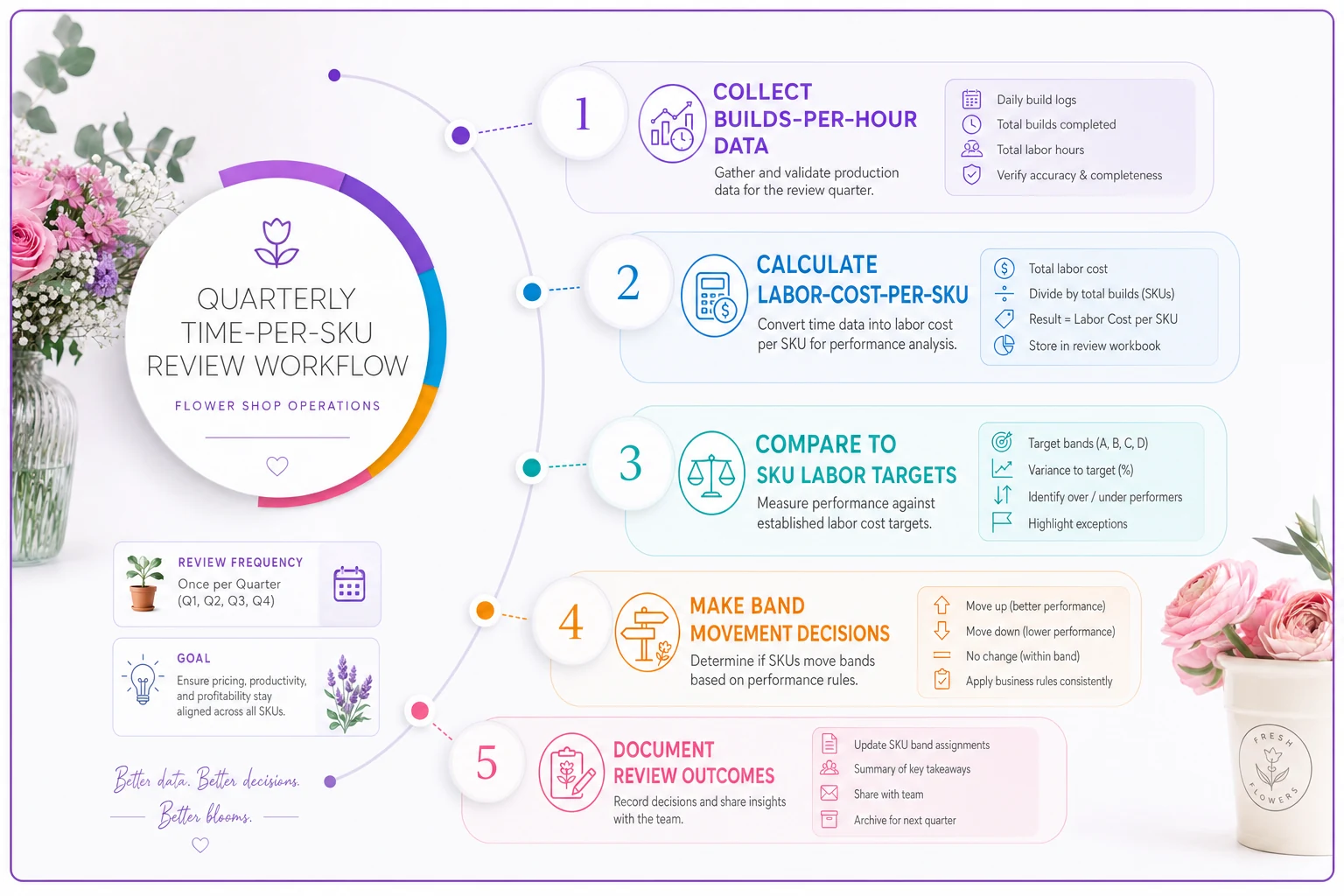
A simple way to run this quarterly:
-
Pull builds-per-hour for each person on your 5–6 highest-volume SKUs.
-
Multiply by their current hourly rate to get labor-cost-per-SKU.
-
Compare against the target labor cost for that SKU's retail price.
-
Anyone consistently beating their band's target is a candidate for upward movement in the band.
-
Anyone consistently missing it after a fair ramp period is a development conversation, not a raise.
Raises stop feeling political when the numbers do the arguing. And when someone asks why a coworker got bumped, you have an answer that doesn't involve favoritism.
Here’s a quick workflow to visualize quarterly time-per-SKU review and band movement.
The move most shops miss: the pay band and the time standard should rise together.
Raises stop feeling political when the numbers do the arguing. And when someone asks why a coworker got bumped, you have an answer that doesn't involve favoritism.
Career ladders: giving people somewhere to go
Pay bands handle "more money for the same role." Career ladders handle "a different, bigger role." Small shops often skip ladders because they assume there's nowhere to climb in a five-person business. But a ladder isn't about headcount — it's about a visible sequence of skill gates.
-
Prep I → Prep II — from "processes stems correctly" to "runs the whole receiving-to-cooler flow unsupervised and catches quality issues on intake."
-
Prep II → Bench Designer — crosses into building standard recipes at speed and quality.
-
Bench Designer → Custom Designer — takes on consults, substitutions, and sympathy/event work.
-
Custom Designer → Lead — owns daily flow, trains others, handles escalations.
Each rung needs two or three concrete, observable criteria — not vibes. "Builds the top 10 SKUs to standard at or under time on three consecutive audits." "Handled five walk-in custom consults with no manager intervention and positive customer feedback." The criteria are the promotion. When someone hits them, the conversation is already decided.
One pattern worth flagging: the jump from Custom to Lead is where small shops most often promote the wrong person. The best designer is not automatically the best coordinator — those are genuinely different skill families. Promoting your top designer into a lead role they're bad at loses you a great designer and creates a weak lead. Sometimes the right lead is the solid-but-not-spectacular designer who's naturally organized and keeps everyone calm. Watch for that.
Seasonal temps need their own rules
Permanent bands and ladders don't fit seasonal hires, and trying to force them creates a mess. Your Valentine's and Mother's Day crew needs a separate, simpler structure — flat seasonal rates, clear scope, and no implied path into the permanent bands unless you deliberately open one.
-
Flat seasonal rate per role, set slightly above your permanent floor for that work to attract reliable help fast. Don't negotiate individually under time pressure — it poisons your band logic the moment regular staff find out.
-
Explicitly scoped work. Seasonal hires do Prep and basic Bench, not custom or consults. Scope creep during peak is how quality slips and how temps end up resentful about doing "designer work" at temp pay.
-
A written on-ramp, not an accidental one. If a strong seasonal hire is someone you'd want permanently, that's a deliberate decision made after the season, placed into the real bands at the appropriate floor — not a battlefield promotion in the middle of Valentine's week.
If your peak planning already lives in a peak-season operations playbook with staffing and prebuilt SKUs, the seasonal pay rules slot right into it. The staffing math and the pay math should be the same document, not two separate guesses.
Low-friction development checkpoints
The failure mode for small-shop HR isn't having no plan — it's having a plan nobody maintains. Annual reviews don't work in floral because the business moves in seasonal waves and people develop (or stall) in weeks, not years. You need something lighter and more frequent.
Weekly (2 minutes, informal): The lead or owner notes one thing each person did well and one thing to work on. Not a form. A running note in whatever tool you already use. The point is a continuous signal, so nothing in a quarterly review is ever a surprise.
Quarterly (20 minutes, structured): This is where pay bands and time-per-SKU numbers come in. Three questions:
-
Where does this person sit in their band, and did the quarter's output justify movement?
-
Which ladder criteria have they hit, and which are next?
-
What's the one skill gate we're developing this quarter?
A drop-in quarterly template managers can literally copy:
-
Name / Role family / Current band position
-
Top SKUs — builds-per-hour this quarter vs. last
-
Labor-cost-per-SKU vs. target
-
Ladder criteria met since last review
-
Next rung + the specific gate to clear
-
Band movement decision (yes/no + the number that justifies it)
-
One development focus for next quarter
That's it. If it takes longer than twenty minutes, you've over-engineered it, and it won't survive contact with a busy March.
A real scenario
A three-person shop — owner plus two designers — was running close to 300 orders a month and churning through help every 8–10 months. Pay was pure gut: both designers earned within a dollar of each other despite one doing nearly all the custom work and the other mostly prebuilt assembly.
They split into role families, built simple bands, and ran their top SKUs against actual build times. Two things surfaced immediately. The custom designer was underpaid by roughly $3/hr relative to the output she generated. And the assembly designer was actually faster than anyone realized — her labor-per-SKU was beating target, she just had no band position that recognized it.
They moved the custom designer up within the Design band and gave the assembly designer a clear ladder gate into bench-plus-some-custom work with the raise attached to hitting it. Nothing dramatic happened overnight. Over the next three quarters, though, turnover stopped — both stayed through the following peak — and the owner could finally answer, with numbers, whether hiring a fourth person made sense. Labor as a share of revenue actually tightened slightly, because the raises were anchored to productivity instead of just added on top.
Not a miracle. Just a structure where effort and pay finally pointed the same direction.
When this is worth doing — and when it isn't
This makes sense when you have three or more people, visible pay inequities you can't fully explain, and recurring turnover among staff you wanted to keep. It also makes sense the moment you're forecasting a hire, because bands and time-per-SKU are what let you check whether the hire actually pencils out.
This is overkill when you're a solo owner with one part-time helper. You don't need a ladder for one person. A fair rate and a clear conversation cover it. Building formal bands at that size is effort spent on a problem you don't have yet.
Who should hold off: shops in genuine cash crisis. If you can't afford to honor movement within the bands you build, don't build them — you'll just advertise a promise you can't keep, which is worse than ambiguity. Fix the cash first, then bring structure to the people side.
Keeping the whole thing running
The reason most small-shop pay structures collapse isn't bad design — it's that the numbers live in someone's head and the reviews quietly stop happening. The bands drift out of date, the time studies go stale, and within a year you're back to one-off raises.
Whatever you use to track orders, assembly times, and staff hours is also where this people data should live, so that pulling builds-per-hour for a quarterly review takes a few minutes instead of an afternoon of digging. When the productivity numbers you already capture feed directly into the pay conversation, the review actually happens — because it's cheap to run. When they're scattered across spreadsheets and memory, it doesn't.
That's the real test of a people strategy for florists: not how elegant the bands look on paper, but whether a busy owner can still run the quarterly review in the middle of wedding season without dreading it. Keep the structure light enough to survive your worst week, anchor every pay decision to output your team can see, and give people a visible next rung. Do that, and compensation stops being the thing that quietly drains your best people — and starts being the thing that keeps them.
Ready to grow your flower shop business?
Join 500+ flower shops using Blomsly to save time, reduce errors, and delight customers with fresh blooms.