



Most florists guess their way through staffing. They know Mother's Day needs more hands, Valentine's requires all-nighters, and regular Tuesdays run fine with two people. But when you dig into actual production capacity, the gaps become obvious.
A shop owner in Portland told me last month she thought her team could handle 40 custom bouquets per shift. After tracking actual completion times, they discovered their real capacity was 27. That gap meant turning away roughly $1,800 in weekly orders during wedding season because they couldn't accurately promise delivery times.
Different bouquet styles require vastly different assembly times. A simple wrapped dozen roses takes maybe four minutes. A cascading bridal bouquet with orchids, eucalyptus, and ribbon work? That's pushing 35 minutes for an experienced designer. Without understanding these time differences, you're essentially planning blind.
Running time studies without disrupting operations
Time studies sound academic, but the process is straightforward. You track how long specific tasks take under normal working conditions. Not your fastest designer on their best day. Not the new hire struggling with ribbon. Real averages from real shifts.
Start with your most common arrangements. Pick five to eight SKUs that represent 60% or more of your weekly volume. For most shops, this includes:
-
Standard wrapped dozens (roses, tulips, mixed)
-
Small vase arrangements ($35-45 range)
-
Medium centerpieces ($65-85 range)
-
Funeral sprays
-
Wedding bouquets (if applicable)
Track each SKU across multiple designers and different times of day. Morning assembly often runs faster than afternoon when fatigue sets in. Your veteran designer might complete arrangements 40% faster than someone with six months experience.
Wednesday morning, designer Sarah:
-
Wrapped dozen roses
3:45
-
Small mixed vase
8:20
-
Medium centerpiece
14:15
Wednesday afternoon, designer Marcus:
-
Wrapped dozen roses
4:30
-
Small mixed vase
11:00
-
Medium centerpiece
17:45
Repeat this across a full week. Include different designers, different days, different energy levels.
You need at least 10 data points per SKU to get meaningful averages.
A quick visual of the time-study workflow:
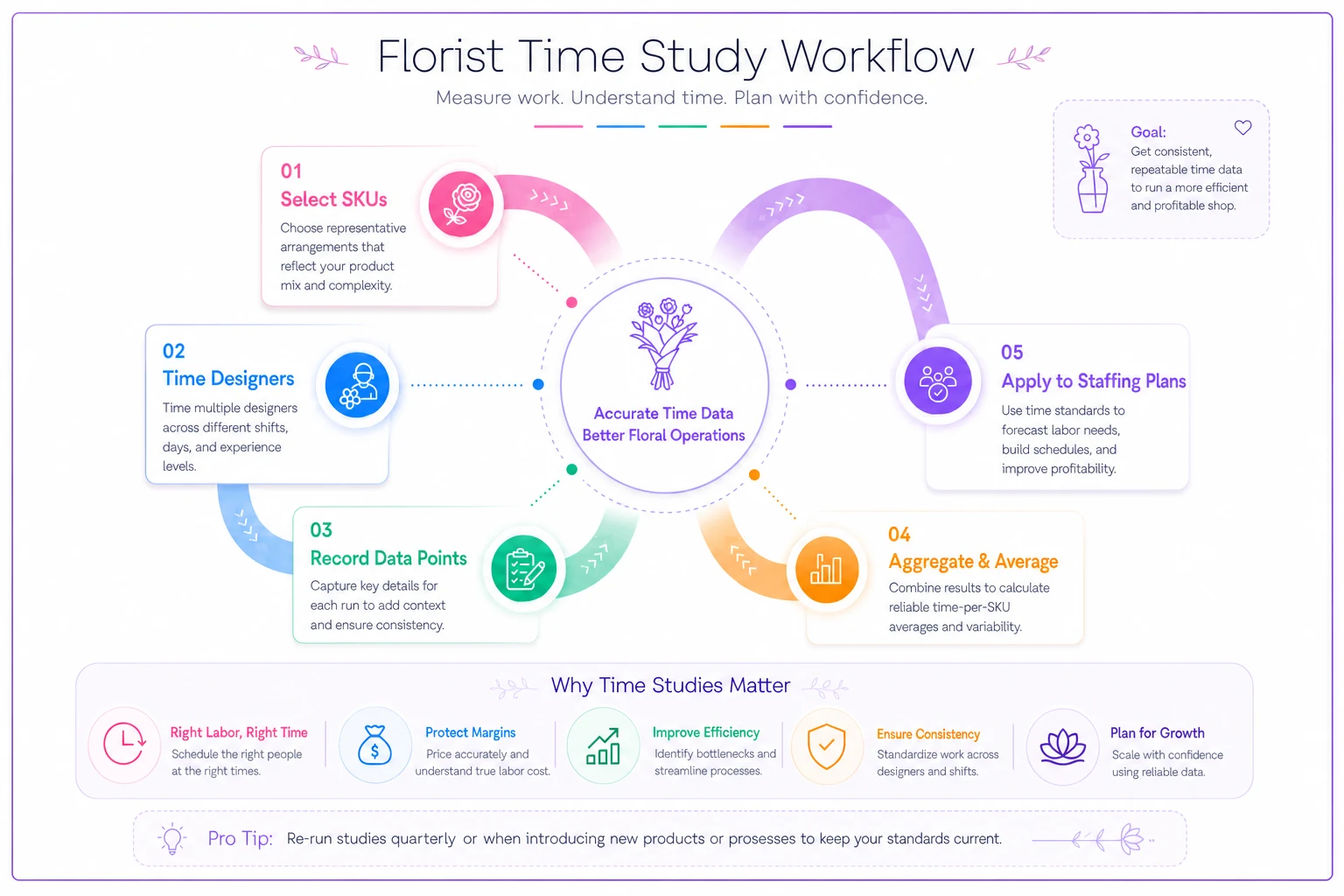
You need at least 10 data points per SKU to get meaningful averages.
Building your time-per-SKU matrix
Once you collect raw timing data, organize it into a usable matrix. This becomes your production planning backbone.
Never miss a bloom or a delivery.
Blomsly helps you manage orders, track stock, and schedule deliveries effortlessly.
- Unified order management
- Real-time inventory tracking
- Delivery scheduling & notifications
No credit card required
| SKU Type | Beginner (mins) | Experienced (mins) | Expert (mins) | Avg Time | Materials Prep |
|---|---|---|---|---|---|
| Wrapped Dozen | 6-8 | 4-5 | 3-4 | 5.0 | 2 mins |
| Small Vase | 12-15 | 8-10 | 6-8 | 10.0 | 3 mins |
| Medium Centerpiece | 20-25 | 15-18 | 12-15 | 17.0 | 5 mins |
| Funeral Spray | 35-45 | 25-30 | 20-25 | 30.0 | 8 mins |
| Bridal Bouquet | 45-60 | 35-40 | 25-30 | 40.0 | 10 mins |
| Corsage/Boutonniere | 8-10 | 5-7 | 4-5 | 6.5 | 2 mins |
Notice the materials prep column. That's the time spent pulling flowers from coolers, gathering supplies, cleaning stems. This happens regardless of designer skill level and often gets overlooked in capacity planning.
Your matrix should also account for complexity variations within each SKU. A "small vase arrangement" using only roses assembles faster than one mixing delphinium, lisianthus, and eucalyptus. Track both if they represent significant volume.
Converting time studies into daily capacity
Raw assembly times tell only part of the story. Real capacity depends on shift structure, break times, and non-production tasks.
A typical 8-hour shift breaks down like this:
-
480 total minutes
-
Minus 30 minutes lunch
-
Minus two 15-minute breaks
-
Minus 20 minutes opening/closing tasks
-
Minus 30 minutes customer interruptions
-
Minus 20 minutes cleaning between arrangements
-
= 350 productive minutes
Now apply your time matrix. If your average arrangement takes 12 minutes (including prep), one designer produces roughly 29 arrangements per shift under ideal conditions. But ideal conditions rarely exist.
Factor in reality adjustments:
-
Phone consultations
-
Walk-in customers
-
Delivery coordination
-
Fixing mistakes
-
Waiting for specific flowers
These interruptions typically reduce productive time by another 15-20%. Your 350 minutes becomes 280-300 minutes of actual production.
This is why that Portland shop struggled. They assumed 480 minutes of production time when reality delivered 280 minutes. Their "40 bouquet capacity" was actually 23-25 bouquets.
Staffing forecasts for events and peak days
Peak periods require different math. Valentine's Day and Mother's Day don't follow normal patterns. Orders cluster around specific products, customer interactions drop to near zero, and efficiency actually improves through repetition.
Start with historical order data. Pull last year's numbers for your peak events:
-
Total orders by day
-
Order distribution by SKU
-
Delivery time requirements
-
Same-day versus pre-orders
Mother's Day forecast example:
Expected orders: 180 arrangements
-
60 wrapped bouquets (5 mins each = 300 mins)
-
80 small/medium vases (12 mins each = 960 mins)
-
30 premium arrangements (25 mins each = 750 mins)
-
10 custom requests (35 mins each = 350 mins)
Total production time: 2,360 minutes
With peak-day efficiency gains (fewer interruptions, batch processing), you might achieve 400 productive minutes per designer per shift. That requires six designer-shifts to handle production.
But timing matters. If 70% of orders need completion by noon for afternoon delivery, you need four designers working the morning shift, not two in morning and two in afternoon.
The compound effect of small improvements
A five-minute reduction in average assembly time might seem trivial. Across 30 daily arrangements, that's 150 minutes saved. Two and a half hours of capacity recovered without hiring anyone.
Where do these improvements come from?
Workspace optimization: Moving frequently used supplies within arm's reach saves 30-60 seconds per arrangement. Reorganizing your cooler so popular flowers sit at waist height instead of floor level saves another 30 seconds.
Pre-processing during slow periods: Removing thorns, cutting stems to rough length, and organizing by color during quiet mornings speeds afternoon assembly when orders pile up.
SKU standardization: Instead of offering "designer's choice" with infinite possibilities, create three defined styles at each price point. Designers work faster with clear parameters.
Batch processing: Grouping similar arrangements reduces tool changes and mental switching. Five wrapped dozens in sequence beats alternating between wrapped, vase, and corsage work.
Pre-cut stems and remove thorns during quiet hours so peak shifts focus solely on assembly.
Batch processing: Grouping similar arrangements reduces tool changes and mental switching. Five wrapped dozens in sequence beats alternating between wrapped, vase, and corsage work.
When automation actually helps (and when it doesn't)
The conversation naturally shifts toward operational software when you start measuring everything. Some automation genuinely helps. Order distribution boards that automatically sort by designer skill and deadline prevent the 3pm scramble. Digital timers that track actual versus estimated completion help refine your matrices.
Automation can't fix fundamental capacity problems. If your studies show you need four designers for Saturday weddings, software won't magically make three designers sufficient. What it can do is eliminate the coordination overhead that steals productive minutes.
A shop in Austin implemented a simple digital workflow board. Nothing fancy—just a screen showing each designer's queue, sorted by deadline. They recovered about 45 minutes per designer per shift just from eliminating the "what should I work on next?" conversations.
The bigger win came from historical tracking. After six months of data, they identified that Tuesday mornings consistently ran 30% below capacity while Thursday afternoons exceeded capacity by 40%. They shifted one designer's schedule and smoothed out the bottleneck.
Mistakes that make time studies worthless
Tracking your best designer on their best day and using that as your standard. That's like planning a road trip based on highway speeds while ignoring city traffic.
Another mistake: forgetting about skill progression. Your newest hire might take 15 minutes for a basic arrangement today. In three months, they'll probably hit 10 minutes. In six months, maybe 8 minutes. Build progression expectations into your capacity planning.
Some shops track assembly time but ignore everything else. They count the 12 minutes of actual arranging but miss the 5 minutes finding the right vase, 3 minutes printing tags, 2 minutes boxing for delivery. Those peripheral tasks add up to 40% of total time.
Running studies once and never updating them. Market changes affect production times. When eucalyptus prices spike and you substitute with italian ruscus, assembly takes longer. When you switch from paper wrap to cellophane, that changes timing too.
Making the data stick
Time studies only matter if your team actually uses them. Post simplified versions where designers can see them. Not the full matrix with twenty SKUs and six skill levels. Just the basics:
Quick Reference Guide:
-
Wrapped bouquet
5 minutes
-
Basic vase
10 minutes
-
Premium arrangement
20 minutes
-
Wedding centerpiece
30 minutes
Use these standards for scheduling, but also for pricing. If a custom arrangement requires 45 minutes of design time, price accordingly. Too many shops price based on flower cost alone, ignoring that labor often represents 35-40% of total cost on complex pieces.
Share capacity numbers with your sales team. When they know Tuesday can handle 60 arrangements but Saturday maxes at 40, they stop overpromising. This prevents the Thursday panic calls asking designers to "squeeze in just one more order."
The reality check nobody talks about
Perfect time standards assume perfect conditions. Real shops deal with:
-
Flowers arriving wilted
-
Ribbon running out mid-arrangement
-
New employees calling in sick
-
Coolers breaking during heat waves
-
Brides changing their minds
Build buffer time into your standards. If studies show 100 arrangements require 20 hours of designer time, plan for 24 hours. That 20% buffer handles the inevitable chaos without destroying deadlines.
Some shops resist this buffer, thinking it reduces efficiency. The opposite happens. When designers aren't constantly racing against impossible deadlines, quality improves, mistakes drop, and ironically, speed increases.
Beyond basic measurements
Once you nail down basic time studies, expand into seasonal variations. December arrangements with pine and holly take longer than April arrangements with tulips and daffodils. Track these patterns across a full year.
Consider customer interaction time too. A wedding consultation might consume 45 minutes of designer time. A funeral order might require 20 minutes of compassionate discussion. These interactions can't be rushed, so factor them into capacity.
Look at remake rates by designer and SKU. If certain arrangements consistently require remakes, either the time standard is too aggressive or training gaps exist. Both affect real capacity.
Time studies reveal uncomfortable truths. That designer you thought was incredibly fast might actually be average—they just work through lunch. That "simple" bouquet wrap might actually be your least profitable SKU when you factor in true labor cost.
The goal isn't perfection. It's clarity. When you know a Mother's Day rush requires 2,400 minutes of production time, you can plan accordingly. Hire temporary help, extend hours, or limit order quantities. All better options than hoping everything somehow works out.
Most florists run their shops on instinct developed over years. That instinct is valuable, but combining it with actual data creates something more powerful—predictable capacity that scales with demand. The shops that figure this out stop turning away profitable orders and stop killing their teams during peak periods. They know exactly what they can handle and plan accordingly.
Ready to grow your flower shop business?
Join 500+ flower shops using Blomsly to save time, reduce errors, and delight customers with fresh blooms.