

Most shop owners don't have a hiring problem. They have a rehiring problem. Someone comes on in April, gets half-trained between deliveries, then burns out by July when peak season hits. By fall you're starting over — same interview questions, same "I'll just show you as we go," same slow bleed of designer time that never gets counted.
Hiring for a 1–5 person floral team is a completely different animal than hiring for a 30-person operation. You can't absorb a bad hire, you can't afford a long ramp, and you definitely can't pull your best designer onto training duty during Mother's Day. What breaks isn't the interview — it's everything downstream. The onboarding, the first-week chaos, the fact that nobody wrote down what "good" actually looks like at your bench.
So this is less about how to write a job ad and more about how the whole system connects: role definitions feeding onboarding, onboarding feeding competency, competency tied to real production KPIs like time-per-SKU. When those pieces don't link, you get people who technically work there but never reach the output you needed six weeks ago.
Why tiny teams get hiring wrong (it's structural, not personal)
In a micro-team, every person wears four hats, so the role in your head is fuzzy. You're not hiring "a designer." You're hiring someone who does 40% bench work, 20% processing, 20% counter/phones, and 20% whatever's on fire that day. When the role is fuzzy, the interview is fuzzy, and the training is fuzzy. You end up evaluating vibes and hoping for the best.
There's also a timing trap. Shops tend to hire reactively — someone quits, or a wedding weekend nearly kills you, and suddenly you're desperate. Desperation hiring means skipping the boring stuff: no defined ramp, no checklist, no clear standard for when someone is trusted alone at the bench. A typical scenario: a new hire gets left to build arrangements on day three because the owner got pulled onto a corporate order, and now every wonky bouquet becomes a rework, a refund, or a customer who quietly stops ordering.
The hiring part usually isn't the bottleneck. The bottleneck is that there's no bridge between "hired" and "productive." That gap is where money leaks. A designer earning around $18–22/hr who takes eight weeks to reach full speed instead of three is easily $1,500–$2,500 of buried cost, and that's before you count errors and the senior-designer hours spent hovering.
Start with role templates, not job ads
Before you write a single word of a job posting, write the role template. Not a legal job description — a working document that says what this person actually produces, what they touch, and what "competent" looks like at each stage.
Never miss a bloom or a delivery.
Blomsly helps you manage orders, track stock, and schedule deliveries effortlessly.
- Unified order management
- Real-time inventory tracking
- Delivery scheduling & notifications
No credit card required
A usable florist role template has four parts:
-
Core outputs — the concrete things this person produces (e.g., "processes and hydrates incoming stems," "builds standard wrapped bouquets to spec," "stages same-day orders for driver").
-
Touchpoints — what they interact with
the cooler, the POS, phone orders, the design kit, the delivery board.
-
Standards — the measurable bar. This is where time-per-SKU lives. "Builds a Standard Market Bouquet in ~6–8 minutes at acceptable quality" is a standard. "Good with flowers" is not.
-
Trust levels — what they're allowed to do alone at week 1, week 2, and week 4.
Here's a simplified comparison of how three common micro-team roles break down. Most shops blur these into one person early on, but writing them separately makes gaps obvious — and makes it clearer what you're actually hiring for when you add headcount.
| Role | Primary outputs | Key time-per-SKU KPI | Solo-trusted by |
|---|---|---|---|
| Processor / Prep | Stem processing, hydration, cooler org, restock | Bunches processed/hour | End of week 1 |
| Bench Designer | Standard bouquets, prebuilt SKUs, order fills | Minutes per standard SKU | End of week 3–4 |
| Counter / Fulfillment | Phone orders, POS, staging, driver handoff | Orders staged accurately/hour | End of week 2 |
The insight most owners miss: when you define the Processor role clearly and hire for it first, you free your senior designer from the least-skilled work — which is usually where their day actually leaks.
When you define the Processor role clearly and hire for it first, you free your senior designer from the least-skilled work — which is usually where their day actually leaks.
A lot of shops try to hire another designer when what they really needed was someone handling prep so the designer they already have can hit their numbers.
The 7-day quickstart plan
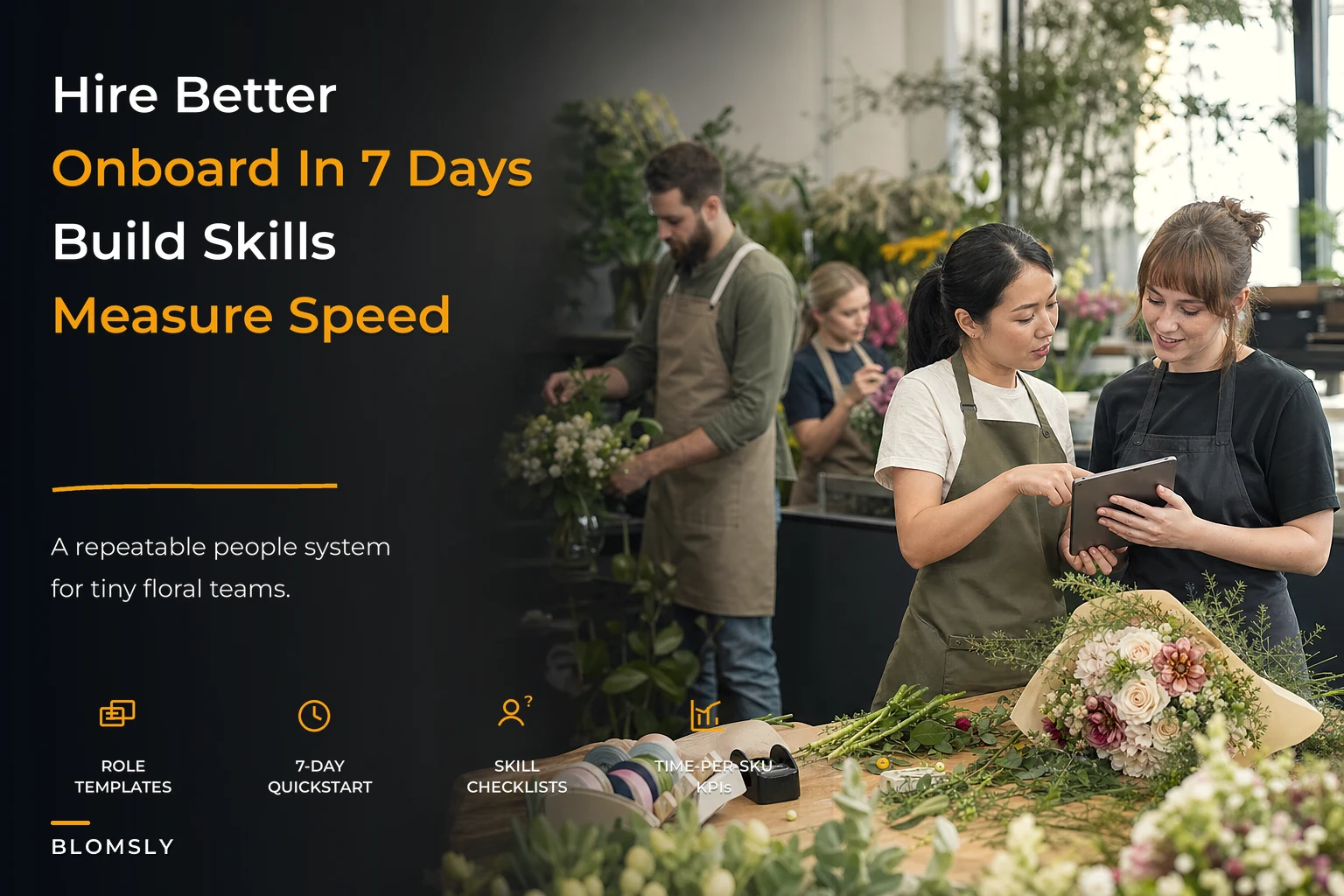
A ramp plan doesn't need to be fancy. It needs to exist, be written down, and be the same every time so you're not reinventing onboarding for each hire. The point of a 7-day quickstart is to get someone to narrow competence fast — one thing they can do reliably and unsupervised — before you widen their responsibilities.
-
Day 1 — Orientation + processing. Cooler layout, stem handling, hydration, POS basics, where things live. They shadow, then do processing hands-on. Nothing at the bench yet.
-
Day 2 — Processing solo + watch the bench. They own morning processing. In slow moments they watch standard bouquets being built and take notes on the spec.
-
Day 3 — First supervised builds. They build 3–5 standard SKUs with someone checking each one. Don't chase speed. Chase spec accuracy.
-
Day 4 — Timed builds, low stakes. Introduce the clock, but on non-customer stems or salvage stock. Compare their time-per-SKU to your standard. Coach the slow steps.
-
Day 5 — Real orders, checked before they leave. They build actual orders; a senior person QCs before staging. Track error rate honestly.
-
Day 6 — Widen touchpoints. Add order intake, staging, driver handoff. Let them see the whole path an order takes.
-
Day 7 — Review + set week-2 targets. Sit down for 20 minutes. Where are they vs. the KPI? What are they solo-trusted on? What's the plan for weeks 2–4?
The mistake people make is treating day one like a firehose — dumping the entire operation on someone and calling it training. Narrow first. Someone who can process stems flawlessly and build two SKU types by day 7 is worth far more than someone who's seen everything once and mastered nothing.
If you've already done the work of setting real assembly benchmarks, this whole plan gets sharper. The quickstart is really just teaching someone to hit numbers you've already measured. If you haven't measured them, that's the prerequisite. The plan for setting bouquet assembly time standards through actual time studies is worth doing before you onboard anyone — otherwise your "standard" is just a guess and you can't fairly evaluate a new hire against it.
Competency checklists that tie to real production
A competency checklist turns "I think they're getting there" into something you can actually see. It's not a personality assessment. It's a list of observable, pass/fail-ish skills tied to the outputs in the role template.
For a bench designer, a working checklist might include:
-
Processes and hydrates a full delivery within the target window
-
Builds a Standard Market Bouquet within the time-per-SKU target, at spec
-
Builds the top 3 prebuilt package SKUs from memory
-
Correctly reads an order ticket and pulls the right recipe/kit
-
Stages a completed order with correct card, label, and add-ons
-
Recognizes stems that shouldn't go out (bruising, wilt, short vase life)
-
Handles a phone reorder without escalating every question
Each item gets a date and who verified it. The reason this matters operationally: it gives you a defensible point where someone graduates from supervised to solo, which directly affects your scheduling and your labor cost. A person who's checked off on processing and standard builds can run a Saturday morning while your designer focuses on wedding work.
Shops that skip checklists tend to keep people in a permanent semi-supervised state. Nobody's ever officially trusted, so the senior designer never fully lets go, and you never actually get the capacity you hired for. The checklist isn't bureaucracy — it's what lets you take your hands off the wheel.
Seasonal temps and the roster problem
Temps are where the whole system either pays off or falls apart. You can't run a 7-day quickstart for someone you hired for a 5-day Valentine's push. Seasonal hiring needs a different track: an ultra-narrow role with an ultra-short ramp.
Design temp roles around your prebuilt and repeatable work, not your custom work. A seasonal temp should never be building custom sympathy pieces. They should be doing high-volume, spec-locked tasks: processing, building one or two prebuilt SKUs, wrapping, staging, boxing. When you strip the role down to two SKUs and a clear spec, a temp can be genuinely useful by hour three instead of day three.
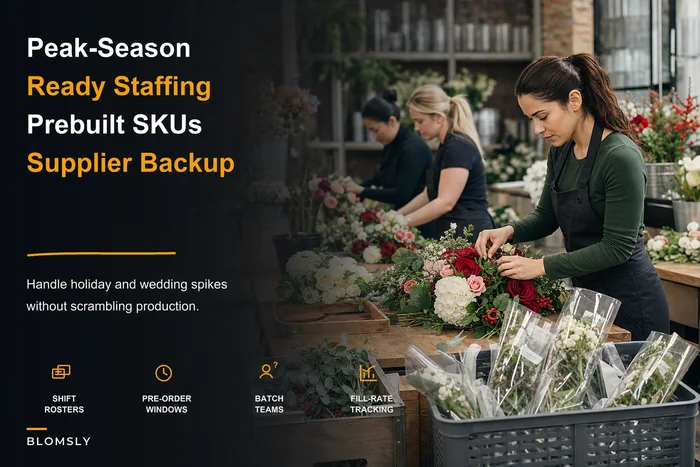
Tie temp performance to time-per-SKU from the start. If your standard wrapped dozen takes a trained designer roughly 7 minutes and your temp is at 14, that's fine on day one — but you should know it, because it tells you how many temps you actually need to hit volume. This is the same math that drives your whole seasonal plan. A lot of the staffing logic here connects directly to the broader peak-season operations approach — staffing, prebuilt SKUs, and supplier contingencies, because temp rosters only work when your product mix is already built for volume.
A seasonal roster should track, per temp:
-
Which SKUs they're cleared to build
-
Their current time-per-SKU vs. target
-
Their reliable output per shift
-
Whether they're a rehire candidate for the next peak
That last one is quietly the most valuable. Shops that keep a simple "would rehire / trained on X" note on every temp build a bench of pre-trained seasonal help. By the third season you're calling back people who already know your cooler, and your ramp cost drops to almost nothing.
Shops that keep a simple "would rehire / trained on X" note on every temp build a bench of pre-trained seasonal help. By the third season you're calling back people who already know your cooler, and your ramp cost drops to almost nothing.
How this connects to the rest of the shop
None of this lives in isolation. A properly onboarded person doesn't just do their job — they plug into workflows you've already built. Someone trained on order intake and staging is directly feeding your fulfillment flow, and the smoother that handoff, the fewer mistakes hit the door. If your same-day order workflow is tight but your people aren't trained to it, you'll still get errors — the system is only as good as the person executing it, and the person is only as good as the training that pointed them at the system.
Visualizing the flow can make handoffs and responsibility clearer for everyone on a tiny team.
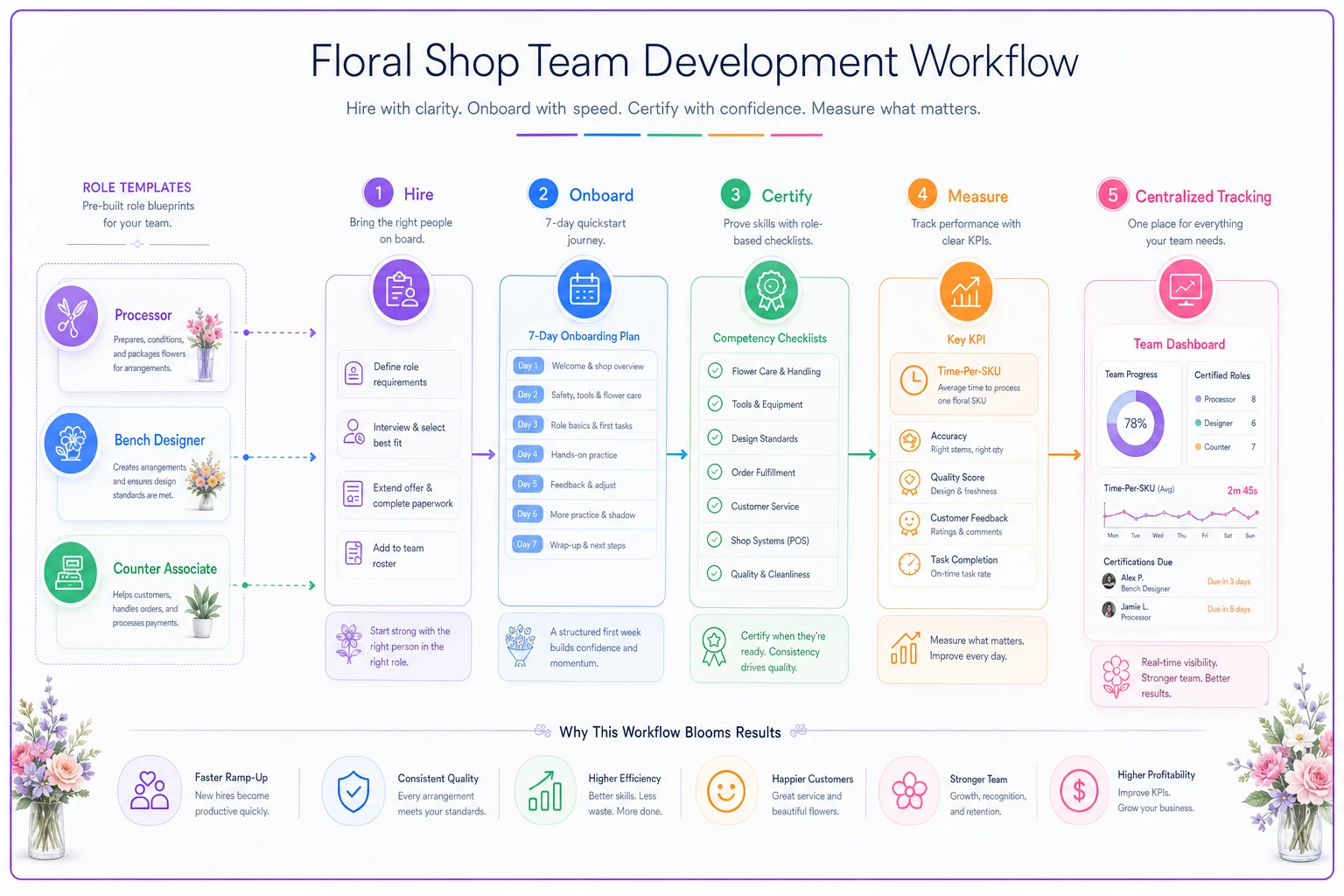
Role templates define the work. The quickstart ramps the person. The checklist certifies them. The KPIs tell you whether any of it worked. Pull one piece out and the rest sags. Skip the checklist and you never get real capacity. Skip the KPI and you can't tell fast from slow. Skip the role template and you're hiring vibes.
This is also where a lot of shops start outgrowing spreadsheets and sticky notes. When you're tracking a handful of people across role templates, ramp progress, competency sign-offs, and time-per-SKU by season, keeping it all in your head stops working. Some shops move this into a shared workflow or operations platform so ramp plans, checklists, and per-person KPIs live in one place instead of scattered across a manager's memory and a notebook by the cooler. Whether that's software or a very disciplined binder matters less than the fact that the information is centralized and repeatable — because the whole value of a system is that it survives the day your best person calls in sick during peak.
A real scenario
A three-person shop doing roughly $28k–$34k a month kept losing seasonal help mid-peak and eating the cost of retraining. Their onboarding was entirely verbal — the owner showed people the ropes between customers. New hires were taking six to seven weeks to reach dependable bench output, and two of the last three quit before they got there.
They did three things. Wrote a one-page role template for the bench-designer position. Built a 7-day quickstart around processing plus two standard SKUs. Added a short competency checklist tied to their existing assembly-time standard.
The next hire hit solo-trusted status on processing and standard bouquets in about two and a half weeks instead of six-plus. Rework on that person's orders dropped noticeably once the checklist forced a real "spec accuracy before speed" phase. When Valentine's hit, they ran two temps against a stripped-down two-SKU role and knew going in that each temp was doing roughly half a trained designer's output — so they staffed accordingly instead of guessing and panicking. Nothing dramatic. Fewer errors, faster ramps, and a season that didn't feel like it was being held together with tape.
When this is worth it — and when it isn't
If you're a true solo operation with no plans to hire, skip most of this. A role template for one person you already are is busywork.
The moment it starts paying off is when you're bringing on your first hire, because that's the point where "it's all in my head" becomes an actual liability. It's also genuinely worth the effort if you hire seasonally every year. The upfront work of building templates and quickstart plans amortizes across every peak — you build it once and reuse it every Valentine's and Mother's Day. Shops that hire the same kind of temp repeatedly and don't systematize it are paying the ramp cost fresh every single time.
Where it goes wrong: don't over-engineer it. A tiny shop does not need a 12-page onboarding manual, a formal performance-review cycle, or an HR platform built for 200 employees. The whole point is right-sized structure — enough to make hiring repeatable and capacity real, not so much that maintaining the system becomes its own second job. If your checklist has more than around 10 items or your quickstart plan reads like a corporate handbook, you've overshot for a team this size.
Shops that get this right treat hiring as an operations problem, not a personality search. They know exactly what they're hiring for, they can get someone useful within a week, they know when to hand over the keys, and they measure whether the person is actually hitting the numbers the business needs. That's the difference between a team that scales and a shop that's permanently one resignation away from starting over.
Ready to grow your flower shop business?
Join 500+ flower shops using Blomsly to save time, reduce errors, and delight customers with fresh blooms.