


The jump from two stores to five is where most florist owners realize that "just open another one" was never really a plan. The second store works because you're still physically bouncing between both, holding the whole operation in your head. The third store is where your head stops being enough. By the fourth and fifth, the shops start quietly drifting into five different companies that happen to share a logo.
The question that actually matters isn't "should I centralize?" It's "which functions should I centralize, and at what store count does keeping them local start costing me money?" Those answers are different for buying, design, delivery, pricing, and inventory. Get the sequence wrong and you either strangle your best store manager with corporate rules way too early, or you let spoilage and double-sells compound across locations until the whole thing feels unmanageable.
What follows is a governance ladder — a 12-month view of what to pull toward the center and what to leave alone, built around the specific failure points that show up as flower shops scale.
Why multi-location florist operations break differently than other retail
Most multi-store playbooks come from businesses selling non-perishable, predictable goods. Flowers break every one of those assumptions. Your inventory loses value by the hour. Demand spikes around dates that don't move but can double or triple volume overnight. And the "product" is assembled by hand, differently, by different people, in each store.
-
Inventory that can't wait. A slow-moving SKU in Store A is dying while Store B is stocked out of the same thing. In non-perishable retail that's an annoyance. In flowers it's margin evaporating in real time.
-
Pricing drift. Store managers quote weddings and sympathy work off gut feel. At one store that's manageable. Across five, you end up with the same arrangement priced three different ways, and customers notice.
-
Design inconsistency. The "signature" bouquet looks different depending on which designer is on. A customer who loved your work at the downtown shop feels let down by the suburban one.
-
Duplicate buying. Each store calls the same supplier independently, nobody hits volume breaks, and you're paying small-order pricing five times over.
The instinct is to centralize everything at once to "get control." That's usually the mistake. Centralizing design too early kills the local responsiveness that made each store work. Centralizing nothing means waste and double-sells quietly bleed you. The art is in the sequencing.
If you haven't nailed down whether you're even ready for store number three, the florist growth decision framework for single-location shop owners is worth running through first — a lot of multi-location pain is really a readiness problem wearing a scaling costume.
The centralize-vs-localize map
Before the month-by-month ladder, here's the general rule of what tends to belong where. Think of "centralize" as "one shared standard and one owner," and "localize" as "the store manager decides."
Never miss a bloom or a delivery.
Blomsly helps you manage orders, track stock, and schedule deliveries effortlessly.
- Unified order management
- Real-time inventory tracking
- Delivery scheduling & notifications
No credit card required
| Function | Default at 2 stores | Default at 5 stores | Why it moves (or doesn't) |
|---|---|---|---|
| Purchasing / PO rules | Local, loosely coordinated | Centralized sourcing, shared PO rules | Volume breaks + consistent quality only work with one buying standard |
| Pricing & quoting | Local | Centralized price book, local approval for exceptions | Drift becomes visible to customers and erodes margin |
| Core recipe / signature SKUs | Shared recipes, local execution | Centralized recipes, enforced | Brand consistency becomes the product |
| Seasonal / local one-offs | Local | Local | Responsiveness is the whole point |
| Inventory & transfers | Local | Centralized visibility, rule-based transfers | Perishability demands cross-store rebalancing |
| Delivery routing | Local | Local routing, shared zone rules | Geography is inherently local |
| Hiring & pay bands | Local | Centralized bands, local hiring | Fairness and retention at scale |
| Marketing / promos | Local | Shared calendar, local execution | Channel caps prevent cross-store stockouts |
Notice that almost nothing is "fully centralized" — even at five stores, execution stays local. What centralizes is the standard and the data, not the daily decisions on the floor.
The 12-month governance ladder
The timeline below assumes you're entering the year with two functioning stores and planning to reach four or five by month twelve. Adjust the pace to your actual openings — the sequence matters more than the calendar.
Months 1–3: Lock the foundation while you still have only two stores
This is the window everyone skips, and it's the most important one. You have enough complexity to see the problems but few enough stores to fix them without it turning into a project.
-
Standardize your PO structure across both stores. Not centralized buying yet — just the same PO format, the same SKU codes, the same reorder cadence by perishability class. If one store calls a product "garden roses – assorted" and the other calls it "DR-ASST-07," you'll never get clean cross-store data later. Getting your perishability-matched PO templates consistent now saves enormous cleanup work at store four.
-
Build the shared price book. Every core SKU, every standard wedding/sympathy tier, one price. Managers can still flag local exceptions, but the default is the book.
-
Write down the signature recipes. The 15–25 arrangements that define your brand. Stem counts, substitution rules, the look. These become the thing you enforce later.
-
Set the data standard. Decide now how orders, inventory, and spoilage get recorded identically in both stores.
You're not centralizing anything yet. You're making the two stores speak the same language so that centralizing later is a policy change, not a rebuild.
Months 4–6: Introduce shared purchasing and transfer rules
Around the time you're opening or stabilizing store three, buying becomes the first real centralization win.
Consolidate your standing orders through one buyer or one shared process. The goal is hitting volume breaks and getting consistent quality grading across stores. You don't have to force every spot-buy through the center — local managers should still grab a deal on peonies when they see one — but the recurring backbone gets centralized.
This is also when inter-store transfer rules earn their keep. Without rules, transfers either never happen (managers hoard their stock) or happen chaotically (someone drives roses across town for a single order). A workable transfer template looks like:
-
Trigger Store A projects surplus of a perishable SKU (more than X days to sell-through at current pace) while Store B is below safety stock.
-
Approval Automatic under a set dollar/stem threshold; manager sign-off above it.
-
Logistics Piggyback on existing delivery routes — never a dedicated trip for a small transfer.
-
Accounting Transfer at cost, logged against both stores so neither manager gets punished for giving up stock.
That last point is the one owners miss most often. If a transfer dings the giving store's numbers, managers stop cooperating and you're back to islands. Make transfers cost-neutral to the people doing them.
Make transfers cost-neutral to the people doing them.
Months 7–9: SKU split rules and the design standard
Now you've got three or four stores and the assortment question gets sharp. Which SKUs should every store carry identically, and which should flex by location?
-
Core (centralized) The signature recipes and everyday bestsellers. Identical everywhere. These carry your brand and your margin.
-
Regional (semi-local) Products that sell differently by neighborhood — a sympathy-heavy store near a hospital, a trendy store in a younger area. The center approves the option list; managers choose their mix.
-
Local one-offs (fully local) Seasonal grabs, local-grower specials, event overflow. No central approval needed.
The mistake people make here is trying to make the regional tier identical "for simplicity." You lose the whole advantage of being local. The downtown and suburban stores should carry different mixes — that's a feature, not a bug. What they shouldn't do is price or build the core tier differently.
This is also the quarter to enforce design consistency on the core tier. Not creativity-killing — just the 15–25 signature arrangements built to the same recipe everywhere. A customer should get the same thing at any of your stores. Everything outside the core stays a designer's playground.
Months 10–12: S&OP cadence and KPI gates
By now you're running four or five stores, and the thing that keeps them aligned is a rhythm, not more rules. This is where a sales & operations planning (S&OP) cadence comes in — a recurring meeting and shared dataset that keeps buying, inventory, and demand in sync across stores.
-
Weekly (per store) Spoilage, stockouts, sell-through on core SKUs, double-sell incidents.
-
Biweekly (all stores) Transfer activity, supplier fill rates, price exceptions granted.
-
Monthly (owner + managers) Demand forecast vs. actual, upcoming peak prep, assortment tier adjustments.
The forecasting and replenishment side of this gets heavy fast once you're coordinating multiple stores. Blending standing orders with spot buys across locations is the difference between smooth peaks and panic. Your peak-season operations playbook becomes a multi-store document at this point — staffing, prebuilt SKUs, and supplier contingencies all have to be coordinated, not improvised store by store.
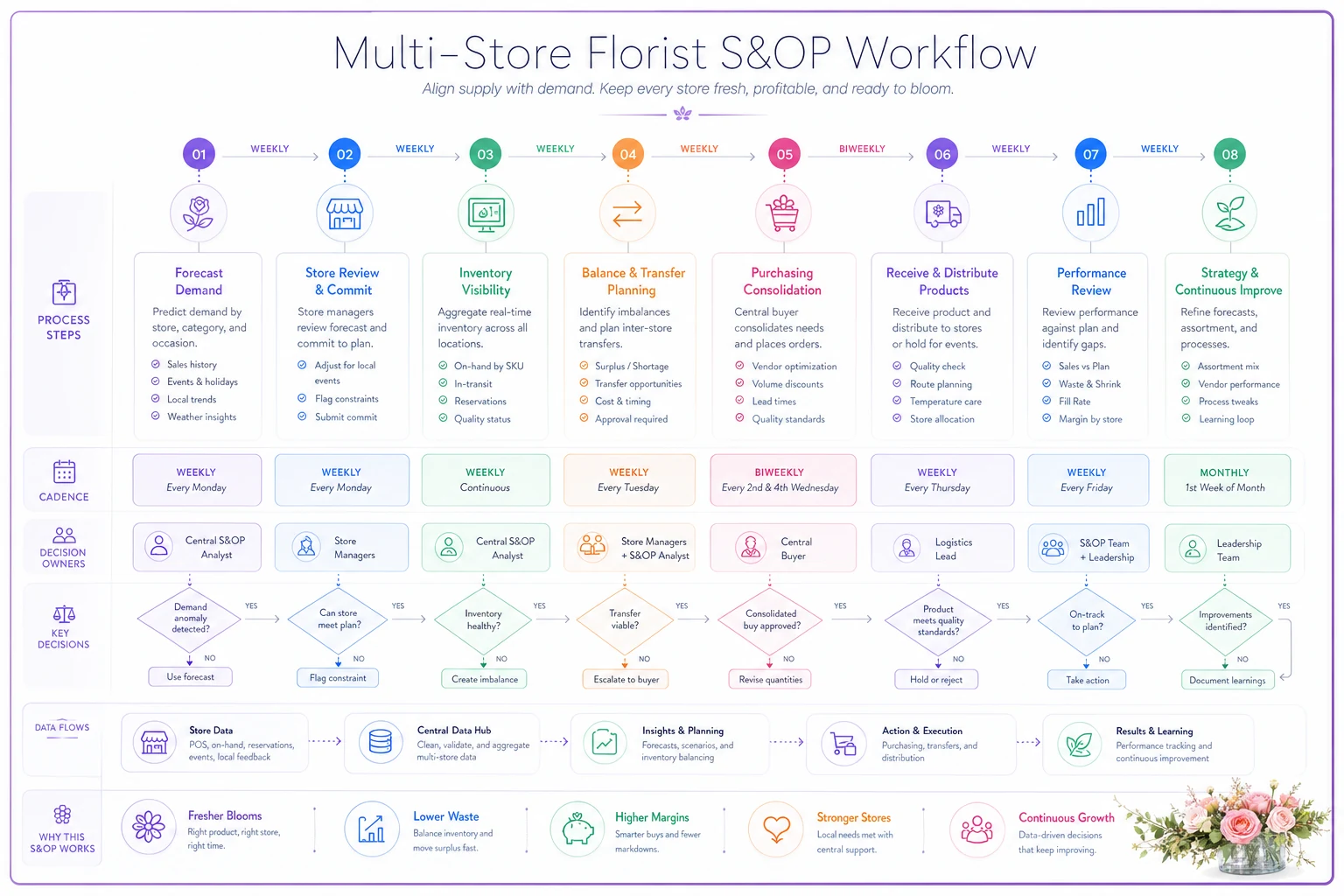
This diagram shows the S&OP rhythm and where transfer and purchasing triggers fire across stores.
KPI gates: how to decide what to centralize next
Don't centralize on a calendar. Centralize when the numbers cross a line. These are the gates worth watching:
-
Spoilage gate If combined spoilage across stores creeps past roughly 8–12% of cost, your inventory visibility and transfer rules aren't working — centralize inventory data before anything else.
-
Price-drift gate If more than around 15% of quotes on core products deviate from the price book, centralize pricing approval.
-
Supplier-cost gate If stores are buying the same SKUs at meaningfully different costs, centralize purchasing — you're leaving volume-break money on the table.
-
Consistency-complaint gate If customers mention inconsistency between locations more than occasionally, tighten the core design standard.
-
Double-sell gate If cross-channel or cross-store double-sells happen more than once or twice a month, you've outgrown siloed inventory and need shared visibility.
The discipline is in not centralizing a function until it trips a gate. Early centralization feels like control but usually just adds overhead and slows your best managers down.
A realistic scenario: three stores, drowning in duplicate buying
A regional florist with three locations — two suburban, one downtown — hit the classic wall around their third store's first full year. Each manager bought independently. Combined, they were running spoilage somewhere in the 14–16% range because Store A regularly tossed stock that Store C had been stocked out of the week before. Supplier costs varied by store because nobody hit volume tiers. And there'd been a handful of embarrassing sympathy orders double-sold between the downtown walk-in counter and the shared phone line.
They didn't centralize everything. They did three things over about four months: standardized SKU codes and the PO format across all three, introduced a cost-neutral transfer rule that piggybacked on existing delivery routes, and moved recurring buying to one shared process while leaving spot-buys local.
The results weren't dramatic overnight, but they compounded. Spoilage settled into the 9–10% range within a couple of months. Consolidated buying pulled a noticeable chunk off their flower cost — roughly the margin of a slow week, recovered every month. The double-sells mostly stopped once inventory was visible across the counter and the phone line. No new hires, no software overhaul — just shared rules and shared visibility.
When centralizing is actually a bad idea
A few situations where pulling things to the center backfires:
-
You centralize design before buying. If your core recipes are enforced but each store still buys independently, you'll enforce a recipe nobody can source consistently. Buying comes first.
-
Your stores serve genuinely different markets. A store in a wealthy wedding corridor and one next to a hospital shouldn't carry the same assortment. Over-centralizing kills the fit.
-
You're centralizing to compensate for a weak manager. Rules don't fix a manager who can't run a floor. You'll just build a bureaucracy around the problem.
-
You haven't standardized your data yet. Centralizing decisions without clean, comparable data across stores means you're making worse decisions faster.
Centralizing decisions without clean, comparable data across stores means you're making worse decisions faster.
Where software quietly earns its place
None of the above requires software to start. You can run shared PO rules, a price book, and transfer logic on spreadsheets and discipline — at three stores. The reason owners reach for an operational platform around store four or five is coordination load: keeping inventory visible across locations in real time, flagging transfer opportunities before stock dies, catching price exceptions automatically, and running the S&OP numbers without someone rebuilding reports by hand every week.
That's the honest role of AI-assisted operational software here — not replacing judgment, but handling the cross-store visibility and the repetitive checks that human managers simply can't track across five locations at once. When inventory, orders, and buying all live in one system, the transfer triggers and double-sell alerts you'd otherwise miss just surface on their own. The managers still make the calls; the system just makes sure they're seeing the whole picture.
The through-line
Scaling from two to five stores isn't about control — it's about sequencing. Standardize language first, centralize buying and inventory visibility second, enforce the core design and pricing third, and let a steady S&OP rhythm keep it all aligned. Watch the gates, not the calendar. And protect the local responsiveness that made each store work in the first place.
The shops that scale well aren't the ones with the most centralized rules. They're the ones that know exactly which three or four functions belong at the center and have the discipline to leave everything else alone.
Ready to grow your flower shop business?
Join 500+ flower shops using Blomsly to save time, reduce errors, and delight customers with fresh blooms.