



Most single-location florists don't struggle because they can't grow. They struggle because they grow into the wrong shape. A shop pulling roughly $400k–$550k a year decides to "expand," opens a second location or chases every wholesale lead that walks in, and eighteen months later the owner is working more hours for thinner margins and a fuzzier picture of where the money actually comes from.
The problem isn't ambition. It's that growth decisions get made emotionally — a slow month, a competitor closing, a landlord offering a "great deal" on the space next door — instead of being run through actual gates. The gates aren't complicated either. They're unit economics, staffing capacity, and a willingness to kill a channel that isn't working before it drains a year of profit.
This is the piece you come back to when you're staring at a growth decision and don't want to wing it. Not tips. A framework for choosing a path and knowing, month by month, whether to keep going or stop.
Why growth decisions break for florists specifically
Flowers are perishable, demand is spiky, and margins vary wildly by channel. That combination punishes vague expansion in ways other retail doesn't. A boutique that chases wire-service volume or events without understanding per-order economics can grow revenue 30% and lose money doing it.
The pattern that keeps showing up: a shop's retail walk-in and web business throws off healthy contribution margin — call it 55–65% after COGS and direct labor on a good bouquet. Then the owner adds a channel that feels like growth (heavy wire service, deep-discount grocery-style volume, or a subscription box that wasn't priced right) and that channel runs at 20–30% contribution. Blended margin drops, but revenue is up, so it looks fine on the top line. The bank account tells a different story a few quarters later.
The core insight: you don't have one business, you have a portfolio of channels, each with its own P&L. Growth is really a channel-mix decision. Once you see it that way, the whole thing gets more manageable — and it's exactly why an omnichannel channel-allocation approach matters before you scale anything.
The three growth paths, and who each one actually fits
Almost every single-location owner is really choosing between three paths. Not ten. Three.
Never miss a bloom or a delivery.
Blomsly helps you manage orders, track stock, and schedule deliveries effortlessly.
- Unified order management
- Real-time inventory tracking
- Delivery scheduling & notifications
No credit card required
-
Diversify — add channels or services (events, corporate accounts, subscriptions, workshops) within your existing footprint and team.
-
Franchise / multi-unit — replicate the model in a second location or license it.
-
Stay boutique — deliberately cap size, raise prices, and optimize margin per order rather than volume.
Each has completely different capital needs, staffing math, and failure modes. Choosing wrong isn't fatal, but choosing wrong and not measuring usually is.
Quick comparison of the three paths
| Path | Best when | Capital needed | Main risk | Margin trajectory |
|---|---|---|---|---|
| Diversify | You have designer capacity and slow weekday periods to fill | Low–moderate | Channel dilution, spreading team thin | Blended margin can drop if new channels aren't priced right |
| Franchise / 2nd unit | Model is documented, first location runs without you daily | High | Fixed costs double before revenue does | Temporary margin hit for 12–18 months |
| Stay boutique | Strong brand, loyal repeat base, premium pricing power | Very low | Ceiling on total profit, key-person dependency | High and stable if managed |
The "best when" column is really just a capacity and readiness test. If your first location can't run for two weeks without you, you have no business franchising, no matter how clean the numbers look on paper.
Gate 1: Unit economics before anything else
Before you pick a path, you need clean per-channel contribution margin. Not gross revenue. Not "we did $12k in events last month." What did an average event order actually contribute after flowers, labor to build it, delivery, and any wire or platform fees?
A typical breakdown for a mid-size shop, per channel:
-
Retail walk-in bouquet avg ticket ~$68, COGS ~$24, direct labor ~$9 → contribution ~$35 (about 51%)
-
Web/local delivery avg ticket ~$85, COGS ~$30, labor ~$11, delivery ~$8 → contribution ~$36 (about 42%)
-
Wire-service inbound avg ~$65, but after wire fees, clearinghouse cuts, and filler substitutions, real contribution often lands ~$14–18 (roughly 22–27%)
-
Corporate weekly accounts avg ~$140/week per account, batched builds, contribution ~$70 (about 50%, and predictable — which matters more than the percentage)
-
Events/weddings avg $2,200, but contribution swings from 15% to 45% depending on how tightly you scope labor
The thing most owners miss: predictability is worth a margin discount. A corporate account at 50% contribution that reorders every single week is often better than a walk-in mix at 55% that vanishes for three weeks in February. When you're evaluating a growth path, weight the stability of the contribution, not just the percentage. The recurring, batched nature of corporate work is exactly why winning and operationalizing local corporate accounts tends to be the lowest-risk diversification move for a boutique shop.
Gate 2: Staffing capacity is the real ceiling
Money constraints get all the attention. Staffing capacity is what actually stops most florist growth.
Run this simple math before committing to any path. Take your current designer hours available per week and subtract what's already committed to existing channels. What's left is your true capacity for growth. If a designer builds retail and web orders for 30 of their 38 usable hours, you have 8 hours a week to spend on a new channel. A single mid-size wedding can eat all 8 and then some.
-
Total productive designer hours per week (not scheduled hours — productive ones, usually 75–80% of scheduled).
-
Subtract hours locked into current committed channels at current volume.
-
Divide remaining hours by the average build time of the new channel's orders.
-
That's your realistic added-order ceiling per week before you hire.
-
If the growth path requires exceeding that ceiling, the path now includes a hire — add that fully-loaded cost into the unit economics from Gate 1.
Here's a quick visual workflow for that staffing-capacity check.
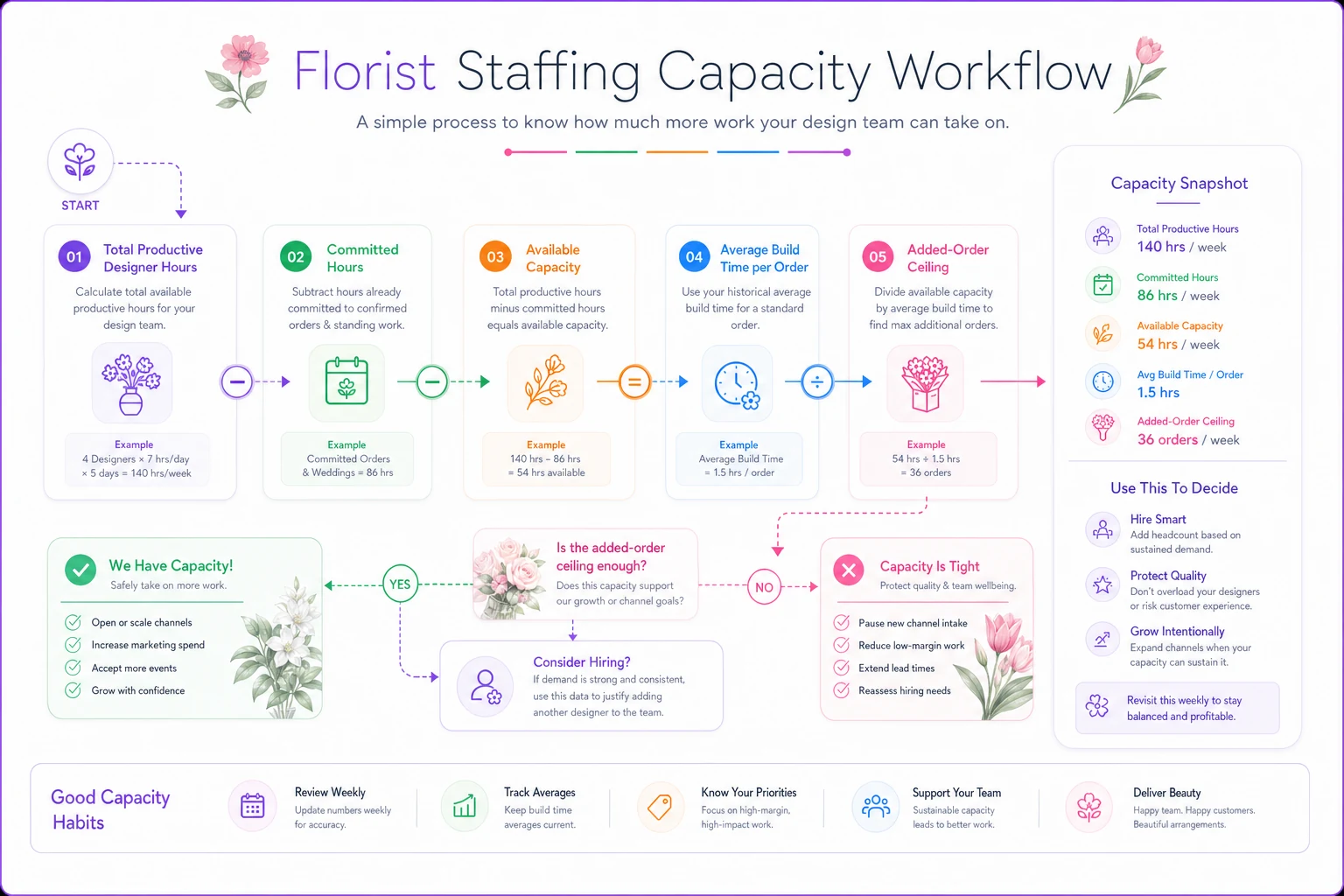
If a designer is routinely over ~85% utilized, run a focused time-and-error audit for one week to identify quick process fixes before hiring.
Where this breaks in real shops: owners plan growth off revenue targets and quietly assume the existing team will "find a way." For a few weeks they do — through overtime and rushed builds. Then quality drops, a wedding goes sideways, and the growth channel gets blamed when the real problem was capacity math nobody did.
Worth naming specifically: the moment you push your best designer past roughly 90% utilization, your error rate on everything climbs — not just the new work. Capacity isn't linear. The last 10% of a person's time is where mistakes live.
Gate 3: Channel-level P&L triggers
Every channel you run or add should have written go/no-go triggers before you start. This is the part almost nobody does, and it's the difference between a disciplined test and an open-ended money leak.
A trigger is a specific number that forces a decision. Examples:
-
Contribution floor "If this channel's contribution margin sits below 30% for two consecutive months, we stop or re-price."
-
Capacity trigger "If this channel pushes total designer utilization above 88%, we pause new orders or hire."
-
Concentration trigger "No single channel exceeds 40% of monthly revenue without an owner review." (Wire service and one big corporate client are the classic concentration traps.)
-
Cash trigger "If the channel hasn't turned contribution-positive within X months, we stop."
Without written triggers, you evaluate channels emotionally. A struggling channel gets excuses — "it's seasonal," "it'll pick up" — instead of a number. With a written trigger, the decision is already made. You just execute it.
Worked examples: running each path through the gates
Take a shop doing roughly $480k/year, one location, owner plus two full-time designers and a part-timer.
Path A — Diversify (add corporate + subscriptions)
The owner has roughly 10 productive designer hours/week of slack in off-peak weeks. They add corporate weekly accounts and a small subscription program.
-
Target
6 corporate accounts at ~$140/week → ~$840/week revenue, ~$420/week contribution.
-
Subscription pilot
25 members at $55/month → ~$1,375/month, contribution ~$620 after flowers and build.
Added annual contribution: roughly $22k (corporate) + $7k (subscription) ≈ $29k, with modest capital outlay.
The risk here is subscription pricing and churn, which is exactly why you run a low-risk subscription pilot that proves the unit economics before scaling to hundreds of members. Diversify wins when you have genuine slack capacity and want to smooth revenue without doubling fixed costs.
Path B — Franchise / second location
Second location: rent ~$3,500/month, one manager-designer at ~$52k, buildout amortized. New fixed costs land around $9k–$11k/month before the doors open on day one.
To break even, the second location needs to clear roughly $180k–$220k in year-one revenue just to cover its own fixed costs and reach the contribution levels of the first shop. Most second locations take 12–18 months to get there. That means the owner is funding a monthly gap — often $4k–$7k/month early on — out of location one's profit.
This path only works if location one already runs profitably without the owner physically present. If the owner is still building bouquets daily at shop one, opening shop two just splits one overworked person across two problems.
Path C — Stay boutique (raise price, cap volume)
Same $480k shop decides not to grow volume. Instead: trim the bottom 15% of low-margin SKUs, raise average ticket from ~$68 to ~$78 through better merchandising and package SKUs, and lean into premium events.
Revenue might stay flat or dip slightly on volume. But blended contribution margin climbs from ~48% toward ~55%. On $480k, that margin shift is worth roughly $34k more annual contribution — with zero new capital, zero new hires, and less operational risk than either other path.
This is the path owners underrate most. Staying boutique and optimizing margin per order frequently beats diversifying, because you're not diluting your best channels or stretching your team. It only fails when a shop uses "stay boutique" as an excuse to avoid fixing pricing and waste — then you get the ceiling and the mediocre margins.
The 12-month test/stop checklist
Whatever path you pick, you're running a test, not making a permanent bet. Here's the cadence to know whether to keep going or pull the plug.
Before you start (month 0):
-
[ ] Written contribution-margin floor for the new channel/path
-
[ ] Capacity ceiling calculated and a hire-trigger defined
-
[ ] Cash-runway limit set ("we fund this gap for no more than X months")
-
[ ] Concentration cap so no channel quietly takes over the business
Months 1–3 (does it work at all?):
-
[ ] Is per-order contribution matching the projection within ~15%?
-
[ ] Is the new work fitting inside capacity, or forcing overtime?
-
[ ] Any spike in errors/late orders on existing channels? (early dilution signal)
Months 4–6 (first real go/no-go):
-
[ ] Contribution above the floor for two consecutive months? If no → stop or re-price.
-
[ ] Trend line up, flat, or down?
-
[ ] Are you still funding a cash gap, and does that match plan?
Months 7–9 (scale or hold):
-
[ ] Consistent enough to justify a hire or more inventory commitment?
-
[ ] Is the channel concentration still within your cap?
Months 10–12 (commit, hold, or kill):
-
[ ] Full-year contribution positive and above floor → commit and systematize
-
[ ] Marginal but improving → hold one more quarter, don't scale yet
-
[ ] Below floor with a flat/declining trend → stop. Redeploy the capacity.
The discipline that matters most is the 4–6 month go/no-go. Shops that lose money on growth almost always had the data to stop at month five and chose not to look at it.
A real scenario
A single-location shop doing about $440k a year got pulled into heavy wire-service volume during a slow stretch. Revenue jumped to roughly $510k over the next year, and the owner felt like the expansion was working.
Wire orders were running at ~24% contribution against her retail mix at ~52%. Because wire filled her designers' time, she'd started turning away — or rushing — higher-margin local delivery orders. Blended margin fell from about 49% to 41%. On the higher revenue, she was actually taking home less than the year before, while working more.
Once she mapped it channel-by-channel, the fix was straightforward: cap inbound wire at ~20% of designer hours, protect local delivery capacity, and set a contribution floor. Within two quarters, revenue settled around $475k — lower than the peak — but her take-home recovered and then some, because the mix was healthier. Less revenue, more profit. That's the whole game.
When each path is a bad idea
Don't diversify if your existing channels are already running your team past 90% utilization. You'll import mistakes into the new channel and export them back into your core work.
Don't franchise if location one still depends on you being physically there most days, or if you can't fund a $4k–$7k monthly gap for over a year without stress. A second location magnifies whatever's undocumented about the first.
Don't stay boutique as a default just because change is uncomfortable. If you're capping volume and leaving obvious pricing and waste money on the table, you've chosen the ceiling without earning the margins that make boutique worth it.
Pulling it together
There isn't a "best" growth path. It's about running whichever path you pick through three honest gates — unit economics, staffing capacity, written P&L triggers — and then treating the next twelve months as a test with a real stop button.
Most owners already have the numbers they need. They just live in scattered spreadsheets, POS exports, and gut feel. The shops that grow well keep per-channel contribution and designer capacity visible enough to make a cold go/no-go call at month five — instead of discovering at month fourteen that a year of growth quietly cost them money. Set the gates first. Let the evidence tell you whether to keep going.
There isn't a "best" growth path. It's about running whichever path you pick through three honest gates — unit economics, staffing capacity, written P&L triggers — and then treating the next twelve months as a test with a real stop button.
Ready to grow your flower shop business?
Join 500+ flower shops using Blomsly to save time, reduce errors, and delight customers with fresh blooms.