


Most shops run every order through the same purchase order format. Same columns, same notes field, same submission rhythm. That works fine when you're ordering paper towels. It falls apart the moment you're ordering something that dies.
Why one PO template can't handle stems, greens, and hard goods at the same time
A rose stem, a bunch of eucalyptus, and a box of floral wire have almost nothing in common operationally. They spoil at different rates, arrive on different cadences, and the mistakes that hurt you differ wildly. A missed accessory order costs you an annoying trip to the craft store. A missed stem order costs you a wedding.
Yet the PO you send your supplier treats them identically. That mismatch is where money leaks — over-ordering perishables to "be safe," under-ordering hard goods and paying rush shipping, and creating chaos when a substitution comes in and nobody wrote down what's acceptable.
This post breaks down supplier-facing PO templates and reorder cadence by SKU class, with worked examples for stems, greens, and accessories, plus a weekly ordering checklist you can actually run on a Monday morning.
The three SKU classes actually behave differently
Before getting into the templates, it's worth being direct about how these three groups differ — because the differences drive everything about the PO.
Never miss a bloom or a delivery.
Blomsly helps you manage orders, track stock, and schedule deliveries effortlessly.
- Unified order management
- Real-time inventory tracking
- Delivery scheduling & notifications
No credit card required
| SKU class | Usable life | Reorder cadence | Substitution tolerance | What a mistake costs |
|---|---|---|---|---|
| Stems (roses, tulips, ranunculus) | 4–8 days in shop | 2–3x weekly | Low — customers notice | Dead product or a blown order |
| Greens (eucalyptus, ruscus, salal) | 10–18 days | 1–2x weekly | Medium — flexible | Bulk waste, less visible |
| Accessories (wire, foam, ribbon, vases) | Months to years | Every 2–6 weeks | High — rarely matters | Rush shipping, stockout |
The mistake most shops make is ordering all three on the same weekly rhythm because that's when they "do the ordering." Greens and hard goods don't need that frequency, and stems often need more. You end up with a fridge full of dying product on one shelf and an empty ribbon drawer on the other.
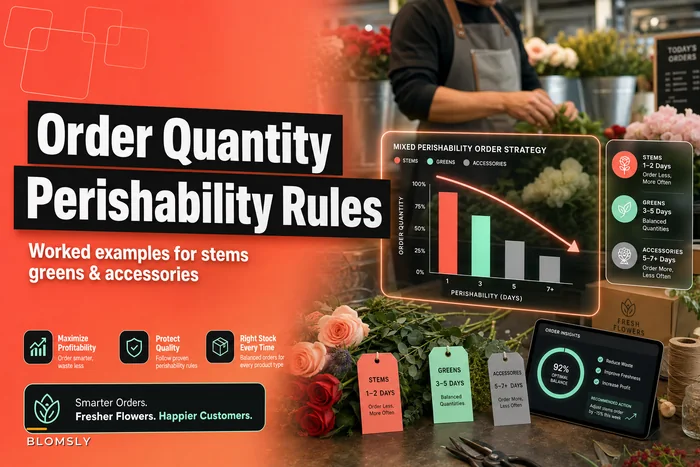
If you haven't already worked out order sizes per class, that's worth solving first — we walked through it in order-quantity rules for mixed-perishability florals. This post assumes you roughly know your quantities and focuses on how to structure the PO and the timing.
What a supplier-facing PO actually needs (that most don't have)
A PO for perishables isn't just a shopping list. It's a set of instructions for what happens when your supplier can't give you exactly what you asked for — which, with fresh product, happens more than most suppliers will admit upfront.
-
Substitution rules baked in per line. Not a blanket "subs OK." A specific rule: "White garden rose — accept Playa Blanca or Alba, do NOT sub spray roses."
-
Grade and stem length minimums. "Roses, 50cm min, no bruised guard petals." Suppliers ship to the loosest interpretation unless you pin it down.
-
Hard need-by date vs. flexible date. Stems for a Saturday wedding are hard. Filler greens are flexible. Marking this tells the supplier where to prioritize when their truck is short.
-
Fill-or-kill flags. For event-critical stems
"If unavailable, call before substituting." For everyday buckets: partial fill is fine.
-
A short-ship credit expectation. State that short-shipped lines get credited, not silently replaced with something else.
The pattern that shows up constantly: shops send a bare item list, the supplier fills gaps with whatever's on the truck, and the designer discovers Tuesday morning that the "roses" are a color that clashes with the whole recipe. Nobody did anything wrong — the PO just didn't say what to do.
The stem PO template
Stems are the highest-stakes, highest-frequency order, so this template carries the most detail.
-
Header fields
-
PO number + submission date
-
Delivery date (marked HARD or FLEX)
-
Split delivery? (some shops split a big order across two drops)
Line item fields:
-
Variety + color
-
Grade / stem length minimum
-
Quantity (in stems, not bunches — bunch counts vary by supplier)
-
Substitution rule (specific, per line)
-
Fill-or-kill flag
-
Tied to event? (event name/date if yes)
> Red rose, Freedom or Explorer, 50cm min, no soft heads — 150 stems — SUB: Hearts or Rhodos OK, no spray — FILL-OR-KILL: partial OK, call if under 100 — EVENT: Morales wedding 11/16
If an event is critical, use a clear FILL-OR-KILL threshold tied to the event's setup window so suppliers know when to escalate.
Cadence for stems: Order 2–3 times a week. The reason isn't just freshness — it's error recovery. If you order Monday and Thursday, a Monday short-ship still has a Thursday order to correct it before the weekend. A single weekly stem order gives you zero recovery window.
The greens PO template
Greens are the forgiving middle child. Longer life, more substitution room — but this is exactly where over-ordering hides because "greens keep."
The trap is that greens seem cheap and durable, so shops over-buy, and then a bunch of ruscus sits in the back cooler browning while everyone assumes it's fine. It's less visible waste than a dead rose, which is precisely why it adds up quietly over time.
Line item fields (lighter than stems):
-
Type
-
Quantity (bunches is fine here)
-
Substitution rule (usually broad — "any comparable filler green")
-
Freshness note if event-tied
> Seeded eucalyptus — 8 bunches — SUB: silver dollar euc OK — general stock, FLEX date
Cadence for greens: Once a week is usually enough, sometimes every 10 days if your volume is low. Because they hold, you don't need the twice-weekly rhythm. The move here is tracking actual usage rather than reordering the same amount out of habit. If you're forecasting demand properly, greens should be one of the easier lines to predict — we covered how to build that system in the demand forecasting systems approach.
The accessories PO template
Accessories are a completely different beast, and treating them like fresh product is where shops waste time and create false urgency.
Wire, foam, tape, ribbon, vases, picks, water tubes — none of it spoils. None of it needs substitution logic. None of it needs a delivery-date priority flag. What it needs is a par level and a reorder point, so you're not ordering emotionally ("we're kind of low on foam") or discovering an empty box mid-arrangement on your busiest day.
Line item fields:
-
Item + SKU/model
-
Par level (target on-hand)
-
Reorder point (order when you hit this)
-
Order quantity (case/pack size)
> Floral foam bricks, standard — PAR: 4 cases — REORDER AT: 1 case — ORDER QTY: 3 cases
The whole point is that accessories run on math, not judgment. When the drawer hits the reorder point, you order — regardless of how you feel about it that week. This removes the two accessory failures shops keep repeating: the panic rush-ship at $40 shipping on a $12 item, and the six unopened cases of ribbon tying up cash and shelf space.
Cadence for accessories: Whenever a reorder point trips, batch it into a single monthly-ish order to save on shipping. There's no freshness clock, so consolidate.
When to break your own cadence rules
The templates above are defaults, not laws. A few situations where you should override:
When to order stems more often than usual:
-
Heavy event week with multiple weddings — add a delivery even if it breaks your rhythm
-
A specialty variety with a known supply problem — order early, accept partial
When to order greens less often:
-
Slow season with visible cooler backlog — skip a week, don't reflexively reorder
When accessories cadence doesn't apply: Right before a peak holiday. Don't wait for the reorder point in early February — front-load foam, wire, and vases before Valentine's demand hits and shipping backs up.
The shops that get burned are usually the ones who either never set a cadence (pure chaos) or set one and follow it rigidly straight into a holiday wall. The rules are there to remove daily decisions, not seasonal ones.
A real scenario: the shop that split its cadence
A mid-size shop doing roughly $40k–$50k a month was running one Wednesday order for everything. The pattern: stems were often either short by the weekend or over-ordered "to be safe," greens were browning in the back at a rate they'd stopped noticing, and every few weeks someone ran to the craft store for wire at 8am.
They made three changes. Stems moved to Monday and Thursday orders with per-line substitution rules and event flags. Greens went to a single Tuesday order tracked against actual weekly usage. Accessories got par levels and were pulled off the weekly order entirely, consolidated into a monthly restock.
Over about two months, stem-related waste dropped noticeably — mostly because the twice-weekly rhythm gave them a recovery window on short-ships, and the substitution rules stopped bad subs from arriving unannounced. Greens waste came down once they were reordering against usage instead of habit. The craft-store runs basically stopped. Nothing dramatic on paper, but it freed up somewhere around $2k–$3k a month that had been quietly leaking out.
The point isn't the numbers. The fix wasn't ordering better — it was ordering differently by class.
Your weekly ordering checklist
Run this every Monday morning before you touch the phone or the supplier portal.
-
[ ] Pull this week's event list and flag which stems are HARD need-by
-
[ ] Check the cooler — what stems and greens are still usable from last order?
-
[ ] Build the stem PO with per-line substitution rules and fill-or-kill flags
-
[ ] Confirm stem delivery dates align with event assembly days (not just event dates)
-
[ ] Build the greens PO against actual usage, not last week's number
-
[ ] Check accessory reorder points — anything tripped? Add to the monthly batch or rush only if truly out
-
[ ] Mark any specialty/at-risk varieties to order early
-
[ ] Send stem PO for the first delivery; schedule the second (Thursday) delivery slot
-
[ ] Log short-ships from last week and confirm credits landed
Run this every Monday morning before you touch the phone or the supplier portal.
Putting it into practice
The whole system comes down to one idea: your purchase order should match how fast the product dies. Stems get detailed, frequent, event-aware POs with real substitution rules. Greens get a lighter, weekly PO tracked against usage. Accessories get par levels and a monthly batch, run on math instead of gut feel.
Here's a simple workflow to visualize how the three templates interact.
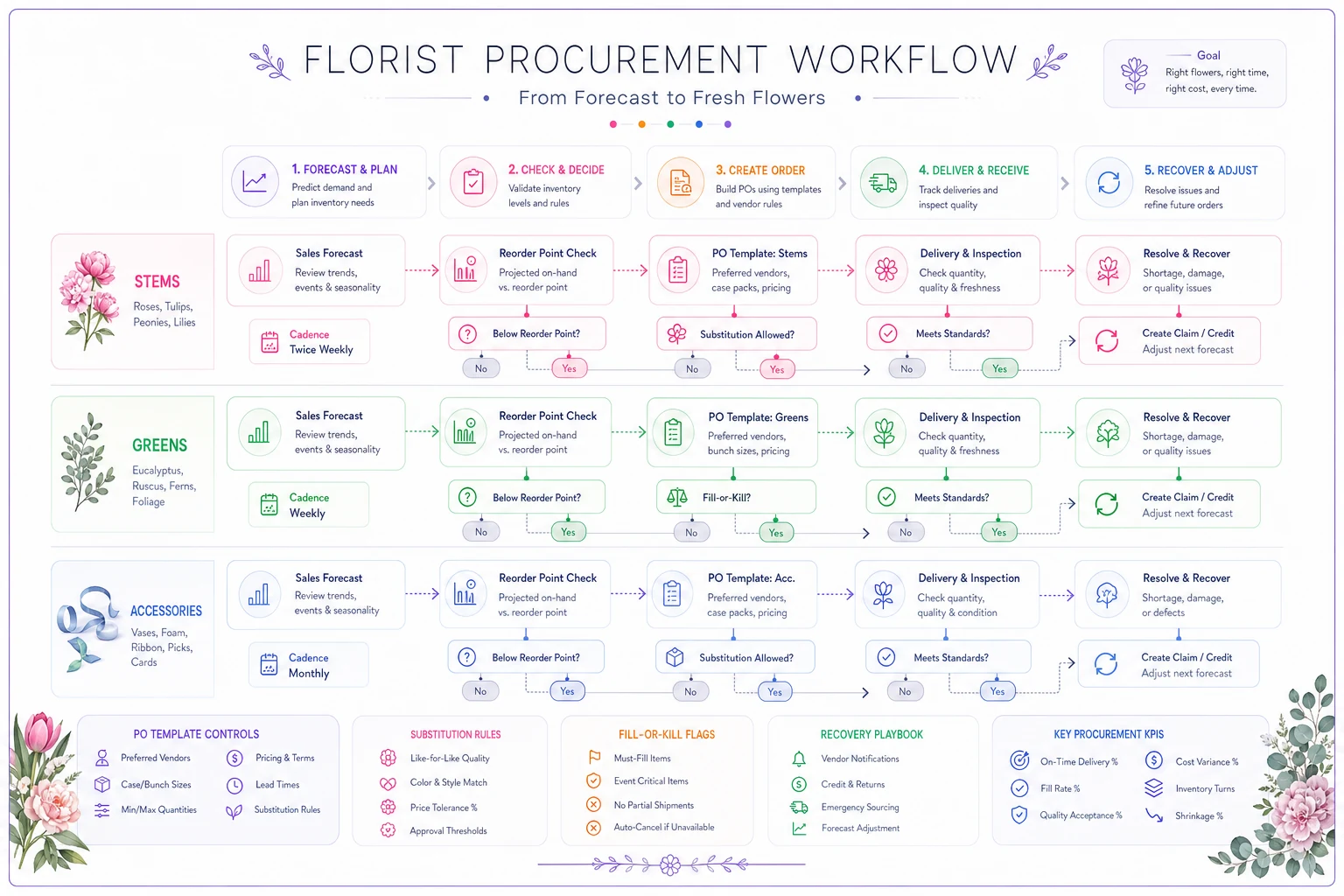
Most shops don't need a fancier tool to fix this — they need three different templates instead of one, and the discipline to run each on its own clock. A good florist purchase order template isn't one document. It's three, each built around a different spoilage curve.
Start by splitting your next order into these three classes and applying the cadence rules above. The Tuesday-morning surprises are usually the first thing to disappear.
Start by splitting your next order into these three classes and applying the cadence rules above. The Tuesday-morning surprises are usually the first thing to disappear.
Ready to grow your flower shop business?
Join 500+ flower shops using Blomsly to save time, reduce errors, and delight customers with fresh blooms.