



Most florists don't have a marketing problem. They have a measurement problem that looks like a marketing problem.
You run Google Ads, boost a few Instagram posts, pay the wire service their monthly cut, slap a sign in the window, maybe sponsor the local 5K. Money goes out across six or seven channels. Orders come in. And when you sit down to figure out what actually paid off, the trail goes cold. The wire service claims credit. Google claims credit. The customer says "I just saw you were nearby." Everyone claims the sale, so nobody really earned it.
That ambiguity isn't harmless. It's the reason florists keep funding channels that quietly lose money while starving the ones doing real work. A legitimate local marketing playbook for florists has to start here — not with tactics, but with a way to decide where the next $500 should go and how you'll know if it worked.
What makes floristry different from almost every other local retail category is perishability. Your inventory dies. That single fact changes how attribution should work, because the timing of a sale matters as much as the sale itself. A bouquet moved on a Tuesday when your cooler is overstocked is worth more than the same bouquet sold on a Friday when you're already slammed. Generic marketing advice ignores this. This playbook won't.
The real reason channel ROI stays invisible
The measurement breakdown in small flower shops almost always comes from the same three places — and they compound each other.
First, orders arrive through channels that don't talk to each other. Phone, walk-in, website, wire service, Instagram DMs, the wedding planner who texts you directly. Each lives in its own silo. When a sale lands, nobody tags where it came from, so your POS shows revenue but not origin.
Second, the channels with the smallest volume are the hardest to judge, and florists have a lot of those. A neighborhood Facebook group might send four orders a month. A funeral home referral might send eight. These low-traffic channels are too small to produce clean numbers, so owners either ignore them entirely or over-weight one good month. Both lead you the wrong direction.
Third, perishability warps the signal. A channel that drives steady weekday orders is operationally more valuable than one that only spikes on holidays — weekday orders help you move product before it wilts. But standard ROI math treats every dollar of revenue the same. It doesn't credit a channel for helping you avoid shrink.
The result is a typical single-location shop spending somewhere around $1,500 to $3,000 a month across channels with no confident answer to "which of these could I cut tomorrow without feeling it?"
Start with stage, not tactics
Before you allocate a single dollar, you need to know what stage your shop is in. The right channel mix for a two-year-old shop fighting for its first 500 customers looks nothing like the mix for an established shop with a solid repeat base. Spending the same way at both stages is how money gets wasted.
Never miss a bloom or a delivery.
Blomsly helps you manage orders, track stock, and schedule deliveries effortlessly.
- Unified order management
- Real-time inventory tracking
- Delivery scheduling & notifications
No credit card required
| Channel | Early stage (building awareness) | Growth stage (filling capacity) | Established (defending base) |
|---|---|---|---|
| Google / local search | 35% | 30% | 20% |
| Instagram / Facebook (organic + boosted) | 25% | 20% | 15% |
| Wire service marketing | 15% | 10% | 5% |
| Referral / partnerships (funeral homes, planners, venues) | 10% | 20% | 25% |
| Repeat / retention (email, SMS, loyalty) | 5% | 15% | 30% |
| Local presence (signage, events, sponsorships) | 10% | 5% | 5% |
The pattern worth noticing: as a shop matures, money should migrate away from paid acquisition and toward retention and referral. Early on you're buying strangers. Later, your cheapest growth is already in your contact list. Shops that are still spending 35% on Google at year six are usually the ones wondering why margins never improve — they're paying acquisition prices for customers they already own.
If your retention channels still look thin after a few years in business, that's a clear signal. Fixing it starts with the groundwork covered in our customer lifecycle playbook to grow repeat sales for local flower shops, which feeds directly into the retention row of this matrix.
When this matrix doesn't apply
If you're heavily dependent on weddings and events, your mix skews toward referral and partnerships at every stage — that's a relationship business, not an impulse business. And if you're in a town small enough that "local search" means forty people, don't force 30% into Google. Put it where the actual humans are: physical presence, word of mouth, community relationships.
Simple attribution rules that survive low traffic
Most florists get this wrong in the same direction: they try to apply high-traffic math to low-traffic channels. You can't run a clean conversion-rate analysis on a channel producing six orders a month. The sample is too small. One good week makes it look like a genius move; one slow week makes it look dead.
So we split attribution into two buckets with two different rules.
For higher-volume channels — Google, website, paid social — use CAC. Total spend on the channel divided by new customers it brought in. If you spent $600 on Google and got roughly 25 new customers, your CAC is around $24. Judge this monthly, and compare it to your average first-order margin. If a new order throws off $30–$40 in gross margin, a $24 CAC is healthy. If it's creeping toward $40, that channel is barely breaking even on the first sale.
For low-traffic channels, ignore CAC and track LTV signals instead. When volume is too thin for reliable CAC, you judge by the quality of the customers the channel sends, not the cost per head. A funeral home referral might send eight orders a month, but if those customers come back for anniversaries and sympathy arrangements, their lifetime value dwarfs a cheap-but-one-and-done Instagram lead.
The practical approach for low-traffic channels:
-
Track each referred customer's second purchase within 12 months (yes/no)
-
Track their average order value compared to your shop average
-
Track whether they needed a discount to convert
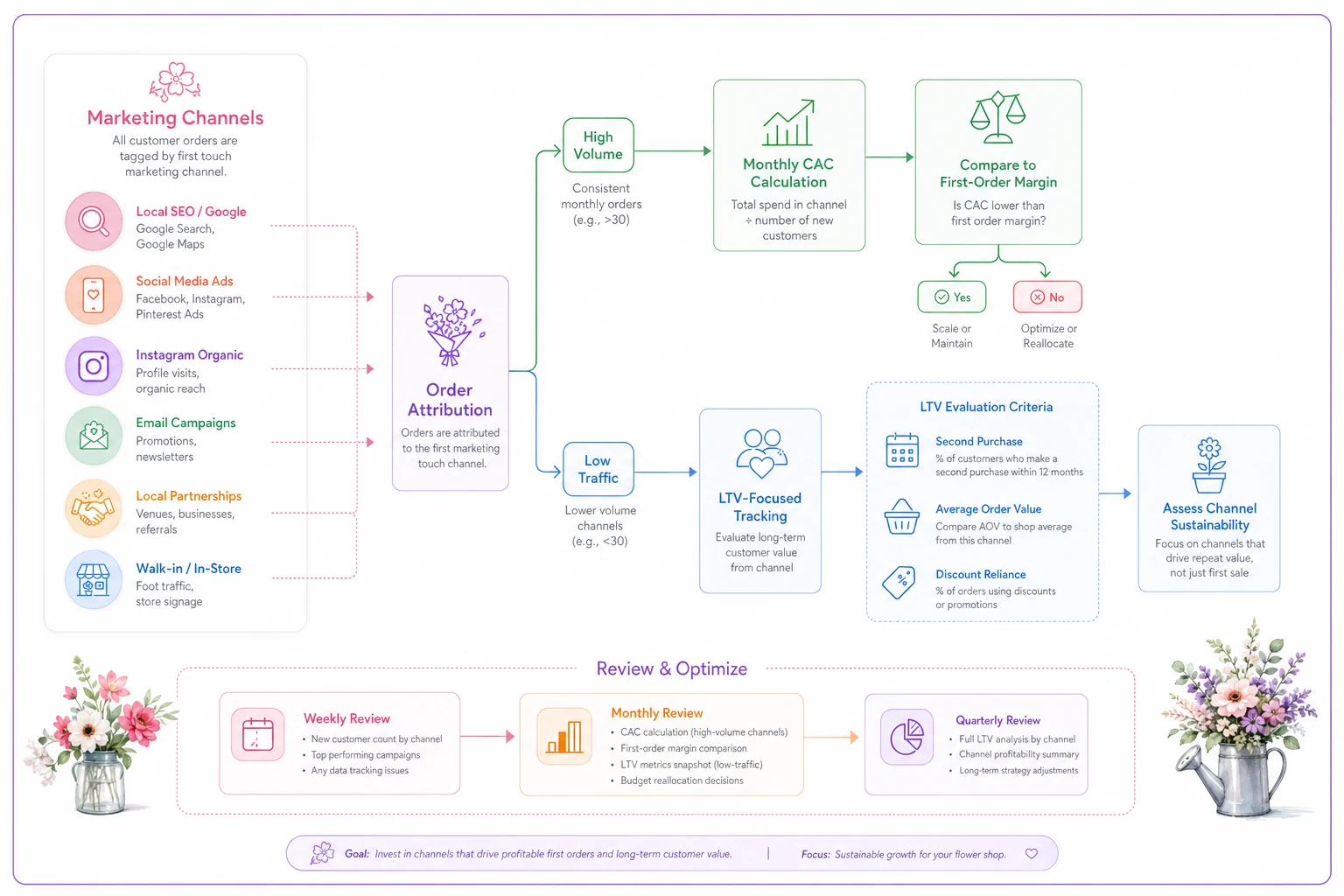
This diagram shows when to use CAC for high-volume channels versus when to track LTV signals for low-traffic sources.
A channel where more than half of customers reorder within a year, at or above your average ticket, without discounting, is worth keeping even at low volume. A channel where almost nobody comes back is a slow leak, no matter how cheap each order looked up front.
The mistake that kills good channels
The most common attribution error isn't being too lax — it's being too impatient. Referral and retention channels pay off on the second and third order, not the first. A shop judging a wedding-venue partnership on month-one revenue will almost always cut it before it matures. Give relationship channels a two-to-three quarter runway before you make a call.
Translating perishable timing into channel rules
This is the part that's genuinely specific to flowers. Your marketing shouldn't just drive sales — it should drive sales at the right time to protect margin. A channel's value changes depending on whether it's moving product when you have surplus or piling orders onto days you're already maxed out.
Think of your week in three timing states:
-
Surplus days — cooler is fuller than demand, shrink risk is climbing
-
Steady days — demand roughly matches capacity
-
Peak / constrained days — you're at or near fulfillment limits
Each channel should have a timing rule attached to it. The goal is to point fast, promotable channels at surplus days, and let steady referral channels run their own rhythm.
-
Surplus days → fire your fast-response channels (email, SMS, Instagram stories) with time-boxed offers to pull demand forward and clear product before it turns. These are the channels you can activate within hours.
-
Steady days → let organic search and standing referrals do the work. No promotion needed; don't spend to generate demand you already have.
-
Peak days → stop promoting on paid channels entirely. Running ads into a day you can't fulfill buys you capacity failures and bad reviews. Spend drops to zero.
That last rule saves more money than almost anything else. Florists tend to advertise harder around holidays when they should often advertise less — the demand is already there, and extra paid spend just inflates CAC on orders you'd have gotten anyway.
When you do run surplus-clearing offers, the discipline matters. You want to move product without stockouts or training customers to wait for deals. The channel-cap approach in our guide on running neighborhood offers without stockouts pairs directly with these timing rules — it keeps a fast promotion from blowing through inventory before the day is done.
Ready-to-use templates
Keep these as simple spreadsheets. Boring and consistent beats elaborate and abandoned — consistency is what makes the numbers trustworthy over time.
Template 1 — Channel scorecard (fill out monthly)
One row per channel:
-
Channel name
-
Spend this month
-
New customers (if trackable)
-
CAC (spend ÷ new customers) — high-volume channels only
-
Reorder rate of its customers — for low-volume channels
-
Average order value vs. shop average
-
Timing role (surplus / steady / peak-silent)
-
Keep / watch / cut
Template 2 — Perishable-timing channel rule sheet
A one-page reference your whole team can see:
-
Surplus trigger when cooler count exceeds X% of forecast demand → fire SMS + email offer within 24 hours
-
Steady state no promotions; monitor only
-
Peak lockout pause all paid acquisition 72 hours before a known peak
Template 3 — Low-traffic channel review (fill out quarterly)
-
List every referral and partnership source
-
Count customers each sent this quarter
-
Of last year's referred customers, how many reordered?
-
Did any require discounting to convert?
-
Decision
nurture / maintain / drop
These channels need patience, so review them four times a year — not monthly:
A measurement cadence you'll actually keep
The best attribution system is the one you don't abandon in March. Most florists build an elaborate spreadsheet, use it twice, and quit. The cadence has to match how much signal each channel actually produces.
Weekly (10 minutes): Check only the fast, timing-sensitive stuff. Did surplus-day offers move product? Did you accidentally run ads into a constrained day? This is operational, not analytical — you're steering, not studying.
Monthly (30–45 minutes): Fill the channel scorecard for high-volume channels. Compare CAC to margin. Shift budget in small increments — never more than 10–15% of a channel's allocation at once, or you lose the ability to tell what caused the change.
Quarterly (1 hour): Run the low-traffic channel review and revisit your stage in the budget matrix. This is where you decide whether it's time to migrate dollars from acquisition toward retention.
Limit budget changes to 10–15% per channel when testing so you can read results.
The rhythm matters because different channels reveal their truth at different speeds. Paid search tells you within a month. A funeral-home referral tells you over a year. Measure each on its own clock.
A real scenario
A single-location shop doing roughly $380k–$420k a year was spending about $2,400 a month across six channels and couldn't say which ones were actually working. They assumed the wire service was carrying them — mostly because the invoices were big and visible.
Two months of origin tagging and a basic scorecard flipped the picture. Google was producing a CAC around $22 against first-order margins near $35 — solid numbers. The wire service, after fees, was netting almost nothing per order: high gross revenue, almost no margin. Meanwhile a quiet referral relationship with two event venues was sending maybe six orders a month, but over 60% of those customers had reordered within the year.
They didn't blow anything up. They trimmed wire-service marketing spend by about a third, moved most of it into email and SMS for retention, and set a hard peak-day lockout on paid ads. Over the following two quarters, total marketing spend dropped slightly while repeat orders climbed. Nothing dramatic month to month — just a steadier, more predictable order flow they weren't overpaying to get.
The change wasn't a new tactic. It was finally being able to see which channels were earning their keep.
Where measurement connects to everything else
Channel ROI doesn't live in isolation. The quality of the destination matters as much as the channel driving traffic to it — a well-performing ad pointing at a weak product page just spends money efficiently on a leak. If your conversion feels off despite decent traffic, the issue may be downstream, which is why the work covered in our piece on occasion-focused floral product templates that convert often moves ROI more than any budget reshuffle.
This is also where scattered systems create real pain. When origin tagging lives in one place, order history in another, and timing decisions in your head, keeping any kind of measurement cadence becomes exhausting fast. Shops that centralize order data — origin, timing, reorder history — in a single operational view find the monthly scorecard takes fifteen minutes instead of an afternoon, because the numbers are already assembled. The tooling itself isn't the point; measurement you can actually do quickly is measurement you'll keep doing. A playbook you abandon by spring protects no margin at all.
Start with one month of honest origin tagging. Judge your big channels on CAC, your small ones on who comes back, and attach a timing rule to each so your marketing works with your cooler instead of against it. That's the whole system — and it's the difference between spending on marketing and actually investing in it.
Ready to grow your flower shop business?
Join 500+ flower shops using Blomsly to save time, reduce errors, and delight customers with fresh blooms.