


Mother's Day morning, 8:47 AM. Three walk-ins waiting, phone ringing constantly, and your newest employee just took an order for "purple roses" that need delivery by noon. Purple roses don't exist, but the order's already in the system, customer's card is charged, and someone has to call back to explain why their specific request is impossible.
This plays out everywhere during peak seasons. Same-day florist workflow breaks down not because people aren't working hard enough, but because rush orders expose every weak spot in your setup. The shops that thrive under pressure have specific systems that catch problems before they multiply.
The rush order breakdown starts earlier than you think
Most florists think their same-day workflow problems start when orders come in. They actually start weeks before, during prep phase.
A shop gets comfortable with regular flow—standard arrangements, predictable delivery windows, familiar customers. Then Valentine's Day approaches. Suddenly you're fielding requests for "something unique with orchids" at 3 PM for 5 PM delivery across town. Your designer stops working on tomorrow's wedding order, your driver breaks their route, and nobody checked if you even have orchids.
The real issue? Your intake process treats all orders identically. A leisurely anniversary arrangement for next week goes through identical steps as a desperate "forgot my wife's birthday" emergency at 4 PM. One needs careful consultation about color preferences. The other needs quick feasibility check and immediate assembly.
An Austin shop restructured their entire intake after losing $4,800 in canceled rush orders one December. They discovered 60% of same-day cancellations happened because staff promised impossible delivery windows just to secure sales. Nobody was checking actual capacity or inventory before saying yes.
Why validation checklists feel like overhead until they save you
Creating intake validation checklists sounds like adding bureaucracy to hectic processes. Shop owners resist because checking boxes feels slower than taking orders. But that "faster" approach costs plenty.
Never miss a bloom or a delivery.
Blomsly helps you manage orders, track stock, and schedule deliveries effortlessly.
- Unified order management
- Real-time inventory tracking
- Delivery scheduling & notifications
No credit card required
Without validation, teams make split-second promises based on optimism rather than reality. "Sure, we can get white peonies by 2 PM!" Meanwhile, your supplier closed at noon, peonies are out of season, and your only driver is loaded with five stops on the other side of town.
Proper validation checklists for rush orders aren't about slowing down—they're about failing fast when orders won't work. The checklist should take under 30 seconds and cover:
Inventory reality check:
-
Is the requested flower/color combo in stock right now?
-
Do we have suitable substitutes ready?
-
Can we source special requests within the time window?
Delivery feasibility scan:
-
Where does this fit in current route planning?
-
Do we have driver capacity in that time slot?
-
Is the delivery address actually serviceable today?
Assembly bandwidth verification:
-
Who's available to build this order?
-
What orders are they currently working on?
-
Can this be done without disrupting confirmed orders?
Place the checklist on a laminated card at each order station so staff can validate orders in seconds.
One shop implemented this through a laminated card at each order station. Their same-day order success rate jumped from 78% to 94% within three weeks. Not because they got faster at fulfilling orders, but because they stopped taking orders they couldn't fulfill.
Prioritization rules that actually reflect floral constraints
Generic priority systems fail in flower shops because they ignore fundamental constraints: flower availability and lifespan. You can't bump orders around like shipping boxes. That wedding centerpiece for tomorrow used specific flowers ordered three days ago. The funeral arrangement needs lilies that won't last if you push delivery to evening.
Real prioritization means understanding three constraint layers most businesses never deal with. Perishability timelines—some arrangements literally can't wait. Flower-specific availability—you might have roses for days but only enough birds of paradise for one arrangement. Designer specialization—not every florist can execute every style equally well.
Priority Level 1: Time-locked orders
-
Funeral arrangements (specific service times)
-
Wedding deliveries (ceremony deadlines)
-
Restaurant/venue orders (event start times)
Priority Level 2: Perishability-sensitive orders
-
Arrangements using flowers at peak freshness
-
Orders with tropical flowers in hot weather
-
Designs requiring specific bloom stages
Priority Level 3: Standard same-day requests
-
Birthday/anniversary surprises
-
Get-well arrangements
-
Thank you bouquets
Priority Level 4: Flexible timeline orders
-
"Anytime today" deliveries
-
Pickup orders with wide windows
-
Corporate/office deliveries
Making these priorities visible to your entire team is crucial. A Dallas flower shop started using colored order tags—red for time-locked, orange for perishability-sensitive, yellow for standard rush, green for flexible. Their fulfillment errors dropped 40% because everyone could see what needed attention first.
Prebuilt assembly packs: the secret weapon nobody talks about
Walk into most flower shops during rush periods and you'll see designers starting every arrangement from scratch. They're picking individual stems, selecting greenery, choosing filler flowers—while the clock ticks toward delivery deadlines. It's like making pasta from flour for every order during dinner rush.
Shops that handle same-day volume without melting down have discovered prebuilt assembly packs. Not premade arrangements (those look generic), but pre-pulled ingredient bundles for common orders.
A Portland shop tracks same-day patterns and preps accordingly:
| Order Type | Pre-pulled Components | Assembly Time | Without Pre-pull |
|---|---|---|---|
| Dozen roses | 12 roses, 6 stems greenery, filler pack, wrap | 3 minutes | 8 minutes |
| Mixed seasonal | 15-stem variety pack, accent flowers, greenery bundle | 5 minutes | 12 minutes |
| Sympathy standard | White/cream flower set, eucalyptus, white ribbon | 7 minutes | 15 minutes |
| Birthday bright | Colorful mix pack, fun filler, birthday pick | 4 minutes | 10 minutes |
These aren't complete arrangements—designers still create unique pieces. But pulling pre-counted rose bundles beats counting stems during rushes. Grabbing "sympathy packs" beats hunting for appropriate whites and creams when three funeral orders arrive simultaneously.
Build these packs during your 7-9 AM prep window, before same-day orders typically surge. You're front-loading mundane assembly parts, leaving designers free to focus on actual design during crunch time.
Cut-off policies that customers understand and staff can enforce
Every flower shop has theoretical cut-off times for same-day delivery. Most customers ignore them. Most staff bend them. Result? A 2 PM cut-off becomes 4 PM scramble that throws off tomorrow's prep and burns out your team.
The problem with most cut-off policies—they're arbitrary rather than operational. "No same-day orders after 2 PM" sounds clear, but what about customers who just need simple wrapped bouquets for pickup? Corporate clients who order weekly? When you're slow and could use revenue?
Effective cut-off policies work because they're built around actual operational constraints, not arbitrary times.
Delivery cut-offs by zone:
-
Zone 1 (within 3 miles)
Orders until 3 PM for same-day
-
Zone 2 (3-7 miles)
Orders until 1 PM for same-day
-
Zone 3 (7-12 miles)
Orders until 11 AM for same-day
Complexity-based cut-offs:
-
Simple wrapped bouquets
Until 4 PM
-
Standard arrangements
Until 2 PM
-
Custom/specific requests
Until 12 PM
-
Wedding/event level
48 hours minimum
Inventory-dependent cut-offs:
-
In-stock arrangements
Standard cut-off applies
-
Special flower requests
Morning of previous day
-
Rare/imported flowers
72 hours notice
Make these policies visible and logical to customers. Post a simple chart by your register. Add it to your website's order page. Train staff to explain the reasoning: "Delivery to that area means our driver needs to leave by 3:30, and your arrangement takes about 45 minutes to create properly."
The compound effect of small delays in floral operations
In most businesses, 15-minute delays are annoying but manageable. In flower shops handling same-day orders, 15 minutes at 10 AM becomes two-hour catastrophe by 2 PM.
Here's the cascade: Your designer spends extra 15 minutes on fussy customer modifications. Now the next three orders start late. The driver waits 10 minutes for those orders to finish. Traffic is heavier, adding 20 minutes to routes. They return late for second delivery run. Meanwhile, afternoon orders pile up, your other designer rushes and makes mistakes requiring rework. By closing time, you're delivering apologies instead of flowers.
This cascade effect is why same-day florist workflow needs built-in buffer time. Not padding (that's waste), but strategic breathing room at known pressure points:
Morning buffer (9-10 AM): Before same-day orders typically surge
-
Complete all prep work
-
Review inventory levels
-
Brief team on special requests
Lunch crunch buffer (12-1 PM): When morning orders need completion
-
Dedicated "catch-up" time
-
No new complex orders accepted
-
Focus on assembly and quality check
Final push buffer (3-4 PM): Before last delivery run
-
Last chance for order modifications
-
Final inventory check for tomorrow
-
Driver route optimization
A Seattle shop built these buffers into their schedule and saw same-day delivery success rates improve from 85% to 96%. They weren't working faster—they prevented pile-ups that make fast work impossible.
When "just this once" exceptions destroy your workflow
Every flower shop knows this customer: calls at 4:45 PM, desperate, promising they'll never ask again if you can just help them out this one time. Your heart says yes. Your workflow says no. Most shops say yes anyway.
The problem isn't single exceptions—it's what exceptions do to operational rhythm. When you break workflow for one rush order, you're not just affecting that order. You're disrupting the designer working on tomorrow's wedding. You're making driver routes inefficient. You're pushing today's prep into tomorrow's time.
The emergency surcharge structure:
-
After standard cut-off
+$25
-
After extended cut-off
+$50
-
Requires special delivery run
+$75
-
Pulls designer from next-day prep
+$40
These aren't punitive—they reflect actual operational costs of breaking workflow. When customers see $75 surcharge for 5 PM orders, they either find it worthwhile (making it profitable for you) or schedule for tomorrow (preserving your workflow).
One shop posts their surcharge structure clearly and saw "emergency" requests drop 60%. Customers started planning better when they understood real costs of last-minute orders.
How AI-powered operational software changes the game
The complexity of same-day flower fulfillment is exactly why operational software enhanced with AI automation makes such a difference. It's not about replacing human judgment—it's handling repetitive checks and coordination that slow humans down during rushes.
During typical same-day orders, someone checks inventory (manually), estimates delivery time (roughly), assigns a designer (whoever's free), and hopes it all comes together. AI-assisted operational platforms can instantly validate inventory against requests, calculate realistic delivery windows based on current routes, and assign orders based on designer strengths and workload.
The real power shows up in pattern recognition. AI systems tracking your operations learn that Tuesday same-day orders spike around 2 PM, certain zip codes always need morning delivery, specific designers work faster on sympathy arrangements. It starts predicting and preparing, not just reacting.
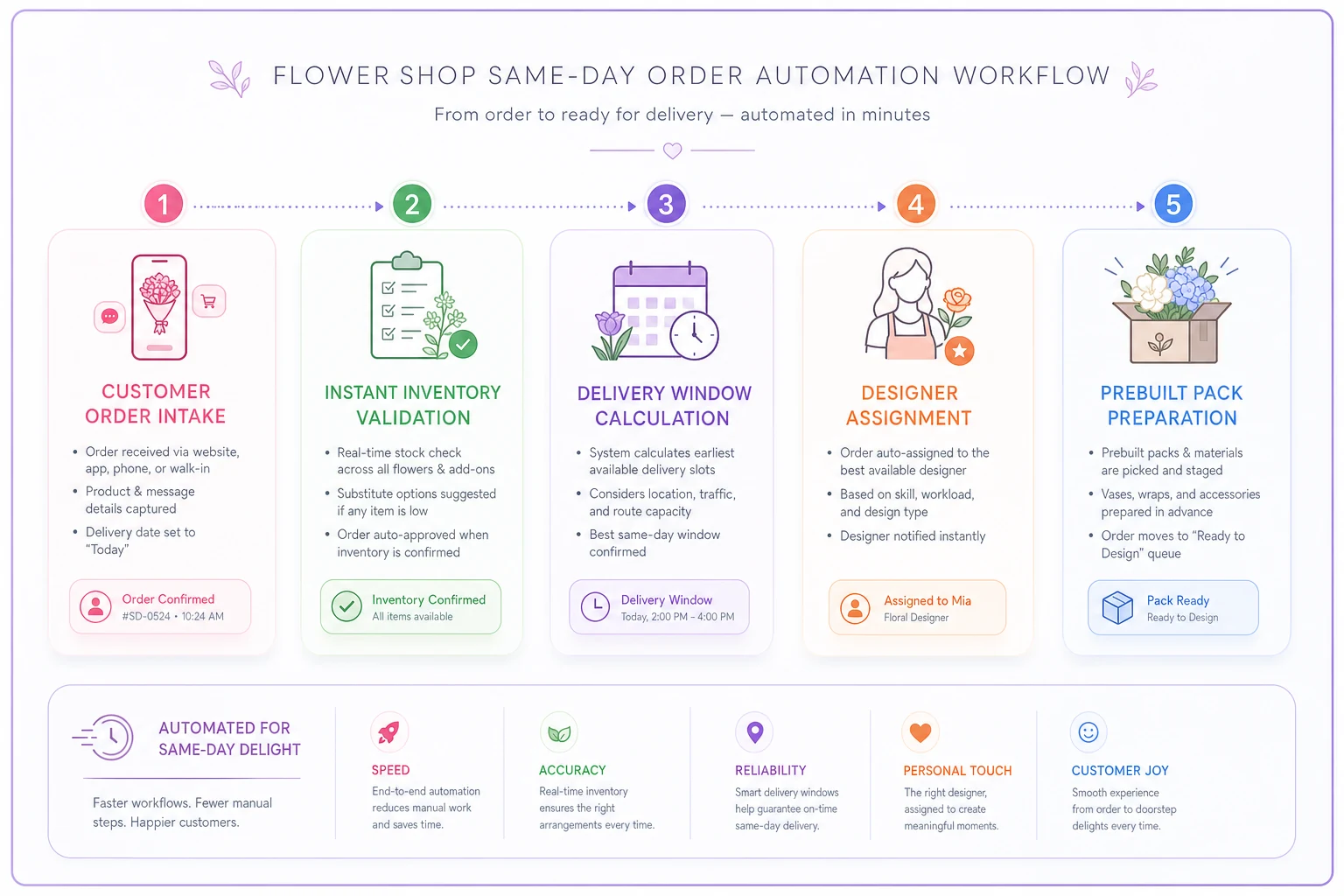
Here's a quick visual of how those operational steps connect in a flow.
A Phoenix flower shop implemented workflow automation and saw immediate improvements. The system automatically flags when order requests exceed current capacity, suggests substitutions based on inventory, and predicts which prebuilt packs to prepare based on historical patterns. Their same-day fulfillment rate increased while staff stress decreased—they weren't rushing anymore because the system prevented overcommitment.
The AI doesn't design arrangements or interact with grieving customers. It handles operational complexity that makes same-day fulfillment feel impossible, freeing your team to do what they do best: create beautiful flowers that brighten people's days.
Building tomorrow's workflow from today's chaos
Same-day orders will always create pressure in flower shops. The difference between shops that thrive and shops that merely survive comes down to systematic preparation rather than heroic effort.
Start with validation checklists—even basic ones prevent more problems than any amount of rushing can solve. Add prioritization rules that reflect actual floral constraints, not generic urgency. Build prebuilt assembly packs for common orders. Set cut-offs that make operational sense and stick to them.
Most importantly, stop treating same-day orders as interruptions to your "real" workflow. They are your workflow, especially during peak seasons. Shops that build systems around this reality are ones whose customers rave about reliability, whose designers don't burn out every Valentine's Day, and whose owners actually enjoy busy seasons that drive revenue.
The choice is straightforward: keep treating every same-day order as crisis to be managed, or build operational structure that turns rush orders into routine fulfillment. One approach leaves you exhausted and error-prone. The other lets you capture more revenue while actually improving customer satisfaction.
Next time someone calls at 2 PM needing flowers by 5 PM, you'll know exactly whether you can fulfill it profitably—or whether that $75 surcharge makes it worthwhile. That's the difference between a flower shop that handles same-day orders and one that masters them.
Same-day orders will always create pressure in flower shops. The difference between shops that thrive and shops that merely survive comes down to systematic preparation rather than heroic effort.
Start with validation checklists—even basic ones prevent more problems than any amount of rushing can solve. Add prioritization rules that reflect actual floral constraints, not generic urgency. Build prebuilt assembly packs for common orders. Set cut-offs that make operational sense and stick to them.
Most importantly, stop treating same-day orders as interruptions to your "real" workflow. They are your workflow, especially during peak seasons. Shops that build systems around this reality are ones whose customers rave about reliability, whose designers don't burn out every Valentine's Day, and whose owners actually enjoy busy seasons that drive revenue.
The choice is straightforward: keep treating every same-day order as crisis to be managed, or build operational structure that turns rush orders into routine fulfillment. One approach leaves you exhausted and error-prone. The other lets you capture more revenue while actually improving customer satisfaction.
Next time someone calls at 2 PM needing flowers by 5 PM, you'll know exactly whether you can fulfill it profitably—or whether that $75 surcharge makes it worthwhile. That's the difference between a flower shop that handles same-day orders and one that masters them.
Ready to grow your flower shop business?
Join 500+ flower shops using Blomsly to save time, reduce errors, and delight customers with fresh blooms.