


Most flower shops that try subscriptions do it backwards. They announce a "Bloom Club" on Instagram, sign up 40 people at a launch discount, and then spend the next three months discovering that half of them churn by month two, delivery days are scattered across the week, and the margin per box is thinner than a single spray rose stem.
By the time the numbers become obvious, you've already committed to weekly buys and told customers this is a permanent offering. Walking it back feels worse than losing money on it.
A floral subscription pilot treats the whole thing like an experiment—defined end date, fixed cohort size, and a decision rule you agree on before you start. The point isn't to grow. The point is to learn whether the economics actually work at a scale small enough that a wrong answer costs you a few hundred dollars instead of a season.
Why most subscription launches fail the math test
The failure pattern is almost always the same, and it has nothing to do with whether customers like flowers.
Subscriptions look profitable on paper because people fixate on recurring revenue and forget that recurring revenue comes with recurring cost. A $55 monthly box sounds great until you account for the stems, the labor to assemble it on a fixed cadence, the packaging, the delivery leg, and payment processing on every renewal. Then subtract the ones who churn after collecting their first discounted box.
In real operations, what kills subscription margin isn't cost per box—it's cadence chaos. When 30 subscribers all pick their own delivery day, you end up running tiny two- and three-stop delivery runs all week, and your designer builds subscription boxes in ones and twos between walk-in orders instead of batching them. You lose the exact efficiency that was supposed to make subscriptions worth doing in the first place.
A pilot forces you to confront both problems—churn and cadence—while the cohort is small enough to actually watch.
Designing the cohort: small enough to fail cheaply
Going too big or too small is the mistake here. A five-person pilot tells you nothing because a single flaky customer swings your entire churn number. A hundred-person launch isn't a pilot—it's a full commitment with a friendlier name.
Never miss a bloom or a delivery.
Blomsly helps you manage orders, track stock, and schedule deliveries effortlessly.
- Unified order management
- Real-time inventory tracking
- Delivery scheduling & notifications
No credit card required
For a small shop, a cohort of 25 to 40 subscribers run for a fixed window of three billing cycles tends to work well—roughly 90 days for a monthly box, or about 6 weeks for a biweekly one. That's enough volume to batch fulfillment meaningfully and enough renewals to see real churn behavior, but small enough that if the math comes back ugly, you've risked maybe $400–$700 in discounts and wasted stems.
The part people skip: cap the signups on purpose. "Only 30 founding memberships available" does two things. It creates urgency that fills your cohort fast, and it keeps you from accidentally onboarding 80 people into a program you haven't validated. The cap is a feature, not a limitation.
Cap signups and advertise limited memberships to control volume and keep the pilot learnable.
Split your cohort so you can actually compare offers. Don't run one flavor of subscription and call it a test. Run two or three variations across segments:
| Offer variation | Price point | Cadence | What you're testing |
|---|---|---|---|
| Designer's Choice, small | ~$38/box | Biweekly | Price sensitivity at entry level |
| Designer's Choice, standard | ~$55/box | Monthly | The "default" everyone assumes works |
| Seasonal premium | ~$85/box | Monthly | Whether higher AOV subscribers churn less |
You're not just checking whether people buy. You're checking which variation produces the lowest churn and the healthiest margin after fulfillment. Sometimes the cheap biweekly box has great retention but terrible per-box margin. Sometimes the premium box has half the churn and carries the whole program. You can't know without running them side by side.
Fulfillment batching rules that actually protect margin
This is where the pilot earns its keep, because it forces you to design fulfillment before volume shows up.
The single most important rule: subscriptions do not get to pick arbitrary delivery days. Pick one or two fixed subscription fulfillment days per cycle—say, every other Wednesday. Every box in the cohort gets built and routed together. This turns subscriptions from a scattered nuisance into a clean batch your designer can knock out in one focused block.
-
Lock the roster the day before. Pull the full list of active subscribers for that cycle's build day. No last-minute adds to the batch.
-
Order stems to the batch, not to guesses. Because your cohort is capped and known, your buy is predictable. Thirty standard boxes at a known recipe means a known stem count, plus a small buffer for breakage.
-
Build in a single production run. Same recipe, same wrap, same care card. Assembly line, not one-off design. This is where the labor economics finally make sense.
-
Route all subscription deliveries as one geographic batch. Since they all go out the same day, you can cluster stops tightly instead of sending a driver across town for two boxes. The same neighborhood-batching logic from our delivery routing heuristics for local florists applies directly—except subscriptions are even easier to batch because you know the addresses weeks in advance.
-
Log what actually went out. Boxes built, stems used, delivery legs, any complaints. This is your cost data.
Shops that let subscription customers choose "any day that works for you" almost always report that subscriptions feel unprofitable. Shops that fix the day and batch everything almost always report the opposite. The flowers didn't change. The scheduling discipline did.
Here's a simple visual of that batching workflow.
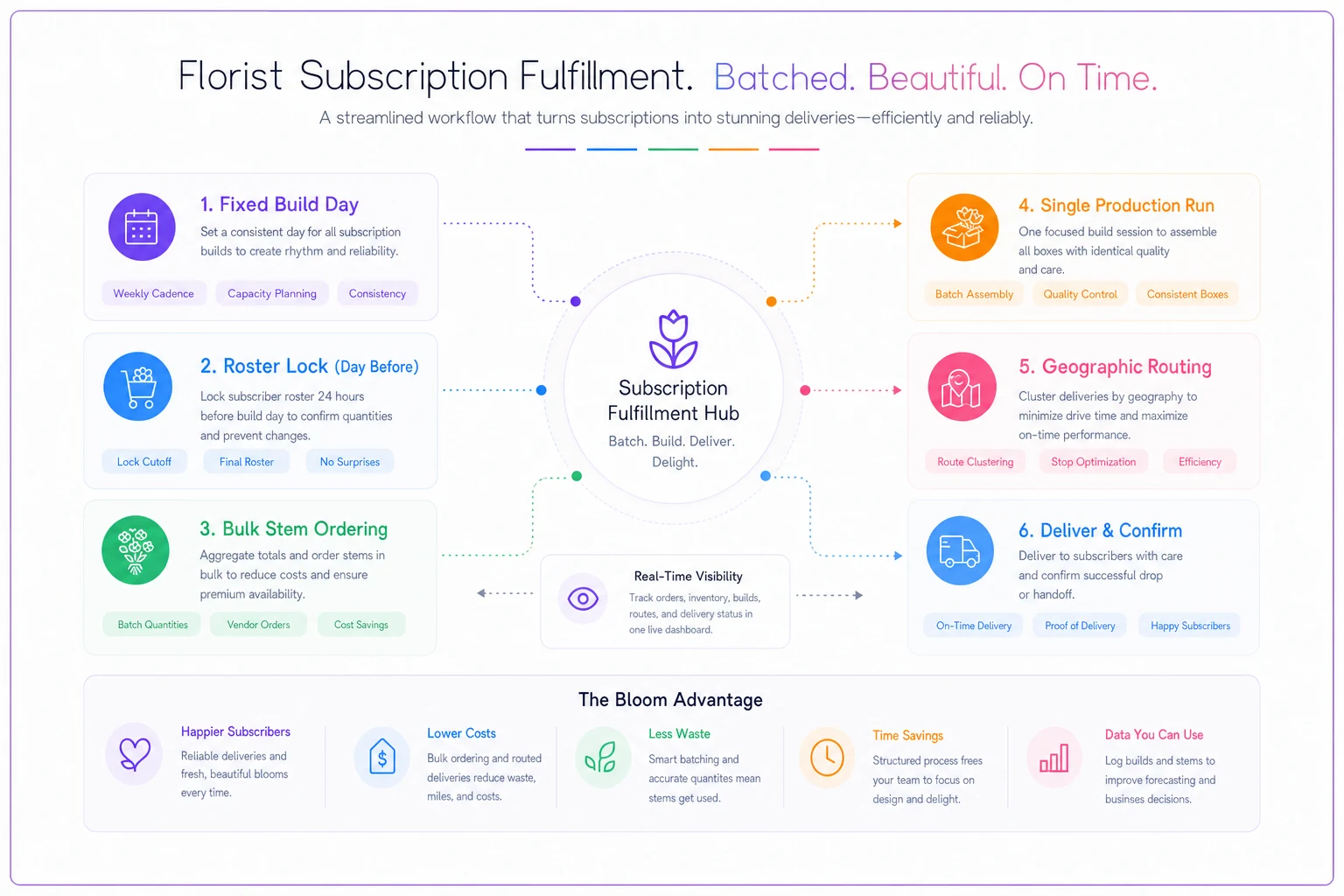
Use it to align your team on the steps.
The LTV and churn math you actually need
Forget complicated cohort modeling. For a pilot, you need three numbers and one ratio.
1. Contribution margin per box. Not revenue—margin. Take the box price and subtract stems, greens, packaging, assembly labor, the delivery leg, and payment processing. A realistic small-shop example on a $55 box:
-
Stems + greens
~$18
-
Packaging + care card
~$3
-
Assembly labor (batched)
~$6
-
Delivery (batched leg)
~$5
-
Processing
~$2
Contribution margin: roughly $21 per box
2. Average subscriber lifespan (in cycles). This is where churn shows up. If about 20% of subscribers cancel each cycle, average lifespan is roughly 5 cycles (1 ÷ 0.20). If churn is 33%, lifespan drops to about 3 cycles. Small changes in churn swing lifetime value hard.
3. Lifetime value (LTV). Contribution margin × lifespan. At $21 margin and 5 cycles, that's about $105 per subscriber in lifetime contribution. At the same margin but a 3-cycle lifespan, it collapses to around $63.
4. The one ratio: LTV vs. acquisition cost. If you gave a 30% first-box discount to sign someone up, your acquisition cost is roughly $16—the margin you gave away. Compare that to your LTV. At $105 LTV against $16 to acquire, the program works. At $63 LTV against a heavier discount, you're barely above water, and that's before any operational hiccups.
The pilot exists to fill in these numbers with your real churn and your real batched costs, not industry averages that don't reflect your neighborhood or your labor rate.
Decision rules: when to scale, when to kill it, when to fix it
Set these thresholds before the pilot starts, in writing, so you're not rationalizing a bad program because you're emotionally attached to it.
-
Scale it if cycle-over-cycle churn stays under ~25% and blended contribution margin per box holds above ~$18 after full fulfillment costs. That combination means the batching works and people stick around long enough to pay back acquisition.
-
Fix and re-test if margin is healthy but churn is ugly, or if retention is solid but margin is thin. These are solvable—adjust the recipe, the price, or the cadence and run one more short cycle.
-
Kill it if both churn and margin are bad after three cycles. That's not a tweak situation. The program doesn't fit your cost structure or your customer base, and you just learned that for a few hundred dollars instead of a full season of payroll.
One thing a pilot does that nobody really talks about: it gives you permission to not scale. Plenty of shops discover their subscription customers are the same people who used to buy fresh weekly at full price—meaning the "subscription" just cannibalized higher-margin walk-in revenue at a discount. That's a real finding, and it's only visible when you compare subscriber behavior against your existing repeat customers. Your broader customer lifecycle playbook for repeat sales should account for that overlap before you decide subscriptions are net-new revenue.
A real scenario: the 30-person biweekly pilot
A mid-sized shop in a suburban strip center wanted to launch subscriptions but had been burned by a loose "flower club" a couple years earlier that quietly died.
They ran a capped pilot: 30 founding members, biweekly Designer's Choice boxes at around $42, all delivered every other Thursday, all built in one morning batch. First-box discount of 25%.
The first cycle looked fine—30 boxes out the door. The second cycle is where it got interesting. Churn came in around 27%, higher than they hoped, and exit notes clustered around one theme: biweekly was too frequent for the price. People felt like they had too many flowers.
Instead of killing the program, they applied the "fix and re-test" rule. They shifted the surviving cohort to monthly at a slightly higher $58 box and ran two more cycles. Churn dropped to roughly 15%, and because the monthly cadence allowed a bigger single build, contribution margin per box climbed to somewhere around $23–$25.
The biweekly version they would have scaled on gut instinct was the weaker product. The pilot cost them maybe $500 in discounts and a few dozen extra stems, and it steered them into a monthly program that's now their most predictable recurring revenue line.
When a subscription pilot makes sense—and when it doesn't
It makes sense when you already have a base of repeat customers, your same-day and event work is stable enough that a fixed weekly build day won't blow up your other production, and you have clean enough records to actually compute margin per box. Subscriptions reward operational discipline; if your fulfillment is already tight, they slot in nicely.
It's a bad idea when your shop is still firefighting daily orders and can't reliably protect a batch day. Adding a recurring obligation to a chaotic production floor just creates a new way to fail. Fix the daily workflow first.
Who should probably skip this entirely: shops whose customer base is overwhelmingly one-time occasion buyers—funerals, last-minute apologies, holiday one-offs. Those customers don't want a standing order, and no amount of pilot design changes that. You'd be forcing a recurring model onto non-recurring demand.
Keeping the pilot data honest
The one operational thing that quietly determines whether your pilot produces trustworthy numbers is record-keeping. If your subscriber list lives in a spreadsheet, your renewals run through the register manually, and your stem costs are a vague memory, your LTV math is fiction.
You don't need anything fancy—but you do need one place where subscriber rosters, renewal dates, cancellations, and per-cycle costs actually live together, so at the end of three cycles you can pull real churn and real margin instead of reconstructing it from memory. Whether that's a well-built spreadsheet or an operational platform that tracks recurring orders and flags cancellations automatically, the requirement is the same: the pilot is only as good as the data it produces.
Run it tight, cap the cohort, fix the fulfillment day, and hold yourself to the decision rules you wrote down before you started. A subscription program that survives that kind of test is one you can actually scale without wondering whether every new box is quietly losing money.
Ready to grow your flower shop business?
Join 500+ flower shops using Blomsly to save time, reduce errors, and delight customers with fresh blooms.