

Corporate accounts are the thing every florist wants until they get their first one. Then reality shows up: the office manager wants fresh arrangements every Monday by 9am, the hotel wants their lobby piece swapped twice a week, and suddenly your two best designers are stuck making the same three vase styles while your Saturday retail orders pile up.
The revenue is real and predictable. The problem is that most shops treat corporate work like retail with a bigger order, and it isn't. It's a completely different operation with its own pricing logic, its own delivery rhythm, and its own paperwork. Get those three things right and a handful of accounts can float your slow months. Get them wrong and you'll be losing money on work you thought was easy.
This is the piece nobody hands you when you decide to chase commercial clients — the actual mechanics of a florist corporate accounts playbook that a small shop can run without hiring an ops manager.
Start with the discovery conversation, not the quote
The single biggest mistake shops make is quoting before they understand the account. A prospect says "we want weekly arrangements for our lobby," you throw out a number, and now you're locked into a price that ignored half the cost drivers.
Corporate buyers ask different questions than brides or same-day gift buyers. They care about consistency, invoicing terms, who to call when something goes wrong, and whether you'll still be reliable in month nine. Your discovery call needs to surface the operational stuff that actually determines your margin.
A discovery checklist worth running before you name any price:
-
Frequency and day-lock. Weekly? Biweekly? Is the delivery day fixed or flexible? A locked Monday delivery is worth less to you than a flexible window because it can't be batched with anything.
-
Number of placements per site. One reception piece is easy. Six arrangements scattered across three floors changes your labor and delivery time completely.
-
Design latitude. Do they want "designer's choice seasonal" or an exact repeatable spec with brand colors? Repeatable specs are easier to batch but harder to source consistently.
-
Container ownership. Are you supplying and rotating vessels, or do they own them? Vessel rotation means you're tracking and washing containers — real unpaid labor if you don't price it.
-
Approval and billing contact. Who signs off, and who pays? These are often two different people, and that gap is where invoices go to die.
-
Payment terms expectation. Net 15? Net 30? Corporate net-30 is normal but it means you're financing their flowers for a month.
-
Volume commitment length. Month-to-month or a term? Longer terms justify better pricing.
-
Failure tolerance. What happens if a delivery is late or a stem arrives brown? Ask now, before it happens.
Run through this and you'll notice something: two accounts that both want "weekly arrangements around $150" can have wildly different profitability once you factor in placements, design latitude and container rotation. One's a gift, one's a trap.
Tiered pricing that protects your retail margin
Corporate pricing should never mirror your retail sheet. Retail prices carry the cost of walk-in browsing, gift wrap, one-off sourcing and the emotional premium of same-day. A standing weekly account removes most of that uncertainty — which is exactly why you can price it leaner and still make more per hour, if you build it right.
Never miss a bloom or a delivery.
Blomsly helps you manage orders, track stock, and schedule deliveries effortlessly.
- Unified order management
- Real-time inventory tracking
- Delivery scheduling & notifications
No credit card required
The trick is tiering. Flat "we'll do it for X" pricing punishes you when accounts scale up and undercharges when they're complex. A tiered structure gives the buyer a clear upgrade path and gives you predictable batching.
| Tier | Typical setup | Design latitude | Delivery cadence | Price logic |
|---|---|---|---|---|
| Standard | 1–2 placements, single site | Designer's choice, seasonal | Weekly, flexible day | Lowest per-stem cost; fully batchable |
| Signature | 3–5 placements, one site | Semi-custom, brand palette | Weekly/biweekly, soft window | Mid markup for spec control |
| Bespoke | 6+ placements or multi-site | Exact spec, event tie-ins | Fixed day, sometimes 2x/week | Premium; treated closer to event work |
The money isn't really in the Bespoke tier — it's in loading up as many accounts as possible into Standard and Signature, because those are the ones you can produce in a single batched run. Bespoke is fine, but it's essentially custom labor and you should price it that way, not pretend it batches like everything else.
A concrete way to think about it: if your retail arrangement at a given price point carries food cost around 28–32%, your standing corporate version of a similar-looking piece can often run leaner on labor per unit because you're making six of them back-to-back. That labor efficiency is your actual margin lever — not slashing flower cost.
One pricing rule that saves shops from themselves: price the container rotation separately, or fold a rotation fee into the tier. Shops that supply vessels and "just swap them out" are quietly eating washing labor, breakage and the cost of vessels sitting in an office for a week. A small rotation surcharge per placement covers it and most clients don't blink.
Delivery cadence: the part that quietly eats your week
This is where corporate accounts turn from profit to pain. Each account has its own preferred day, and if you say yes to every request, you end up with a delivery running somewhere every single morning — each one too small to be efficient.
The fix is to design your cadence around your week, not theirs. When you're selling, offer delivery windows that align with routes you're already running. A Tuesday/Thursday corporate cadence, for example, lets you cluster commercial stops and keep your retail delivery days clean.
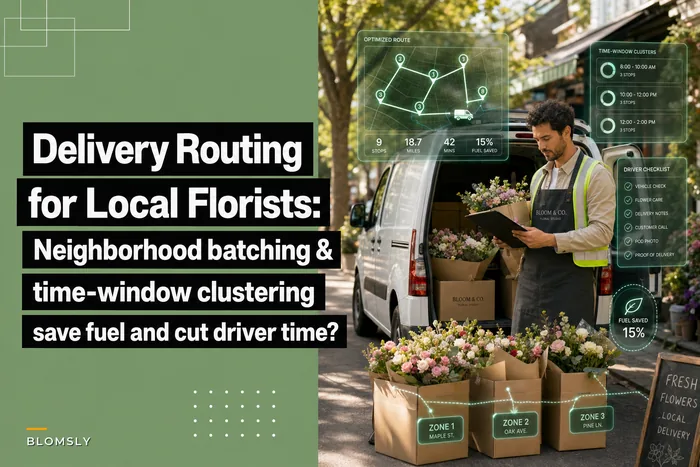
This is the same logic behind smart route design generally — if you haven't tightened up your delivery approach, the thinking in our piece on neighborhood batching that saves fuel and time applies directly to corporate stops too. Corporate deliveries are actually easier to batch than retail because the addresses never change and the timing is predictable — but only if you refuse to scatter them across all five weekdays.
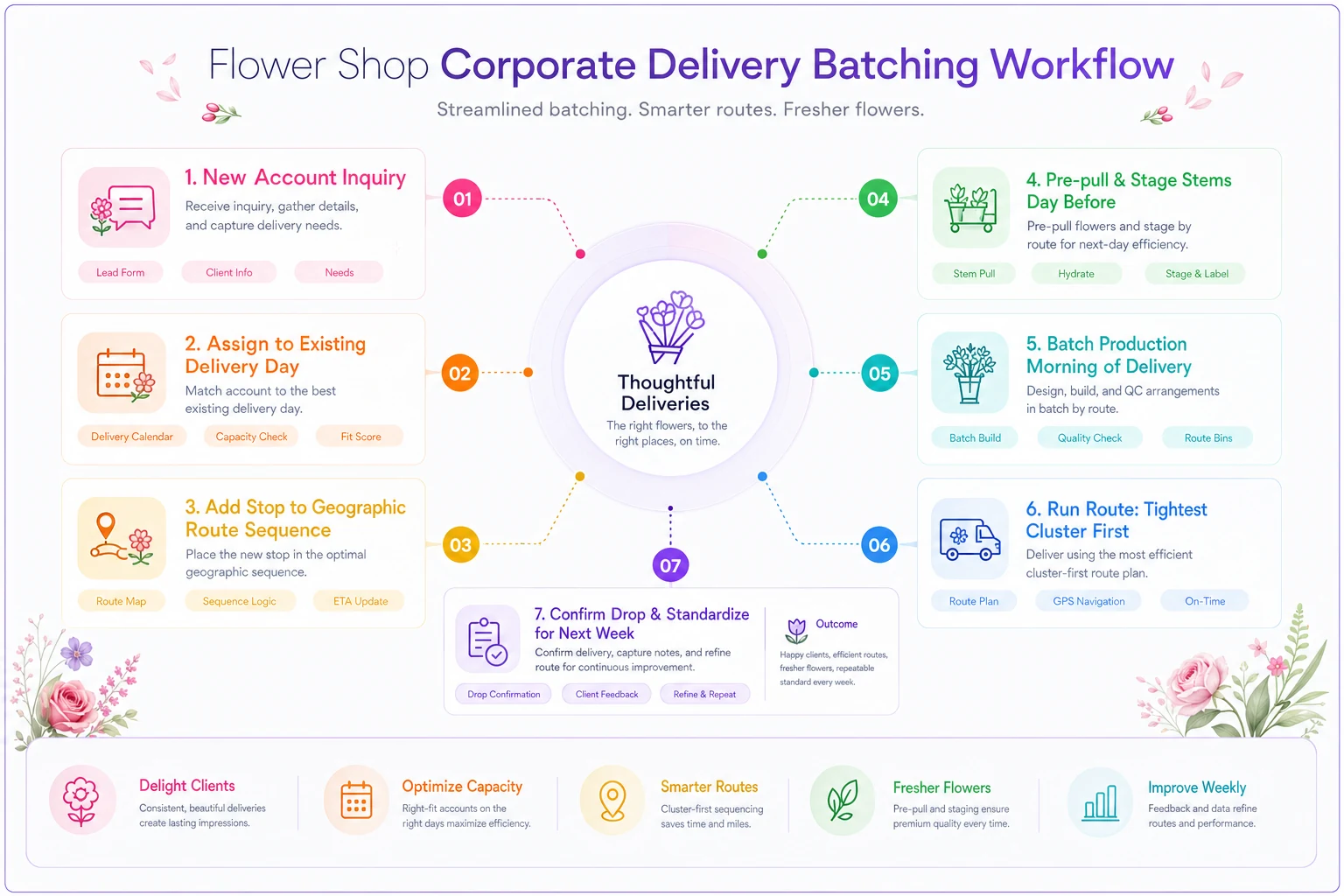
A workflow that holds up in practice:
-
Assign each new account to an existing delivery day, not a new one. Offer two window options during the sales call and let them pick.
-
Group all corporate stops for a given day into one produced batch the afternoon before or early that morning.
-
Sequence the run geographically, hitting the tightest cluster first while pieces are freshest.
-
Build a 10-minute buffer per stop for the first month of any new account — commercial buildings have loading docks, security desks and freight elevators that eat time you didn't plan for.
-
Confirm the drop location and contact once, then standardize it so drivers aren't guessing every week.
A quick visual of the delivery batching flow:
The insight most shops miss: the day-lock is a pricing variable. If an account absolutely must have Monday-before-9am delivery and won't flex, that's a premium, because it prevents batching. Flexible-day accounts should cost less — they're the ones filling out your efficient runs.
Batching rules for corporate runs
Batching is where the actual money gets made or lost. A designer making one arrangement, cleaning up, starting the next, cleaning up again is running at maybe half the speed of someone producing six identical pieces in sequence.
Some rules that consistently hold:
-
Batch by design spec, not by account. If three different accounts get the same low seasonal centerpiece, make all of them together, then split into deliveries. Don't produce account-by-account.
-
Pre-pull and pre-process the day before. Corporate runs use predictable stem counts. Stage the buckets so the morning is pure assembly, not sourcing.
-
Cap the number of distinct corporate specs per day. More than three or four unique designs in one morning batch and your efficiency collapses. This is a good reason to steer accounts toward Standard and Signature tiers.
-
Standardize your repeatable recipes. Every recurring arrangement should have a written stem-count recipe so any designer can produce it identically. Consistency is what the client is actually paying for.
-
Protect a hard cutoff between corporate batching and retail production. If corporate work is bleeding into your retail assembly window, you've overcommitted your morning.
Batch by design spec, not by account.
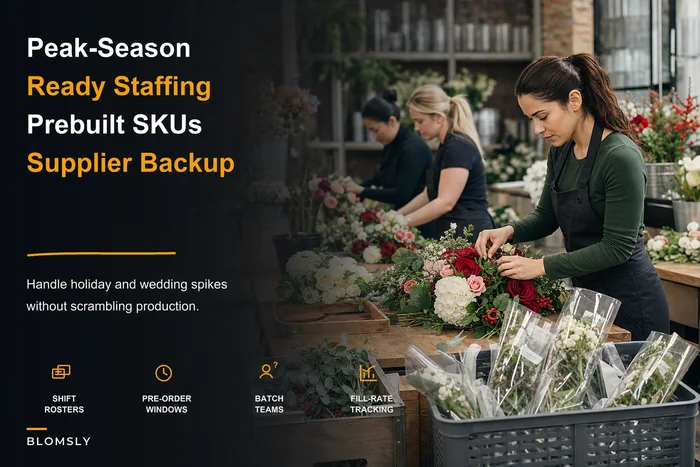
During heavier periods this batching discipline matters even more — the prebuilt-SKU thinking in our peak-season operations playbook works hand-in-hand with corporate recipes, since a well-defined corporate spec is basically a prebuilt SKU that repeats every week.
The paperwork nobody wants to build (but pays for itself)
Corporate accounts fall apart on administration more than on flowers. The design is rarely the problem — the invoice sent to the wrong person, vague expectations, the "wait, I thought that was included" conversations are what kill accounts.
You need three documents ready before you sign anyone.
A simple SLA (service level agreement). Doesn't need to be a legal monster. One page covering:
-
Delivery day and window
-
What happens if a delivery is missed or late (make-good policy)
-
Quality standard and replacement policy for damaged or wilted pieces
-
Notice period for pausing or canceling service
-
Container responsibility
Spelling out the make-good policy before anything goes wrong is what separates a shop that keeps accounts from one that loses them the first time a truck breaks down. When the office manager knows exactly what happens if Monday's delivery slips, a late delivery becomes a shrug instead of a lost contract.
A clean recurring invoice template. Corporate buyers want line items, PO numbers if they use them, clear payment terms, and a consistent format their accounting team can process without emailing you. The most common cause of slow corporate payment isn't the client being difficult — it's an invoice that doesn't match how their AP system expects to see things.
An account setup sheet. One internal doc per account capturing: placements, recipes, delivery day and window, drop location, site contact, billing contact, payment terms, container details. This is the document that means the account survives your designer quitting or your driver being out sick.
Keeping these consistent across a growing roster of accounts is genuinely where a lot of shops slip — recurring invoices go out late, the SLA lives in someone's email, the account details are in one person's head. This is the kind of repeatable, rules-based admin that operational software with light automation handles well: recurring invoices generated on schedule, delivery reminders tied to each account's cadence, and account specs stored in one place instead of scattered across sticky notes and text threads. It won't design the flowers, but it stops the paperwork from being the reason an account walks.
A real scenario
A neighborhood shop — mostly retail, one full-time designer plus the owner — picked up four corporate accounts over about six months. Two offices, a boutique hotel lobby, and a small restaurant group. Each wanted its own delivery day, and the owner said yes to all of them.
Within two months the shop was running a corporate delivery four mornings a week, each stop too small to be efficient, and the designer was starting corporate pieces one at a time between retail orders. On paper the accounts were worth roughly $2,600–$2,900 a month combined. In practice the owner suspected they were barely breaking even, and Saturday retail was suffering because the designer was burned out by Friday.
The fix was unglamorous. They renegotiated all four accounts onto two delivery days — Tuesday and Friday — offering a small discount to the one account that had to shift. They wrote three repeatable recipes so pieces could be batch-produced instead of made individually. They added a modest container-rotation line to the two office accounts. And they moved everyone to a standardized net-15 invoice sent automatically the day after delivery.
Nothing about the flowers changed. The corporate morning dropped from four scattered runs to two batched ones, the designer got her production window back, and the accounts went from break-even to a comfortable margin. The owner described it as finally feeling like "found money" instead of a second job. Same revenue, roughly the same clients, completely different operation.
When corporate accounts make sense — and when they don't
They make sense when your retail volume has predictable slow windows that recurring commercial work can fill, when you have the design capacity to batch, and when you can hold a disciplined delivery cadence. They're especially useful for smoothing out the mid-week and off-season troughs that otherwise leave your designers idle.
They're a bad idea when you're already at capacity on your good retail days, when you can't say no to custom-everything requests, or when your cash position can't absorb net-30 terms. An account that pays in 30 days while you buy flowers weekly is a financing arrangement, and you need to be able to carry it.
Some shops genuinely shouldn't chase this at all. If your whole brand is built on one-of-a-kind, high-touch custom work, corporate recurring accounts will feel like a factory you didn't want to build. That's a legitimate choice. Corporate work rewards consistency and systems, not artistry for its own sake.
The short version
Corporate accounts aren't bigger retail orders. They're a separate operation that lives or dies on three things: pricing that reflects real cost drivers instead of copying your retail sheet, a delivery cadence built around your week instead of theirs, and administrative templates that make invoicing and expectations boring and predictable.
Nail the discovery conversation, tier your pricing so most accounts land in your batchable range, lock your delivery days, standardize your recipes, and get the SLA and invoice right before you sign. Do that and a handful of accounts can quietly stabilize your revenue through every slow stretch of the year — without ever hijacking your retail floor.
Ready to grow your flower shop business?
Join 500+ flower shops using Blomsly to save time, reduce errors, and delight customers with fresh blooms.