
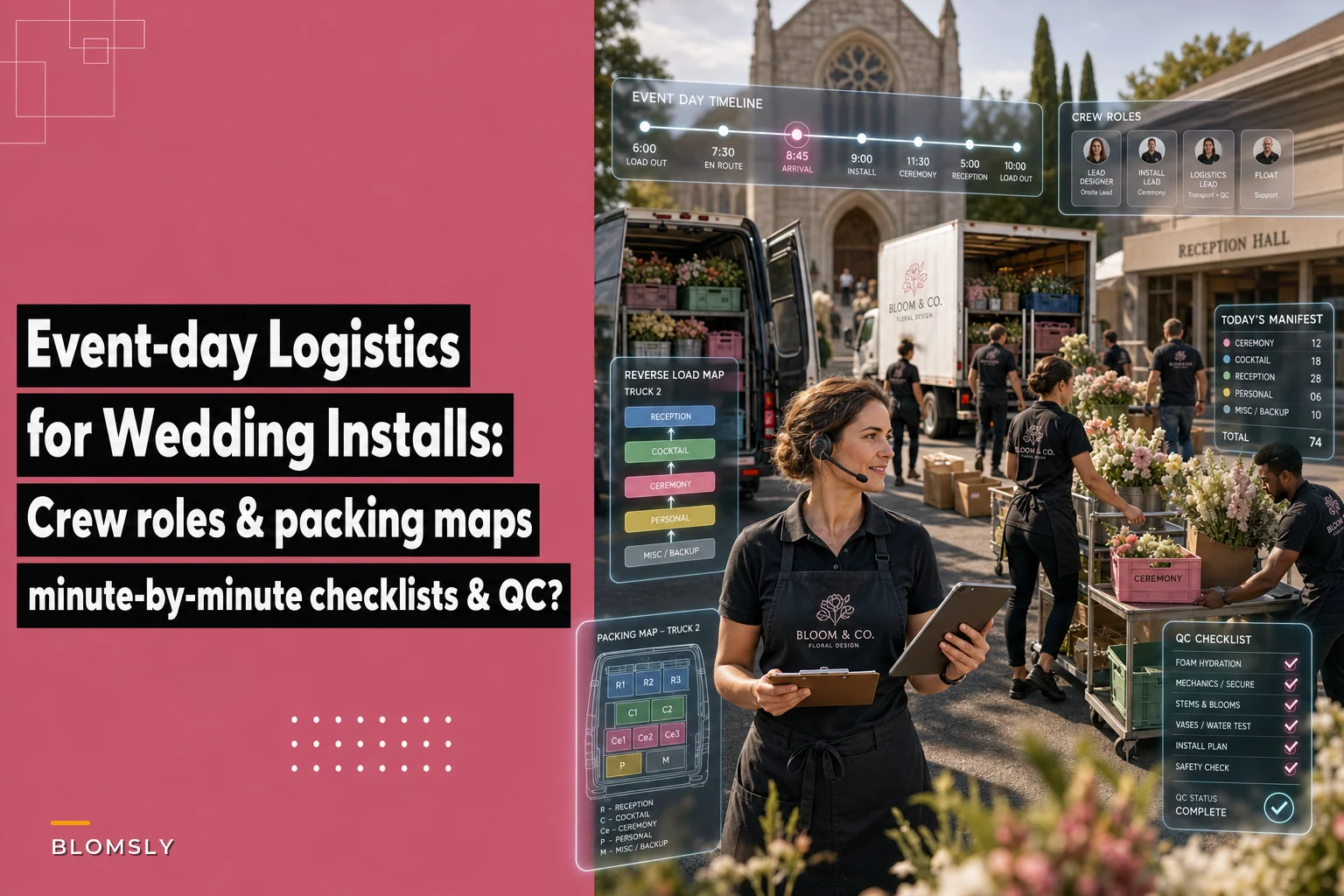

The worst weddings aren't the ones where the flowers were slightly off-color or a boutonnière ran short. They're the ones where the ceremony arch shows up 40 minutes late because the truck went to the reception venue first, or the bridal bouquet is sitting in a bucket back at the shop while your lead designer is already across town at the second site.
Multi-site drops are where florists lose money and sleep. A single wedding might have a ceremony church, a reception hall, a hotel where the bridal party is getting ready, and sometimes a separate cocktail location — four addresses, three time windows, one crew. When even one handoff goes sideways, the failures cascade.
This post is narrow on purpose. It's about the logistics layer of the event day — crew roles, packing maps, and minute-by-minute execution — not the design, not the sales consult. If you've already nailed your assembly standards and your peak-season staffing, this is the piece that keeps day-of chaos from undoing all that upstream work.
The failure almost always happens at the seams, not the stems
When a wedding day goes wrong, owners tend to blame the obvious things: a supplier shorted stems, a designer was slow, traffic was bad. But if you actually trace back what caused the panic, the root cause is almost never the flowers themselves. It's the transitions — the moments where product moves from one person, vehicle, or location to another.
A typical example looks like this. A shop books a Saturday with three sites. The team preps beautifully all week. Friday night everything is built and bucketed. Then Saturday morning, two vans get loaded by whoever's standing closest to the cooler, nobody wrote down which arrangements went in which van, and the driver heading to the ceremony realizes at 9:45 that the aisle markers are in the other van — the one already 25 minutes toward the reception venue.
Nothing was broken. Nothing was short. The team just lost track of where things were and who owned what during the handoffs. That's the seam. And the reason it keeps happening is that most shops treat event day as an extension of normal operations, when it's actually a completely different operating mode — more like a coordinated tour than a fulfillment shift.
Your daily fulfillment workflow doesn't scale to multi-site events. Your regular same-day order workflow is built for many small independent deliveries. A wedding is one giant interdependent delivery split across time and space. Different problem, different system.
Crew role cards: stop everyone from "helping" everywhere
The most common staffing mistake on event day is having a crew of four capable people who all do a little bit of everything. It feels efficient. It isn't. When everyone owns everything, nobody owns anything, and the gaps between tasks are exactly where things fall.
Never miss a bloom or a delivery.
Blomsly helps you manage orders, track stock, and schedule deliveries effortlessly.
- Unified order management
- Real-time inventory tracking
- Delivery scheduling & notifications
No credit card required
What works better is assigning fixed roles for the day, written on a physical card each person carries. Not job titles — event-day roles. Someone can be your best designer all week and be the Load Master on Saturday.
| Role | Owns | Does NOT touch |
|---|---|---|
| Load Master | Van loading, packing map, verifying counts against manifest | Design changes, client communication |
| Site Lead (per venue) | Placement, onsite QC, client sign-off at that location | Loading order, route decisions |
| Driver/Runner | Route sequence, timing, unloading in correct order | Design decisions, client conversations |
| Float | Fixes, missing-item runs, backup labor | Fixed placement duties (stays mobile) |
Give the Load Master the packing map and the manifest so they can sign off each vehicle during loading.
The Load Master role is the one shops skip most often, and it's the one that prevents the "flowers in the wrong van" disaster. One person, and only that person, decides what goes in which vehicle and confirms it against the manifest before doors close. When that ownership is clear, the 9:45 panic mostly disappears.
The Float role is the unsung hero of big Saturdays. On a three-site wedding you will discover something missing or damaged — a broken vase, a boutonnière that got crushed, an arch piece that needs a few more stems. The Float exists so that solving that problem doesn't pull a Site Lead away from placement. Without a Float, every small fix steals a person from a critical task, and small fixes are guaranteed.
Packing maps: label the load, not just the boxes
Labeling boxes with the venue name isn't enough. Venue-only labels don't tell you load order or unload order, and on a tight timeline those matter more than the labels themselves.
A packing map is a simple diagram of each vehicle showing what goes where, in what order, based on the reverse of your drop sequence. If the ceremony site is first, ceremony product loads last so it's closest to the doors. Obvious once you say it, routinely ignored when four people are loading fast at 7 a.m.
-
Van 1 (Ceremony → Cocktail) Ceremony aisle pieces load last (unload first). Arch florals in secured buckets, front-left. Cocktail arrangements behind them, back-right, in transport crates.
-
Van 2 (Reception) Centerpieces loaded by table group — head table and sweetheart table load last so they come out first for the Site Lead to place while the rest gets staged.
The map lives with the Load Master and gets a physical checkmark as each item goes in. The point isn't bureaucracy. The point is that when a driver arrives at the ceremony and opens the doors, the first thing they touch is the first thing that needs to come out. Every second of digging around in a packed van under time pressure is a second closer to a late ceremony.
Shops that build the packing map the night before, when everything's calm, have dramatically smoother mornings than shops that improvise the load on the fly. The map takes maybe 15 minutes to sketch. The improvised version costs you those same 15 minutes — plus your composure — at the worst possible time.
The minute-by-minute template is a timeline, not a to-do list
A checklist tells you what to do. A minute-by-minute template tells you when it has to be done by — and that distinction is everything on event day. The failures aren't usually about forgetting a task. They're about doing tasks in the wrong order or discovering too late that you're behind.
Build the timeline backwards from the hard deadline, which is guest arrival at the ceremony. Everything anchors to that. If guests arrive at 3:00 and you need the ceremony fully placed and inspected by 2:30, you work backward through placement time, drive time, load time, and final QC at the shop.
-
7
00 AM
— Crew arrives. Load Master runs the manifest count against buckets. Anything short gets flagged now, while there's still time to source or rebuild. -
7
45 AM
— Vans loaded per packing map. Load Master signs off on both loads. -
8
15 AM
— Van 2 departs for reception (longest placement job, earliest window). -
9
00 AM
— Van 1 departs for hotel drop (bridal bouquets, bridal party personals). -
9
30 AM
— Hotel Site Lead delivers, gets bride's coordinator sign-off, photographs placement. -
10
15 AM
— Van 1 proceeds to ceremony site. -
11
00 AM–1:30 PM
— Ceremony placement and reception placement run in parallel across sites. -
1
30 PM
— Onsite QC pass at each site (see checklist below). -
2
00 PM
— Float sweeps all sites for fixes, missing items, damage. -
2
30 PM
— Ceremony locked and photographed. Crew clears out before guests.
The parallel window in step 7 is where the crew role cards pay off. Two sites are being worked simultaneously by different Site Leads, and neither is waiting on the other because loading and sequencing were already handled. When you don't build the timeline backward, you tend to schedule everything as if sites happen one after another — and then you run out of Saturday.
Visualizing the flow helps teams understand load, route, and onsite sequencing.
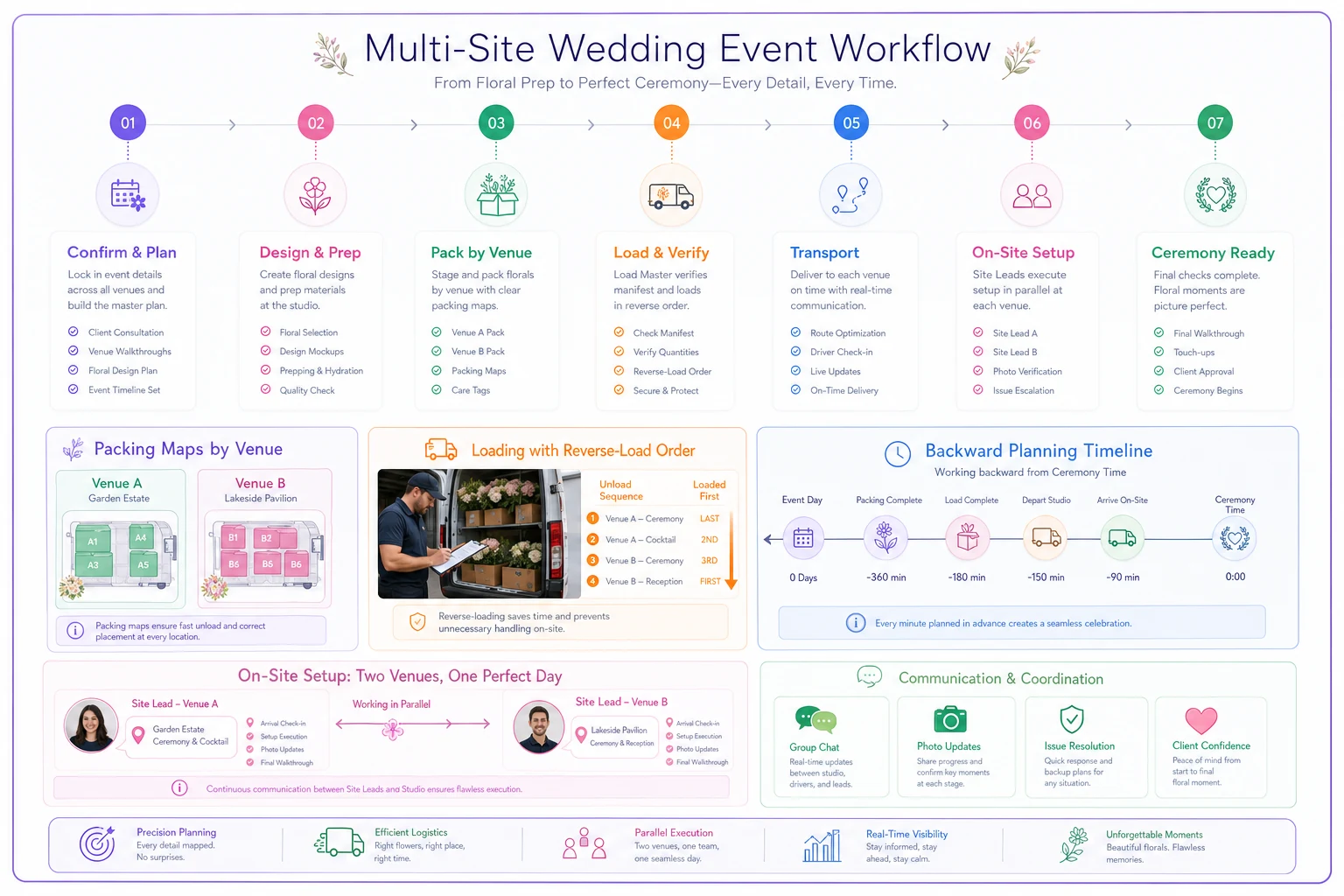
Building these timelines from real placement times matters. If you've done the work to set assembly and task time standards, you already have realistic numbers for how long placement actually takes instead of guessing. A timeline built on optimistic guesses fails by 11 a.m.
Onsite QC: the checklist that catches failures before the client does
QC at the shop is not the same as QC onsite. Product looks different in a church than under your shop lights, and things break in transit. The onsite QC pass is your last chance to catch a problem while you still have a crew, a Float, and time to fix it.
Run this at each site before the crew leaves:
-
[ ] Count placed items against the manifest for this site (not the whole wedding)
-
[ ] Check every arrangement for transit damage — crushed blooms, tipped water, bent stems
-
[ ] Confirm placement matches the client's diagram or planner's layout
-
[ ] Verify personals are accounted for and labeled (boutonnières and corsages get lost constantly)
-
[ ] Photograph the completed placement at that site
-
[ ] Get a sign-off from the venue coordinator or planner if one is present
-
[ ] Confirm water levels and any needed touch-ups for arrangements sitting for hours
The photograph step is the one shops undervalue. When a client later claims something was missing or wrong, a timestamped photo of the completed setup ends the dispute instantly. It also builds a reference library for how each recurring venue should look, which speeds up planning for future weddings there.
The personals line deserves emphasis. Boutonnières and corsages are small, they travel in separate boxes, and they get delivered to a different location than the main installation. They are the single most common "we forgot the—" item on wedding days. Give them their own line on every checklist and their own labeled box.
A real scenario: three sites, one near-miss, one fix
A mid-sized shop doing roughly 30–40 weddings a season kept having what the owner called "small Saturday disasters" — nothing catastrophic, but enough near-misses that the lead designer was burning out and one client had left a rough review about a late ceremony setup.
The pattern was clear: no fixed roles, boxes labeled only by venue, and a timeline that listed tasks but no times. On the wedding that finally forced a change, the crew arrived at the ceremony site to find the aisle arrangements loaded behind the reception centerpieces. Unloading meant pulling out and re-staging about 20 centerpieces on the sidewalk just to reach the ceremony pieces. They finished placement roughly 15 minutes before guests instead of the planned 30, with zero margin for the boutonnière box left in the second van.
The changes were unglamorous. They assigned a Load Master and a Float for every multi-site event. They started sketching packing maps the night before, loaded in reverse drop order, and built timelines backward from ceremony start. QC got a physical checklist with the photo step.
The following season, the small disasters mostly stopped. Setups were finishing with the planned buffer again, the Float was absorbing the inevitable fixes without derailing placement, and — maybe the most telling sign — the lead designer stopped dreading Saturdays. Nothing about the flowers changed. The seams got tighter.
When this level of process makes sense — and when it's overkill
This full system is built for multi-site events. If your typical wedding is a single-venue setup where you drop and place in one location, most of this is more structure than you need. A single site with a straightforward load doesn't require a packing map or a dedicated Load Master — one clear checklist and a sensible loading order will do.
Where it becomes essential is any wedding with two or more locations, tight sequential timing, or a crew of three or more people who might otherwise all try to do everything. The more addresses and handoffs involved, the more the seams multiply, and the more you need explicit ownership and timing.
It's also worth scaling the system to the season. During peak stretches when you're running multiple weddings in a weekend, the role cards and packing maps stop being nice-to-haves — they're what let you run parallel events without your best people being stretched across both. If you're already thinking about peak-season staffing and prebuilt SKUs, event-day role structure is the natural companion to that planning.
The one thing not to do is build all this documentation and then leave it in a binder nobody opens on Saturday morning. Role cards work because people carry them. Packing maps work because they get checkmarks during loading. Timelines work because someone's watching the clock against them. A system that lives only on paper is just paperwork.
The through-line
Wedding-day failures on multi-site events are rarely a flower problem and almost always a coordination problem. The stems are fine. The design is fine. What breaks is the invisible layer underneath — who owns what, where things are, and whether you're on time to the one deadline that can't move.
Fixed crew roles remove the confusion of everyone helping everywhere. Packing maps make sure the first thing you touch is the first thing you need. Minute-by-minute timelines, built backward from guest arrival, keep you from running out of Saturday. An onsite QC pass with photos catches the last problems while you still have the people and time to fix them. Put those four pieces in place and the seams that used to unravel your weddings mostly hold — which is the whole point.
Wedding-day failures on multi-site events are rarely a flower problem and almost always a coordination problem. The stems are fine. The design is fine. What breaks is the invisible layer underneath — who owns what, where things are, and whether you're on time to the one deadline that can't move.
Fixed crew roles remove the confusion of everyone helping everywhere. Packing maps make sure the first thing you touch is the first thing you need. Minute-by-minute timelines, built backward from guest arrival, keep you from running out of Saturday. An onsite QC pass with photos catches the last problems while you still have the people and time to fix them. Put those four pieces in place and the seams that used to unravel your weddings mostly hold — which is the whole point.
Ready to grow your flower shop business?
Join 500+ flower shops using Blomsly to save time, reduce errors, and delight customers with fresh blooms.