

Most florists don't have a forecasting problem. They have a signals problem. The information you'd need to order correctly is already sitting in your calendar, your delivery zone, and your standing corporate accounts — it's just scattered, unweighted, and stuck in someone's head. So the shop ends up buying on feel, then paying for it three days later when the cooler tells the story.
Florist demand forecasting isn't about predicting exactly how many stems you'll sell. That number is unknowable and chasing it wastes your time. The point is to build a system that ranks your signals correctly, updates on a predictable cadence, and separates the stuff you know is coming from the stuff you're guessing at. Once you split those two, ordering gets a lot calmer.
This is the pillar piece. If you've read the posts on order-quantity rules for mixed-perishability florals or the lifecycle rules for perishable inventory, this is the layer that sits above both of them — deciding how much demand to plan for before you ever get into order quantities or safety stock.
Why forecasting breaks for most shops (and it's not the math)
The forecasting failure almost never looks like a failure. It looks like a shop that's "doing fine." Orders get filled, customers are mostly happy, and the owner assumes buying is under control because nothing exploded.
Then you look at the cooler on a Thursday and there are 14 bunches of alstroemeria nobody remembers ordering, three cases of hydrangea going soft, and a sticky note that says "reorder ranunculus??" with no quantity attached. That's not a fine operation. That's a shop running entirely on the most recent memory of whoever happened to place the last order.
The pattern underneath it: most florists forecast reactively and treat every signal as equal weight. A wedding deposit that cleared two months ago gets the same mental priority as a hunch that "roses always move in February." One of those is money in the bank. The other is folklore. When you don't rank signals, you buy for the loud ones and ignore the reliable ones.
The second reason it breaks is that the person forecasting is usually doing forty other things. Buying decisions get made at 6am between unloading a delivery and prepping a same-day order. There's no dedicated moment where someone sits down, looks at confirmed demand, and then decides what to estimate on top of it. It's all guessing, all the time, squeezed into whatever gaps exist.
The signals hierarchy: rank before you order
The most useful thing you can do is stop treating all demand information as one undifferentiated blob. Sort it into tiers by how certain it is. Buy against certainty first, then layer probability on top.
Never miss a bloom or a delivery.
Blomsly helps you manage orders, track stock, and schedule deliveries effortlessly.
- Unified order management
- Real-time inventory tracking
- Delivery scheduling & notifications
No credit card required
| Tier | Signal type | Certainty | How you treat it |
|---|---|---|---|
| 1 | Committed orders (paid weddings, events, confirmed corporate standing orders) | Very high | Buy exact quantities, plus a small breakage buffer |
| 2 | Calendar anchors (Valentine's, Mother's Day, Christmas, local prom/graduation dates) | High | Buy against historical volume for that exact date, adjusted for day-of-week |
| 3 | Local event cues (funerals announced, big weddings you didn't book, festivals, home-game weekends) | Medium | Buy a lean flexible base you can build many things from |
| 4 | Ambient/walk-in demand (Tuesday foot traffic, "just because" web orders) | Low | Cover with versatile core stems only, never specialty |
The thing most owners miss: Tier 1 and Tier 2 should feel boring. If your committed orders and calendar anchors are causing stress, your forecasting system isn't the problem — your data capture is. Committed demand is the easiest thing in the world to plan for, as long as someone wrote it down somewhere the buyer actually looks.
Tier 3 is where the real skill lives. A funeral notice in the local paper for a well-known person is a demand signal, but you don't know if the family orders from you or the shop across town. So you don't buy a funeral-specific spike. You buy flexible base stems — whites, greens, versatile filler — that you could build into sympathy work OR fold back into everyday bouquets if the order never comes. That's the difference between reading a signal and betting on it.
Local cues most shops ignore
-
Weather swings. A sudden warm week pulls forward outdoor-event and "surprise" gifting demand. A cold snap kills walk-ins.
-
Local obituaries and funeral home schedules. Sympathy work is a significant, somewhat predictable category if you actually track it.
-
School and sports calendars. Homecoming, banquets, senior nights. These repeat annually and almost nobody logs them.
-
Neighboring business events. A restaurant reopening, a gallery opening, a church anniversary. These generate one-off orders that tend to cluster.
None of these are precise. That's fine. They tell you which direction to lean, not an exact number.
Cadence: when you actually update the forecast
A forecast you update "whenever" is a forecast you don't really have. The rhythm matters more than the sophistication. What breaks in most shops isn't the quality of the estimate — it's that nobody revisits it on a schedule, so it drifts until it's wrong.
A cadence that holds up across shop sizes:
-
Daily (5 minutes) Check same-day and next-day committed orders against what's in the cooler. This is reconciliation, not forecasting. You're catching gaps, not planning.
-
Twice weekly (15–20 minutes) Set your spot order. Look at Tier 1 and Tier 2 for the coming 7 days, then decide your Tier 3/4 flexible buy. This is your main forecasting moment.
-
Weekly (30 minutes) Review last week — what did you overbuy, what ran short, what walked out the door that you didn't plan for. Adjust standing rules if a pattern shows up twice.
-
Monthly Look at the calendar 6–8 weeks out. Lock in anchor-date planning early so you're not fighting supplier availability at the last minute.
-
Seasonally Reset your baseline volumes and standing purchase rules for the coming season.
Visualize the cadence as a simple loop.
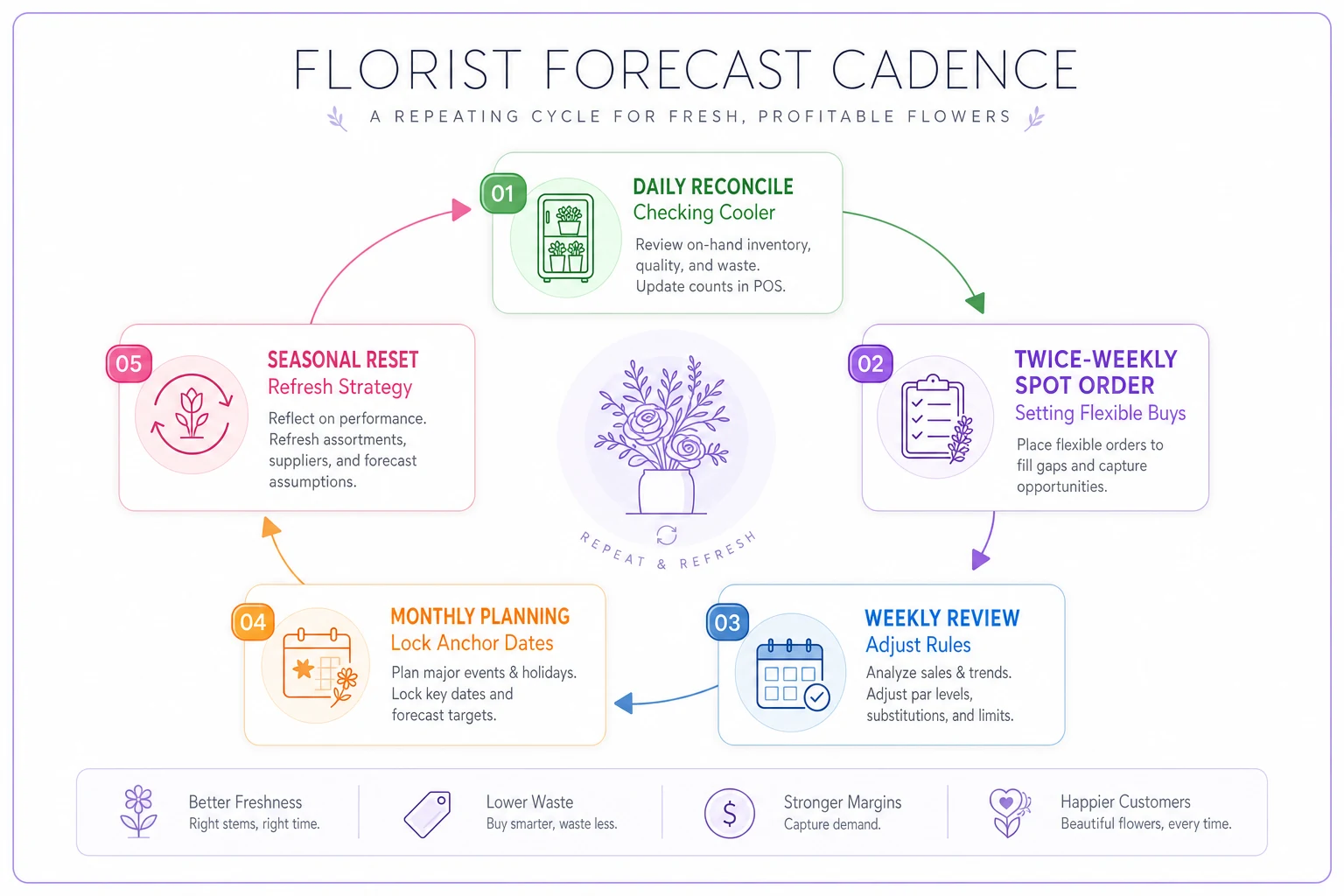
The twice-weekly spot order is the heartbeat. A lot of florists buy more often than that out of anxiety, which is how you end up with three partial hydrangea buys in a week that add up to more waste than one planned buy would've caused.
One pattern worth calling out: shops that forecast on a fixed cadence overbuy far less than shops that "buy as needed." "As needed" sounds disciplined but it usually means "buy whenever someone panics," and panic buying skews high every single time.
Blending spot orders with standing purchase rules
This is what separates a system from a scramble. You want two buying channels running at once.
Standing purchase rules cover your predictable core — the roses, standard filler, everyday greenery — set as recurring quantities that only change seasonally or when a rule review flags them. You don't re-decide these every week. They just flow.
Spot orders cover the variable layer: the color story of the week, specialty stems for a specific event, the Tier 3 flexible base you're buying against local cues. These change constantly and get set at your twice-weekly buying moment.
The mistake most shops make is running everything as spot orders. Every stem becomes a fresh decision, which means every stem is subject to whatever mood or bandwidth the buyer has that morning. That's exhausting and it produces inconsistent results.
The opposite mistake — running everything as standing rules — is worse in a different way. Your core stays stable, but you have no mechanism to respond to a big funeral, a weather swing, or a surprise corporate order. Rigid where the business actually needs flex.
A healthy split looks like roughly 60–70% of your buy on standing rules and 30–40% as spot orders. If your spot percentage is way higher, you probably haven't identified your true core yet. If it's way lower, you're likely leaving flexible-demand money on the table.
How the two channels talk to each other
The blend only works if the standing rules absorb some of your Tier 3/4 demand. In plain terms:
Standing rules should be sized to cover your baseline everyday demand plus a modest cushion for low-certainty walk-in demand. That way, when a small Tier 3 opportunity shows up — say two sympathy orders you didn't see coming — you can build them from core stock without an emergency buy. Spot orders are then reserved for what your core genuinely can't cover: specialty colors, event-specific varieties, volume spikes that exceed the cushion.
When you get this right, a normal week barely touches the spot channel. The spot channel gets busy exactly when it should — anchor dates, event clusters, unusual local activity. That's the signal the system is working: quiet weeks stay quiet in the buying office too.
What changes as you grow
At one location with one buyer, the whole system can live in that person's head plus a shared sheet. It's fragile but it functions, because there's only one brain making the calls and it's usually consistent with itself.
The moment you add a second person who can buy — or a second location, or you take two weeks off — the informal system falls apart. Now two people are reading the same funeral notice and both buying flexible base for it. Or one person assumes the other locked in the Mother's Day anchor order and neither did. Coordination failures replace forecasting failures, and they're harder to catch because everyone assumes someone else handled it.
This is where the signals hierarchy and cadence stop being nice-to-haves and become load-bearing. A documented tier system means anyone can look at the same information and reach roughly the same buying decision. A fixed cadence means there's a defined owner for each review, not a vague hope that buying "gets done." Growth doesn't require a better forecaster — it requires the forecast to live outside any single person's memory.
For anchor-date planning specifically, the peak-season operations playbook goes deeper on how staffing and prebuilt SKUs need to move in lockstep with your Tier 2 forecasting — because ordering right and then not being able to assemble fast enough is just a different flavor of the same failure.
A real scenario
A single-location shop doing roughly $30k–$35k a month was throwing out somewhere around 10–12% of what they bought — mostly specialty stems purchased "in case" that never got used. Their buyer placed spot orders four or five times a week, every buy a fresh gut call. No standing rules, no tiers, no cadence.
They made three changes. First, they built standing purchase rules for their true core — around 15 stem and green varieties that showed up in almost everything — sized to baseline plus a small walk-in cushion. Second, they moved spot buying to twice a week and required every specialty buy to tie to a Tier 1 or Tier 2 signal. Third, they started logging local sympathy and event cues so Tier 3 buying became a lean flexible base instead of a specialty gamble.
Waste dropped to around 6–7% within two months. Not zero — you're never hitting zero with perishables — but a real recovery on a shop that size. The less visible win: the owner stopped getting the 6am "what do I order?" text, because the answer was mostly already decided by the rules.
When a formal system isn't worth it
If you're running a truly small operation — a handful of orders a day, one buyer who's also the owner, minimal specialty inventory — a heavy tiered forecasting system is overkill. You can carry most of it in your head and be fine.
The signal that you've outgrown "in my head" is simple: the first time your buying quality drops because you were sick, on vacation, or slammed, you needed a system yesterday.
Similarly, if your business is almost entirely committed event work — weddings and contracts, very little walk-in — your forecasting is really just order aggregation. The Tier 3/4 machinery matters a lot less. Build for where your demand actually lives, not for a generic template.
Where software fits (and where it doesn't)
None of this requires software. Plenty of shops run a solid version of this on a whiteboard and a shared spreadsheet. What software changes is the coordination and memory problem — the stuff that breaks when the shop grows past one buyer.
An operational platform that centralizes committed orders, standing purchase rules, and your buying cadence in one place does two things well: it makes sure the person buying is looking at the same signals every time, and it keeps historical patterns visible so your anchor-date forecasts get sharper year over year instead of resetting to memory every season. AI-assisted tools can help by surfacing patterns you'd otherwise miss — flagging that a stem's usage has quietly crept up for three weeks, or that your spot-buy percentage is drifting past healthy range — so a rule review gets triggered before waste compounds.
But the tool doesn't do your forecasting for you. The hierarchy, the cadence, the discipline of buying against certainty first — those decisions are yours. Software just makes them harder to skip.
The takeaway
Good florist demand forecasting isn't a smarter guess. It's a system that ranks your signals by certainty, updates on a rhythm you actually keep, and splits your buying into a stable core plus a flexible spot layer. Get those three things working together and the cooler stops surprising you — not because you predicted the future, but because you stopped betting on it.
Start with the signals hierarchy. Sort what you actually know from what you're guessing, and buy those two things differently. Everything else in this article is built on that one split.
Ready to grow your flower shop business?
Join 500+ flower shops using Blomsly to save time, reduce errors, and delight customers with fresh blooms.