

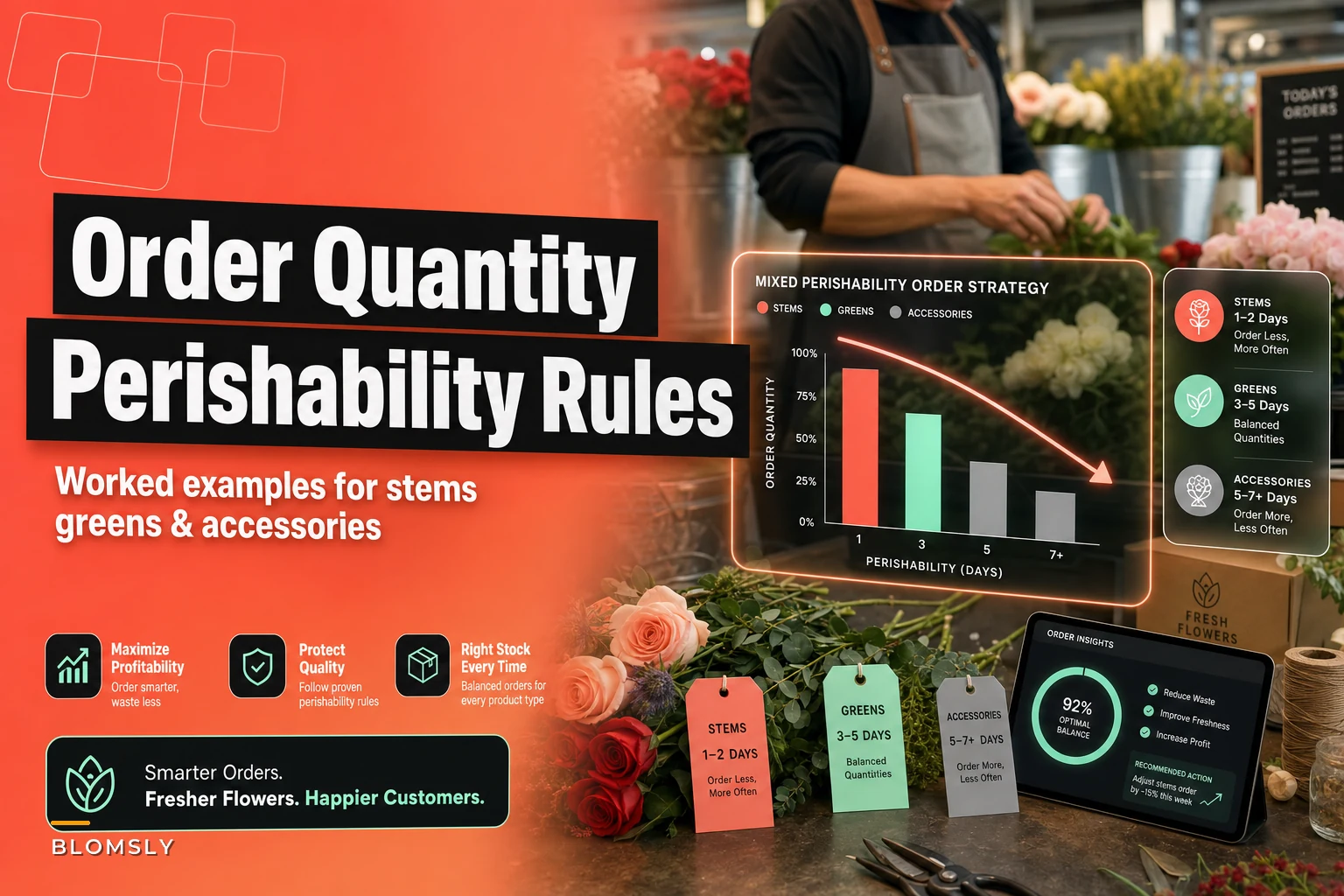

That sinking feeling when you're staring at buckets of wilted peonies while scrambling to find enough eucalyptus for tomorrow's wedding order? It's not a supplier problem. It's a math problem.
Most flower shops treat all inventory the same – order when it looks low, pray it arrives fresh, hope you sell it before it dies. But roses, dusty miller, and ribbon don't follow the same lifecycle rules. One spoils in 3 days, another lasts 2 weeks, and the third sits on your shelf for months.
Shops that separate their inventory into lifecycle categories waste less product and run out of critical items less often. The ones that don't are constantly firefighting – either throwing away expensive stems or desperately calling suppliers for emergency greens.
Why treating peonies like eucalyptus destroys your margins
Walk into any flower shop on a Monday morning and you'll see the aftermath of mismatched ordering rules. Premium stems turning brown in the cooler. Empty buckets where the Italian ruscus should be. A designer mixing three different batches of baby's breath because you keep running out mid-week.
This happens because flower shops typically use one of two broken ordering strategies:
The "eyeball method": Order when buckets look empty. This works until you realize you're checking roses daily but forgetting about leather leaf for weeks. By the time you notice you're low on greens, it's too late.
The "standard weekly order": Same quantities every week, regardless of what's actually moving. Great for your supplier's revenue. Terrible for your waste percentage.
Neither approach accounts for the fundamental reality of floral inventory: different categories deteriorate at wildly different rates and have completely different demand patterns.
A $30 bunch of garden roses might last 4-5 days in your cooler. A $12 bunch of salal tips stays fresh for 14+ days. Wire and foam? Indefinite shelf life. Yet most shops order all three using the same mental math.
Say you're ordering 15 bunches of premium stems weekly at $25 per bunch. If just 20% spoils because you're using the wrong reorder timing, that's $75 weekly, or roughly $3,900 annually in pure waste. And that's before counting the lost sales when you're out of stock on Saturday afternoon.
Breaking down the three lifecycle categories (with real cooler data)
Your inventory actually behaves in predictable patterns once you separate it properly:
Never miss a bloom or a delivery.
Blomsly helps you manage orders, track stock, and schedule deliveries effortlessly.
- Unified order management
- Real-time inventory tracking
- Delivery scheduling & notifications
No credit card required
Fast-turn stems (3-7 day shelf life) These are your roses, peonies, tulips, ranunculus – basically anything customers specifically request by name. They move fast but die faster.
In a typical shop doing around 25-30 arrangements weekly, you'll turn these every 2-3 days. That means if you order 20 bunches of roses on Monday, you better have plans for most of them by Thursday. Order too much and you're composting money. Order too little and you're sending customers elsewhere.
Medium-turn greens (10-14 day shelf life) Your workhorses: eucalyptus, ruscus, leather leaf, myrtle. These provide structure and fill for almost every arrangement. They last longer but you use them constantly.
A shop doing those same 25-30 weekly arrangements might go through 8-10 bunches of mixed greens, but spread across the entire week. The longer shelf life gives you buffer, but you still need enough on hand for unexpected orders.
Long-life accessories (30+ day shelf life) Dried elements, branches, preserved greens, plus all your hard goods like wire, foam, ribbon. These don't spoil but they do take up capital and space.
The trap here is over-ordering because "it doesn't go bad." Sure, that case of oasis foam won't spoil, but the $200 tied up in it could be buying fresh product that actually generates revenue.
The actual math: EOQ adapted for perishables
Traditional retail uses Economic Order Quantity (EOQ) formulas, but those assume products don't die in your storage room. For florals, we need modified calculations that factor in shelf life.
Red roses example:
Weekly demand: 15 bunches Cost per bunch: $22 Ordering cost (time, delivery fee): $25 per order Holding cost: 30% of value (includes cooler space, spoilage risk) Shelf life: 5 days maximum
Standard EOQ would tell you to order: √(2 × 15 × 25 / (0.30 × 22)) = 10.7 bunches
But that assumes infinite shelf life. For 5-day shelf life roses with daily usage around 3 bunches, you need to cap any single order at 4-5 days of demand maximum. So instead of ordering 11 bunches once, you're ordering 7-8 bunches twice weekly.
The adjusted formula becomes: Order quantity = MIN(EOQ, Daily Usage × Remaining Shelf Life)
Safety stock calculations that actually work for florals
Safety stock for flowers isn't like safety stock for hardware. You can't just keep extra inventory "just in case" because that extra inventory dies.
-
For fast-turn stems
Safety stock = 1 day of average demand
-
For medium-turn greens
Safety stock = 3 days of average demand
-
For long-life accessories
Safety stock = 2 weeks of average demand
If you typically use 3 bunches of roses daily, keep 3 extra bunches maximum. Any more and you're guaranteeing waste. This covers you for one unexpectedly busy day or one late delivery.
Using 1.5 bunches of eucalyptus daily? Keep 4-5 bunches as buffer. The longer shelf life means you can hold more buffer without waste, and you need it because running out of greens stops production entirely.
For accessories like ribbon, this seems like a lot, but ribbon doesn't spoil and supplier minimums often force larger orders anyway. Better to have too much ribbon than to halt production waiting for a delivery.
Real shop example: Downtown Blooms' inventory overhaul
A shop in Denver was struggling with constant stockouts of greens while throwing away $400+ weekly in dead premium stems. They were ordering everything twice weekly in set quantities, regardless of what was actually moving.
Their broken system:
-
Monday order
20 bunches roses, 10 bunches mixed greens, 5 bunches accent flowers
-
Thursday order
Same quantities
-
Result
Dead roses every Sunday, out of eucalyptus by Wednesday
The fix:
First, they tracked actual usage for two weeks:
-
Roses
18 bunches/week, heaviest Fri-Sat
-
Eucalyptus
8 bunches/week, steady daily use
-
Dusty miller
3 bunches/week, sporadic
-
Lilies
6 bunches/week, mostly weekends
Then they built separate reorder rules:
Fast-turn (roses, lilies):
-
Order Monday for Tues-Thurs demand
8 bunches roses, 2 bunches lilies
-
Order Thursday for Fri-Sun demand
12 bunches roses, 4 bunches lilies
-
Safety stock
2 bunches roses, 1 bunch lilies
Medium-turn (eucalyptus, dusty miller):
-
Order weekly
10 bunches eucalyptus, 4 bunches dusty miller
-
Safety stock
3 bunches eucalyptus, 1 bunch dusty miller
Results after 6 weeks:
-
Waste dropped from $400 to about $150 weekly
-
Stockouts reduced by roughly 75%
-
Freed up $1,200 in working capital previously tied up in dying inventory
Freed up $1,200 in working capital previously tied up in dying inventory
The worksheet math you can actually use
Practical worksheet for calculating your order quantities:
Section 1: Categorize Your SKUs
| SKU | Category | Shelf Life | Weekly Usage | Unit Cost |
|---|---|---|---|---|
| Red roses | Fast-turn | 5 days | 15 bunches | $22 |
| White roses | Fast-turn | 5 days | 8 bunches | $24 |
| Eucalyptus | Medium-turn | 12 days | 6 bunches | $18 |
| Salal tips | Medium-turn | 14 days | 4 bunches | $12 |
| Curly willow | Long-life | 60+ days | 2 bunches | $15 |
Section 2: Calculate Order Frequencies
Fast-turn: Weekly usage ÷ shelf life = order frequency
-
15 bunches ÷ 5 days = need to order every 2-3 days
Medium-turn: Can consolidate to weekly orders
-
6 bunches eucalyptus = order weekly
Long-life: Can order monthly or match supplier minimums
Section 3: Set Reorder Points
Reorder point = (Daily usage × Lead time) + Safety stock
-
If roses take 1 day to arrive and you use 3 bunches daily
- Reorder point = (3 × 1) + 3 = 6 bunches
-
When inventory hits 6 bunches, place your order
Section 4: Calculate Order Quantities
For each order:
-
Fast-turn
Daily usage × Days until next order (3 bunches/day × 3 days = 9 bunches per order)
-
Medium-turn
Weekly usage + Safety stock buffer (6 bunches/week + 2 bunches buffer = 8 bunches per order)
Order quantity = MIN(EOQ, Daily Usage × Remaining Shelf Life)
Here's a quick visual workflow for the worksheet process.
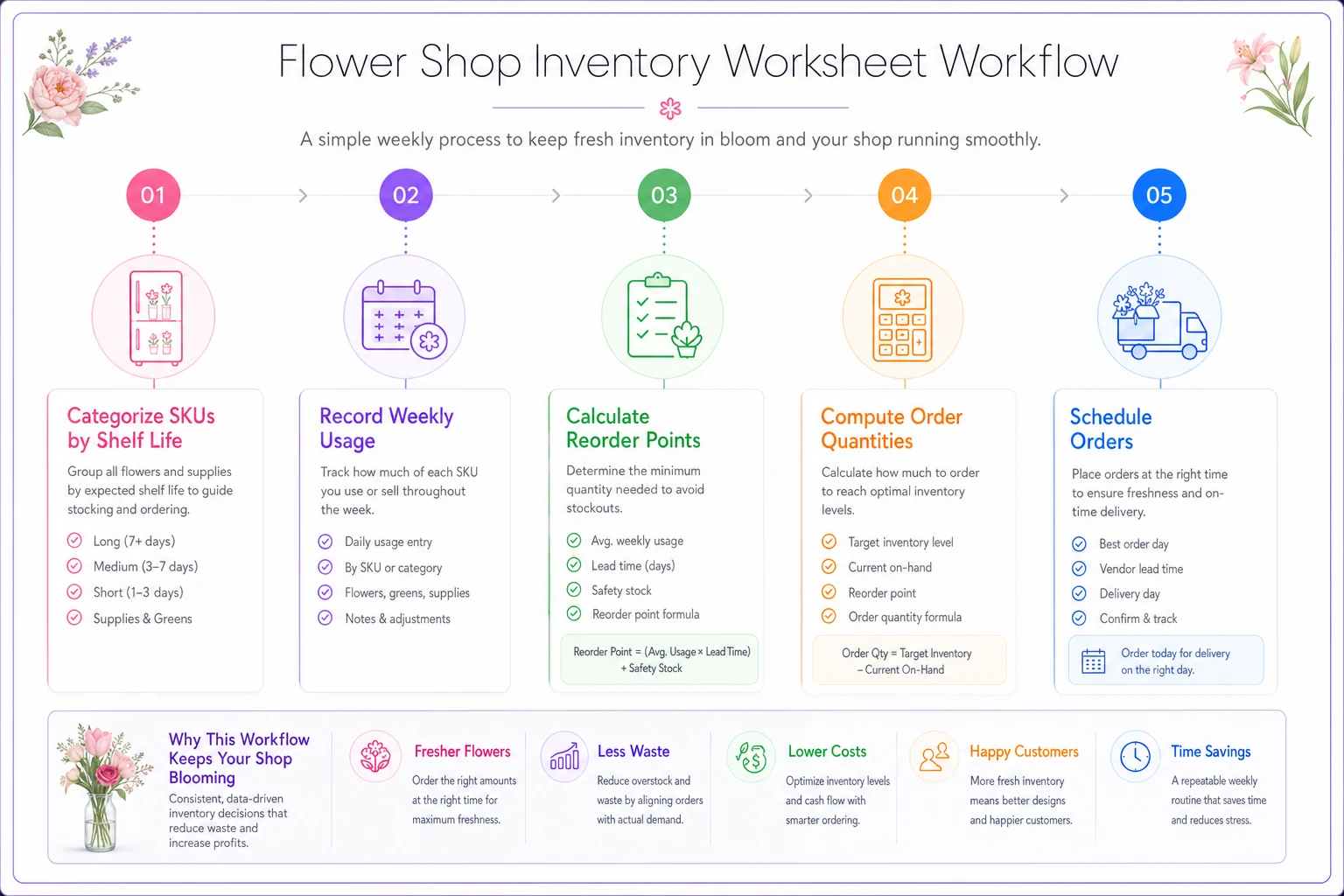
Use the worksheet sections above to move from raw SKU data to scheduled orders without guesswork.
When the math meets reality (supplier minimums and delivery schedules)
Your supplier doesn't care about your perfect calculations. They have minimums, delivery schedules, and their own constraints.
Common adjustments:
Supplier requires $300 minimum? Bundle your fast-turn and medium-turn orders to hit minimums. Don't pad with long-life items just to reach the threshold – that's how you end up with a closet full of ribbon nobody wants.
Only delivers Tuesdays and Fridays? Adjust your fast-turn calculations to match. If roses last 5 days and delivery is Tuesday/Friday, your Tuesday order needs to last through Thursday, and Friday's order covers the weekend plus Monday.
Volume discounts at certain quantities? Only worth it for longer-shelf-life items. Saving 20% on roses doesn't matter if 30% spoil. But saving 20% on preserved eucalyptus that lasts months? Take it.
Setting up tracking without drowning in spreadsheets
The math only works if you track actual usage, not theoretical demand. Most flower shops don't have time for complex inventory systems.
Minimum viable tracking:
-
Daily tally sheet by the cooler Simple hash marks for what goes into arrangements. Takes 5 seconds per arrangement, gives you real usage data.
-
Weekly waste log Every Sunday, count what you're tossing. If it's consistently the same items, your order quantities are off.
-
Stockout notes Any time you can't fulfill an order due to missing inventory, write it down. Patterns emerge quickly.
Put the daily tally sheet on a clipboard by the cooler and make it part of closing duties.
This basic tracking gives you enough data to refine your calculations monthly. You don't need perfect data, just directionally correct information that improves over time.
For shops ready to level up operations, AI-powered inventory management platforms can automate much of this tracking and calculation. Modern operational software can predict demand patterns, automatically adjust reorder points based on historical data, and even submit orders directly to suppliers. But even with sophisticated tools, understanding the underlying math helps you validate what the system recommends.
The difference between surviving and scaling
Shops using proper order quantity math typically see:
-
Waste reduction of 40-60% within the first month
-
Stockout incidents drop by more than half
-
Working capital freed up (no money tied up in dead inventory)
-
Designers spending less time managing inventory, more time designing
The bigger impact is psychological. When you're not constantly firefighting inventory problems, you can focus on growth. You can say yes to last-minute orders because you know you have the greens. You can offer premium stems confidently because you've minimized spoilage risk.
One shop owner in Portland told me switching to categorized ordering rules was like "finally getting glasses after years of squinting." Everything just worked better.
Your next Monday morning
Print this out. Grab your last month's invoices. Start with your top 10 SKUs and classify them into the three categories. Calculate basic reorder points using the formulas above.
You don't need to perfect the entire system immediately. Start with your highest-value, fastest-moving items. Get those right and you'll see immediate improvement.
The shops that thrive aren't the ones with the best suppliers or the highest prices. They're the ones that treat their cooler like the manufacturing floor it actually is – with real math, clear processes, and systems that prevent problems rather than just react to them.
Stop letting roses rot while you're out of ruscus. The math isn't complicated once you break it down by lifecycle. Your cooler (and bank account) will thank you for it.
Stop letting roses rot while you're out of ruscus. The math isn't complicated once you break it down by lifecycle. Your cooler (and bank account) will thank you for it.
Ready to grow your flower shop business?
Join 500+ flower shops using Blomsly to save time, reduce errors, and delight customers with fresh blooms.