



Most florist pricing falls apart in the gap between "gross margin on the markup sheet" and what actually landed in the bank. You mark a mixed bouquet up 3.2x, feel good about it, and then by end of month the cooler ate a chunk of your roses, a wire order came in at half your retail, and the promo you ran on Instagram pulled in orders that each cost $14 to acquire. The markup said healthy. The bank account said otherwise.
The problem isn't that florists don't understand margin. It's that the real cost of a stem-based product gets spread across four or five systems that never talk to each other — purchasing, the cooler, the design bench, delivery, and whatever channel the order came through. Each one quietly shaves margin, and none of them show up on a single screen. So you end up pricing on gut and defending promotions you can't actually measure.
This piece walks through how to build one spreadsheet — a true unit-economics model — that pulls those hidden costs into a single per-SKU number, then uses that number to set go/no-go thresholds for promotions and channels. The actual columns, the math, and the decision gates.
Why gross margin lies to florists specifically
A dry-goods retailer can lean on markup because their cost of goods is stable. A can of soup costs the same whether it sells today or Thursday. Flowers don't work that way, and that single difference breaks every borrowed pricing rule.
Three things make floral unit economics different from almost any other small-retail category:
-
Shrink is a cost of the product itself, not an exception. Some percentage of every stem you buy will never sell. That's not waste to be eliminated — it's a planned cost that belongs inside your unit cost, the same way a restaurant builds in trim loss.
-
Labor-per-unit is wildly uneven. A single-variety bunch and a hand-tied garden bouquet might retail $15 apart but cost you 25 minutes apart in design time. Markup ignores this entirely.
-
The same SKU has different economics on different channels. A $75 arrangement sold walk-in, sold via your own website, and sold through a wire service are three different products from a margin standpoint — even though the flowers are identical.
A pattern that shows up constantly: a shop looks profitable in aggregate but has no idea which parts are carrying the business and which are bleeding it. The wedding work subsidizes the daily counter. The high-touch bouquets subsidize the quick grab-and-go. Owners feel this vaguely but can't point to it, because the P&L only shows the blended result.
Stop blending. Build the number at the SKU level, per channel, with shrink and labor baked in.
The five inputs that make up a true unit margin
Before the spreadsheet, you need to agree on what actually goes into a unit. Five components, and most shops only track two of them.
Never miss a bloom or a delivery.
Blomsly helps you manage orders, track stock, and schedule deliveries effortlessly.
- Unified order management
- Real-time inventory tracking
- Delivery scheduling & notifications
No credit card required
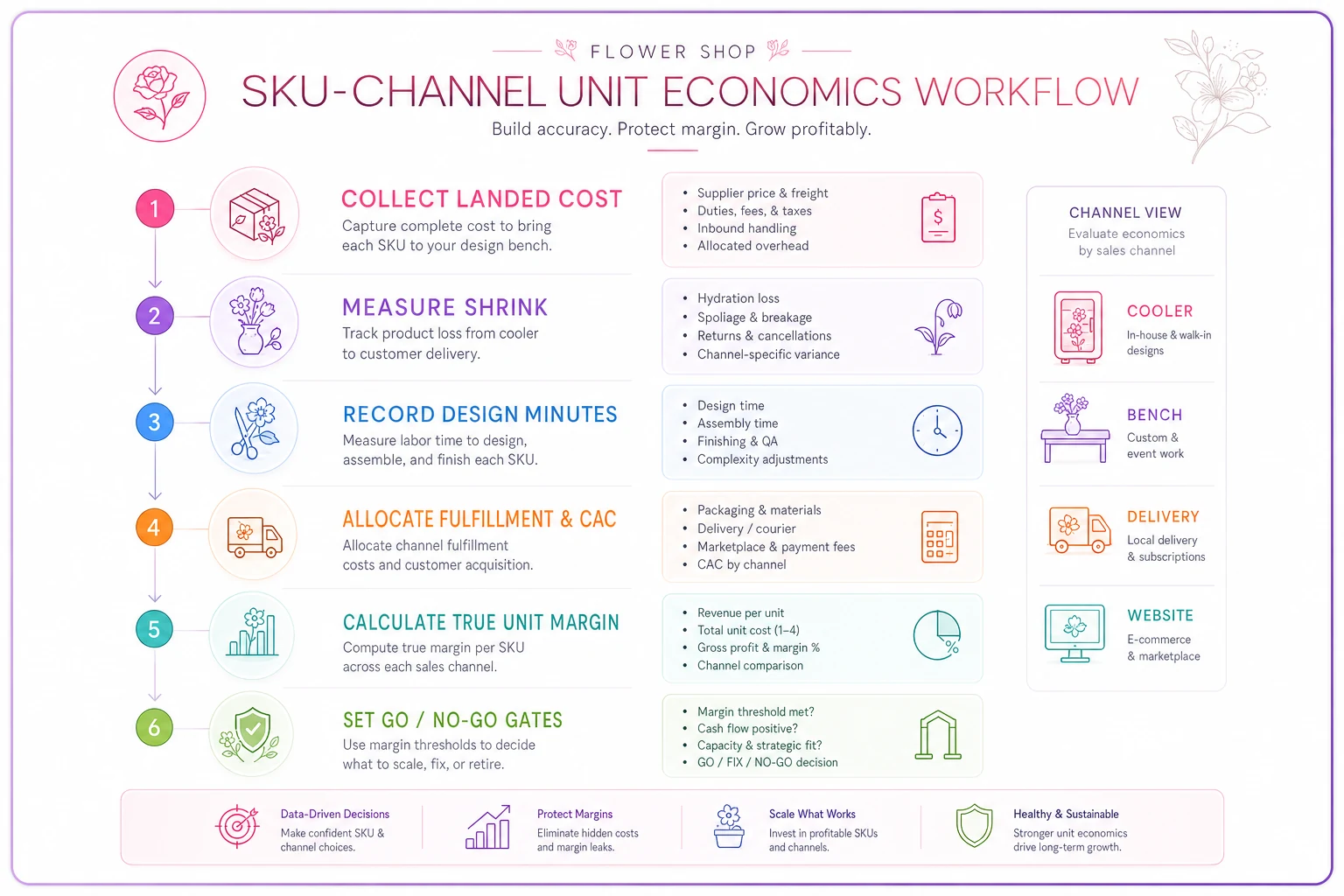
1. Landed product cost. Not the invoice price — the landed cost. Invoice plus inbound freight, allocated per stem or per bunch. If a box of 100 roses costs $90 and freight on that box was $18, your landed cost is $1.08 per stem, not $0.90. On a dozen-rose SKU that's a $2.16 difference you were ignoring.
2. Shrink load. This is the big one. If your actual shrink on roses runs 12%, then every rose you sell has to carry the cost of the ones you didn't. Effective cost per sellable stem = landed cost ÷ (1 − shrink rate). At 12% shrink, that $1.08 landed rose actually costs you $1.08 ÷ 0.88 = $1.23 per rose that makes it into a paid arrangement.
3. Design/assembly labor. Time-per-SKU times your loaded labor rate. If a designer costs you $24/hour loaded (wage plus taxes and overhead) and a given bouquet takes 11 minutes, that's $4.40 of labor in the unit. You need a rough time standard per SKU class — doesn't have to be a stopwatch study, just an honest average.
4. Fulfillment/freight-out. Delivery cost allocated to the order, or packaging cost for pickup. This swings hard by channel and by route density.
5. Channel acquisition cost (CAC). What it cost to get that order. Wire-service commission (often 20–27% plus fees). Paid-ad cost per order. Marketplace take rate. Walk-in effectively has a near-zero marginal CAC once your rent is covered, which is exactly why walk-in margin can quietly prop up everything else.
Stack those five, subtract from price, and you have true unit margin. Here's what that looks like laid out.
The core worked example
Take one SKU — a mid-tier mixed bouquet, retail $65 — and run it through the full stack across three channels.
| Line item | Walk-in | Own website | Wire service |
|---|---|---|---|
| Retail price received | $65.00 | $65.00 | $48.75* |
| Landed product cost | $14.00 | $14.00 | $14.00 |
| Shrink load (@ 10%) | $1.56 | $1.56 | $1.56 |
| Design labor (12 min @ $24/hr) | $4.80 | $4.80 | $4.80 |
| Fulfillment / delivery | $0.00 | $9.00 | $9.00 |
| Channel CAC | $0.50 | $6.50 | $12.19 |
| True unit margin ($) | $44.14 | $29.14 | $7.20 |
| True unit margin (%) | 68% | 45% | 15% |
*Wire service shows the net you actually receive after the sending/receiving split, roughly 25% off the order plus the clearinghouse fee.
The flowers cost the same in all three columns. The business is completely different. Walk-in is a 68% product. The wire version of the identical bouquet is a 15% product that barely clears labor — and if shrink runs higher than 10% or the order needs a redesign, it goes negative.
This is the moment most owners have when they first build the sheet: the channel they lean on hardest for volume turns out to be the one they're practically donating margin on. That's not an argument to drop wire service entirely — it fills slow days and sometimes brings in customers who eventually reorder direct. It is an argument to stop treating all orders as equal and to set caps and floors around the thin ones.
Turning the number into decision gates
A margin number sitting in a cell doesn't change behavior. Thresholds do. Once you have true unit margin per SKU per channel, you set go/no-go gates that anyone on the floor can apply without asking you.
A simple gate structure that works for most small shops:
-
Contribution floor. Any SKU-channel combo below this margin % doesn't get promoted, period. A common starting floor is 25% true margin — below that, you're working for the privilege of working.
-
Promo gate. Before discounting, calculate the post-discount true margin. If a 20% promo on the website bouquet above takes it from 45% to roughly 22%, it's below floor — no-go unless there's a specific strategic reason (new-customer acquisition you can prove recovers over repeat orders).
-
Channel-mix cap. Limit how much of a given SKU's volume can flow through the thinnest channel. If wire orders are 15% margin, you might cap them at around 20% of that SKU's monthly units so the blended result stays healthy.
-
Break-even volume check. For any promo, compute how many additional units you need to sell to cover the margin you're giving up on existing demand. If the promo can't plausibly hit that volume, it's a loss dressed as a campaign.
That fourth gate is the one most people skip — and it's the most important. A promo that discounts customers who were going to buy anyway isn't marketing, it's a price cut. The question is never "will this sell more?" It's "will it sell enough more to pay for the margin I'm handing back on the baseline?"
The break-even volume math, plainly
If your website bouquet makes $29.14 at full price and $14.30 after a 20% discount, you're giving up $14.84 per existing order. If you normally sell 40 of those a month, that's roughly $594 in given-back margin. To break even, the promo has to generate about 42 additional units at the discounted margin ($594 ÷ $14.30). That's more than doubling your baseline on that SKU. If that's not realistic, the promo loses money no matter how busy it feels.
What breaks as the shop grows
At one or two people, you can hold most of this in your head. You know the rose shrink is running hot this week, you know the garden bouquets are eating the bench. The model is informal but it exists.
The trouble starts around the point where you add a third or fourth person and a second sales channel. Now the person building the promo isn't the person who buys the flowers, and neither of them sees the delivery cost. Three things reliably break:
-
Shrink assumptions go stale. You priced on 10% shrink in spring and never updated when summer heat pushed hydrangea loss to 20%. Every SKU heavy on that stem is quietly underwater and the sheet still says fine.
-
Labor time drifts. New designers are slower, seasonal builds are more complex, and your 12-minute standard is now 18. Three extra minutes at $24/hr is $1.20 a unit — across a few hundred units a week that adds up to real money nobody budgeted.
-
Channel mix shifts without anyone deciding it. A good month of wire volume feels like a win until you realize it dragged blended margin down four points because nobody was watching the cap.
This is the coordination problem at the heart of florist unit economics. The data to price correctly exists in your shop — it's just scattered across the cooler, the POS, the delivery log, and the wire terminal, and no human reliably reconciles it weekly.
The spreadsheet works brilliantly right up until keeping it current becomes a part-time job nobody owns. That's the practical case for pulling these inputs into connected operational software rather than a standalone sheet — not because spreadsheets are bad, but because the inputs change faster than anyone updates them by hand. When your POS, purchasing, and delivery data feed a live margin view, shrink and labor shifts surface on their own instead of waiting for someone to notice. If you want the broader financial context around this, the shrink-adjusted cashflow and margin playbook covers how these unit numbers roll up into cash planning.
A real scenario
A single shop doing roughly $40k–$48k a month — four designers, selling walk-in, web, and wire — thought their web channel was the growth engine because order count was climbing.
When they built the per-SKU, per-channel sheet, two things came out. First, their shrink on premium stems was running closer to 16% than the 9% they'd assumed, so their mid-tier bouquets were making about 8 points less than the markup implied. Second, a standing 15%-off web promo they'd run "to stay competitive" was dropping half their web SKUs below the 25% floor — and the break-even math showed the promo would've needed to nearly double web volume to pay for itself. It wasn't close.
They didn't blow anything up. They retired the blanket promo and replaced it with targeted offers on their genuinely high-margin SKUs, tightened premium-stem order quantities to pull shrink down toward 11%, and set a soft cap on low-margin wire volume. Over the next two months blended margin moved up roughly five to six points on basically flat revenue — which on their volume was a few thousand dollars a month they'd simply been leaving in the cooler and the wire fees.
Nothing there required more sales. It required knowing which units made money.
When this framework is worth the effort — and when it isn't
Build this if:
-
You run more than one sales channel and they pay you different amounts for the same work.
-
Your shrink varies enough by season that a flat assumption is clearly wrong.
-
You're about to run promotions and want to know in advance whether they'll pay.
-
You're planning to add staff and need defensible time standards and pricing.
It's probably overkill if you're a true single-operator shop selling almost entirely walk-in, with stable sourcing and no discounting. At that scale the mental model is close enough, and your time is better spent elsewhere. Build the full sheet when channel complexity — not revenue — crosses the line.
Don't do this at all if you're going to build it once, feel enlightened for a week, and never update the inputs. A stale unit-economics model is worse than none, because it gives you false confidence to run promos on numbers that no longer reflect reality. The value is entirely in keeping shrink, labor, and mix current — which is exactly why so many shops eventually move this off a manual spreadsheet.
A copy-ready structure to start with
Set up one row per SKU-channel combination, with these columns:
-
SKU name and class
-
Channel
-
Retail price received (net, after any wire/marketplace split)
-
Landed product cost (invoice + allocated freight-in)
-
Current shrink rate for this SKU's main inputs
-
Shrink-adjusted product cost = landed ÷ (1 − shrink)
-
Design minutes × loaded labor rate
-
Fulfillment/delivery cost
-
Channel CAC
-
True unit margin ($) and (%)
-
Flag column
below floor? (yes/no)
Then a second small tab with your gates: contribution floor %, max share per thin channel, and a break-even calculator where you drop in a discount % and baseline units and it spits out the additional volume required.
Track SKU-channel rows weekly to catch shrink and labor drift before they compound.
A simple workflow for building and maintaining the sheet:
The same discipline applies to loyalty and discounting programs — redemption caps and tier rules only hold if they're built on true margin rather than markup. The logic in margin-safe loyalty tiers leans directly on the unit numbers this sheet produces.
The real takeaway
The point of florist unit economics isn't precision for its own sake — flowers are too variable for that, and anyone selling you four-decimal certainty is selling you fiction. The point is directional truth you can act on: which SKUs carry the shop, which channels you're subsidizing, and whether the next promo pays for itself before you run it.
Markup tells you what you hoped to make. True unit margin tells you what you actually made. The gap between them is where most small shops lose money they can't explain — and closing that gap starts with putting all five cost components on one screen and refusing to price on anything less.
Markup tells you what you hoped to make. True unit margin tells you what you actually made. The gap between them is where most small shops lose money they can't explain — and closing that gap starts with putting all five cost components on one screen and refusing to price on anything less.
Ready to grow your flower shop business?
Join 500+ flower shops using Blomsly to save time, reduce errors, and delight customers with fresh blooms.