


Most loyalty programs at flower shops don't fail because customers ignore them. They fail because they work too well on the wrong customers, and nobody built rules to stop the bleeding.
A shop rolls out "spend $500, get VIP status," then six months later the owner realizes their top tier is stuffed with people who buy discounted grocery-style bouquets, redeem every reward on holidays when margin is already thin, and expect same-day delivery on Mother's Day for free. The program is technically a success. Enrollment is up. Repeat visits are up. Gross margin per order is down four points, mostly buried inside the busiest weeks of the year.
That's the trap. A loyalty program without margin guardrails isn't a retention tool — it's a slow discount you can't turn off. This post is about building the guardrails.
Why florist loyalty programs quietly destroy margin
The core issue is that flowers aren't a fixed-cost product. Margin swings wildly by SKU, by season, and by fulfillment method. A loyalty reward that costs you 8% margin in February can cost you 22% margin on Valentine's week, because stem costs spiked and your labor is maxed out.
-
Redemption timing. Customers naturally save rewards for big occasions. That means your "free upgrade" or "$20 off" lands precisely when your cooler is tight, your designers are underwater, and your delivery routes are full. You're giving away discounts on your scarcest capacity.
-
Reward stacking on low-margin SKUs. If a reward can be applied to your value-tier bouquets, you're discounting the products that already had the thinnest margin. A 40%-margin bouquet becomes a 22%-margin bouquet fast.
-
Delivery abuse. Free or discounted delivery as a perk sounds harmless until your top-tier customers live 14 miles out and order every week. Delivery cost doesn't care about loyalty status.
The pattern across shops is that the loyalty program looks profitable on a spreadsheet that only counts revenue, and looks scary the moment you overlay contribution margin by week. If you've already built out a profit-per-SKU matrix and seasonal pricing tiers, you're well ahead — because tier rules should be built on top of that margin data, not on top of gross sales.
Tie tiers to LTV and margin, not just spend
The first fix is philosophical, then it becomes mechanical.
Never miss a bloom or a delivery.
Blomsly helps you manage orders, track stock, and schedule deliveries effortlessly.
- Unified order management
- Real-time inventory tracking
- Delivery scheduling & notifications
No credit card required
Stop qualifying tiers on lifetime spend. Qualify on lifetime contribution — roughly, revenue minus product cost minus fulfillment cost. Two customers can both spend $800 a year with you, but one buys premium arrangements picked up in-store (high margin, low cost to serve) and the other buys value bouquets delivered across town every week (thin margin, expensive to serve). Rewarding both identically is how you fund your worst customers with your best ones.
| Tier | Qualification (trailing 12 mo) | What it rewards | What it must NOT unlock |
|---|---|---|---|
| Base | Any account | Points, birthday note | Nothing that touches margin |
| Silver | ~$300+ contribution | 5% back as store credit | No peak-week redemption |
| Gold | ~$650+ contribution | Free local delivery (off-peak), priority pickup | No free delivery Feb / May holidays |
| Signature | ~$1,200+ contribution + 6+ orders | Early access to seasonal collections, one annual upgrade | Rewards still blackout on top 3 holidays |
Notice two things. Qualification uses contribution, not sales. And every tier has an explicit "must not unlock" column — because the reward is only half the design. The restriction is the part that protects you.
The thresholds above aren't universal. Run them against your own data. A shop doing around $400k a year will set different numbers than one doing $120k. The method matters more than the exact dollar amounts.
Redemption caps: the single most important rule
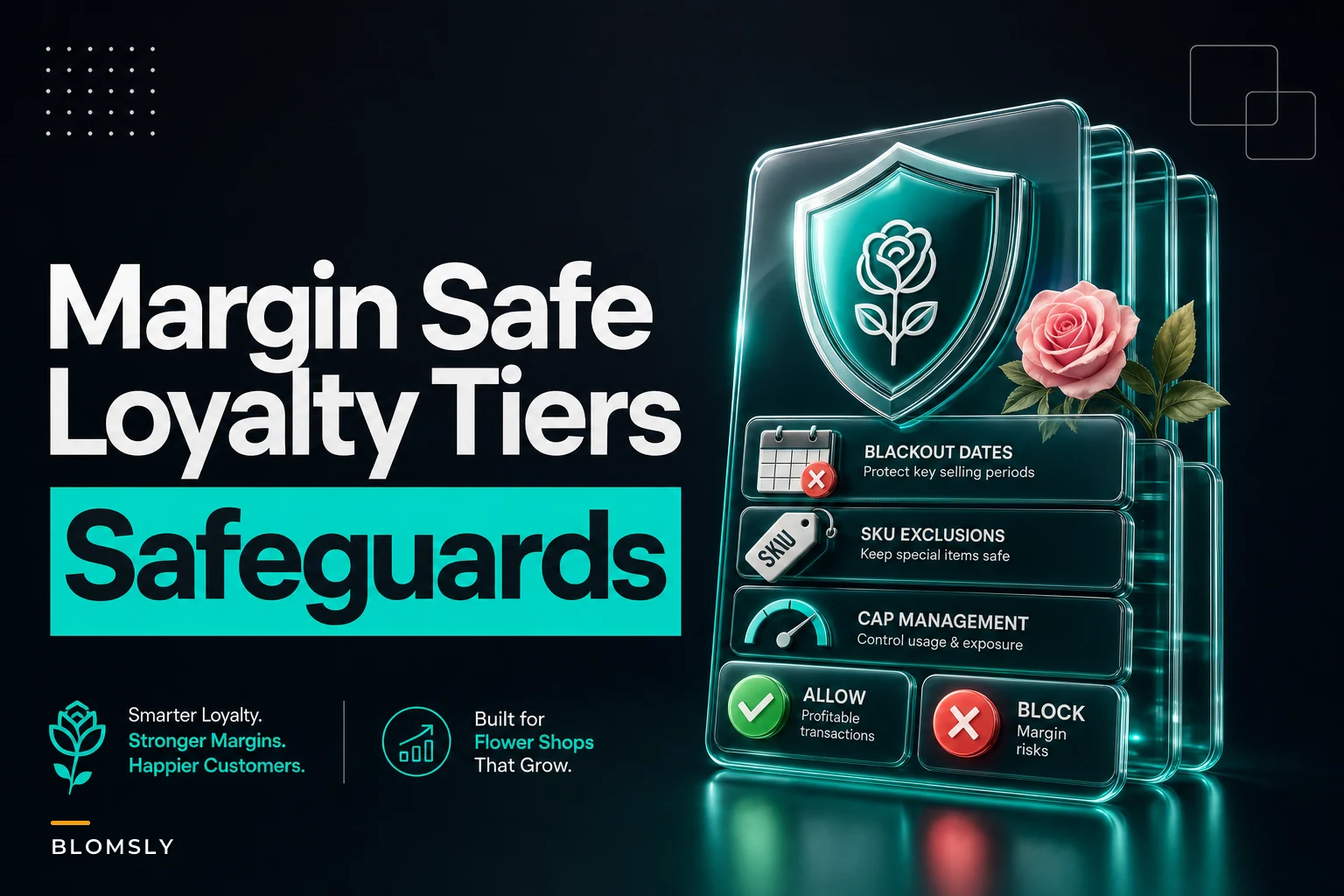
If you take one thing from this post, take this: every reward needs a cap, a blackout, and an eligibility filter.
Caps limit how much value moves per order or per period. Example: store-credit rewards can cover at most 20% of an order's subtotal, and no more than one reward applies per transaction. This stops a customer from stacking six months of points onto one Valentine's order and walking out at half price.
Blackouts protect your peak capacity windows. The big three for most shops — Valentine's week, the Mother's Day stretch, and the December holidays — should be redemption-blackout periods for anything that costs money to fulfill. Points can still accrue. They just can't be burned on the days you can least afford it. Customers accept this the same way they accept blackout dates on airline miles.
Eligibility filters decide which SKUs a reward can touch. Rewards apply only to full-margin arrangements and premium tiers — never to value bouquets, sale stems, or clearance product. This one rule alone recovers most of the margin leak in most shops.
> "Silver members earn 5% back as store credit. Credit is redeemable on premium and signature arrangements only, capped at 20% of subtotal, one per order, excluding the two weeks before Valentine's Day and Mother's Day."
Caps plus SKU filters are the fastest way to stop margin leakage in most shops.
Boring? Yes. Boring is what keeps the program profitable.
Protect operational capacity, not just money
Margin isn't the only thing loyalty programs quietly eat. They eat design-bench time and delivery slots too.
Perks like "priority fulfillment" or "same-day guarantee for VIPs" sound premium. But if you hand that to 60 top-tier customers, you've effectively promised to jump the queue for 60 people at once — during exactly the weeks your queue is already jammed. Priority for everyone is priority for no one, and it burns your designers out.
-
Cap the number of priority slots per day, not per customer. Hold 3–4 same-day priority slots daily for Signature members, first-come. When they're gone, they're gone. This keeps a premium perk from becoming an unbounded promise.
-
Route delivery perks through your existing batching logic. Free delivery as a reward should still respect neighborhood batching and cutoff times. A reward doesn't get to break your route plan; it gets to ride inside it.
The mistake shops make is treating loyalty perks as separate from operations. They aren't. A reward is just another order flowing through the same cooler, the same bench, and the same van. If a perk can't survive contact with a busy Friday, it's a bad perk.
Enforcement heuristics that actually hold up
Rules only matter if they're enforced consistently, and consistency is where small shops struggle. When enforcement lives in one manager's head, it falls apart the moment that person is off and a nice customer pushes back at the counter.
-
The redemption reads at point of sale, not at the owner's discretion. If your system flags "this reward isn't eligible on this SKU / this date," staff never have to argue. The rule is the rule.
-
One override log. If you make an exception for a genuinely valuable customer, log it. Exceptions are fine occasionally; untracked exceptions become the norm within a month.
-
Blackouts are calendar-driven, not judgment-driven. Load your blackout dates up front, for the whole year. Nobody should be deciding on Valentine's morning whether rewards apply.
-
Re-qualify tiers on a rolling 12-month window. Someone who earned Signature two years ago on one big wedding order shouldn't hold that status indefinitely. Rolling windows keep tiers honest and keep your best perks pointed at currently-active customers.
A visual of enforcement workflow follows.
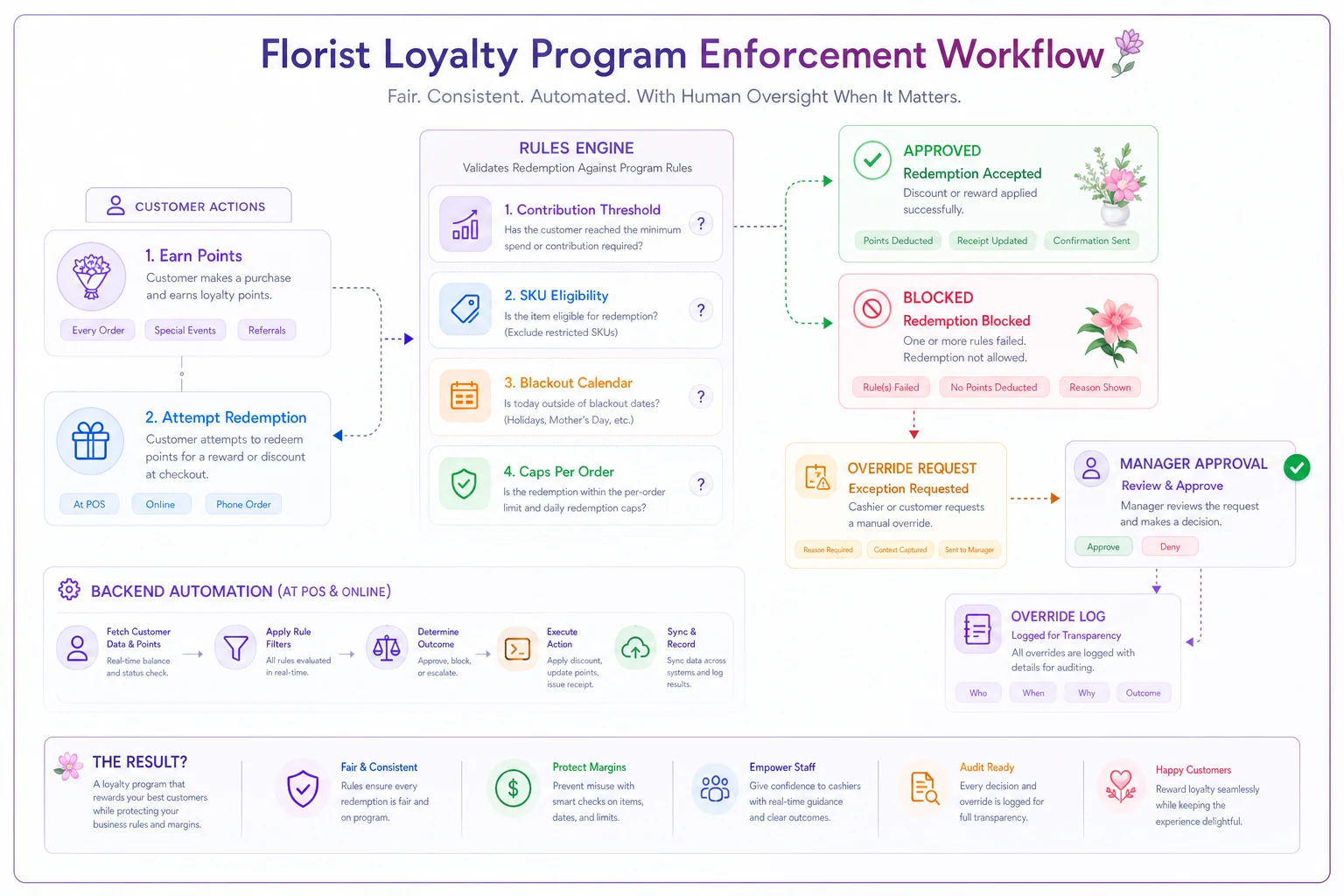
This is also where AI-assisted operational software earns its place — not as a marketing gimmick, but because enforcement across dates, SKUs, and caps is exactly the kind of repetitive rule-checking that shouldn't rely on a busy staff member at the counter. When your platform automatically applies eligibility filters, respects blackout calendars, and flags override attempts, the program enforces itself. Staff stay focused on the customer instead of mentally cross-referencing loyalty rules during a rush.
Measurement: the templates that tell you if it's working
Most shops measure loyalty by enrollment and repeat-visit rate. Those numbers go up almost automatically and tell you almost nothing about profit. You need to measure the program against LTV and margin, on a regular cadence.
-
Contribution margin per tier. Are Signature members actually more profitable per order, or just higher-spending? If your top tier's margin isn't clearly better than lower tiers, your reward design is leaking.
-
Redemption concentration by week. What share of reward value gets burned in your top 3 weeks? If it's climbing, your blackouts aren't tight enough.
-
Reward-to-incremental-revenue ratio. For every dollar of reward value given, how much incremental spend did it drive? Rewards that only subsidize purchases customers would've made anyway are pure margin loss.
-
Tier migration rate. Are Base customers climbing to Silver and Gold over time? Healthy migration means the program is pulling behavior in the right direction.
-
Cost-to-serve per tier. Delivery frequency and priority-slot usage by tier. This is where seemingly "profitable" customers sometimes turn out to be expensive.
A simple worked example: say your Gold tier gives 5% back and free off-peak delivery. Over a quarter, Gold members generated roughly $18k in revenue, you handed out around $900 in credit plus maybe $400 in absorbed delivery costs. If their contribution margin still lands meaningfully above your Base tier after those costs, the tier is doing its job. If it's basically even with Base, you're paying for loyalty that isn't paying you back — and it's time to tighten caps or raise the qualification bar.
For the retention side of the math — how tiers interact with repeat purchase behavior over a customer's life — it's worth reading this alongside your broader customer lifecycle playbook for repeat sales, since tiers are really just one lever inside that larger lifecycle.
When a tiered program actually makes sense
Not every shop should run tiers.
A tiered loyalty program makes sense when:
-
You have enough repeat customers that segmentation is meaningful (a shop where 90% of orders are one-time gift buyers won't get much from tiers).
-
You already track contribution margin by SKU, or can start to.
-
You have some system for enforcing rules at point of sale, so enforcement doesn't collapse onto one person.
A tiered loyalty program makes sense when you can actually measure and enforce the behaviors that drive profit.
When it's a bad idea
Skip tiers, or keep it to a flat points program, if:
-
Your order volume is too low to produce clean tier data — you'll be guessing at thresholds.
-
Your margins are so tight that any reward pushes value-tier orders underwater. Fix pricing first.
-
You can't enforce blackouts and caps reliably. An unenforced program is worse than none, because it trains your best customers to expect discounts on your worst days.
If you can't segment, measure, and enforce, a tiered program will likely do more harm than good.
A short real scenario
A neighborhood shop doing around $250k a year launched a "$400 spend = VIP, free delivery forever" program. Within two seasons, their busiest delivery days were clogged with free VIP deliveries, and their Valentine's margin had slipped noticeably because VIPs were stacking rewards on holiday orders.
They didn't scrap it. They rebuilt the rules: qualification moved to trailing 12-month contribution (roughly $650 for the equivalent tier), free delivery became off-peak only, rewards were filtered to premium SKUs, and the two big holidays became redemption blackouts. Priority delivery got capped at a handful of slots per day instead of an open-ended promise.
Over the next couple of quarters: total loyalty revenue held roughly steady, but the top tier's per-order margin came back up, and Valentine's week stopped being a discount event. Roughly the same customers, roughly the same enrollment — a healthier program underneath.
The takeaway
A florist loyalty tiers program should reward the customers who actually make you money, on the days you can afford it, using the products that carry margin. Everything else — the caps, the blackouts, the eligibility filters, the rolling re-qualification — exists to make sure the program never quietly turns into a discount you forgot you were giving.
Build the restrictions with the same care you build the rewards. Reward generously where it's safe, and hold the line hard where it isn't.
A florist loyalty tiers program should reward the customers who actually make you money, on the days you can afford it, using the products that carry margin. Everything else — the caps, the blackouts, the eligibility filters, the rolling re-qualification — exists to make sure the program never quietly turns into a discount you forgot you were giving.
Build the restrictions with the same care you build the rewards. Reward generously where it's safe, and hold the line hard where it isn't.
Ready to grow your flower shop business?
Join 500+ flower shops using Blomsly to save time, reduce errors, and delight customers with fresh blooms.