

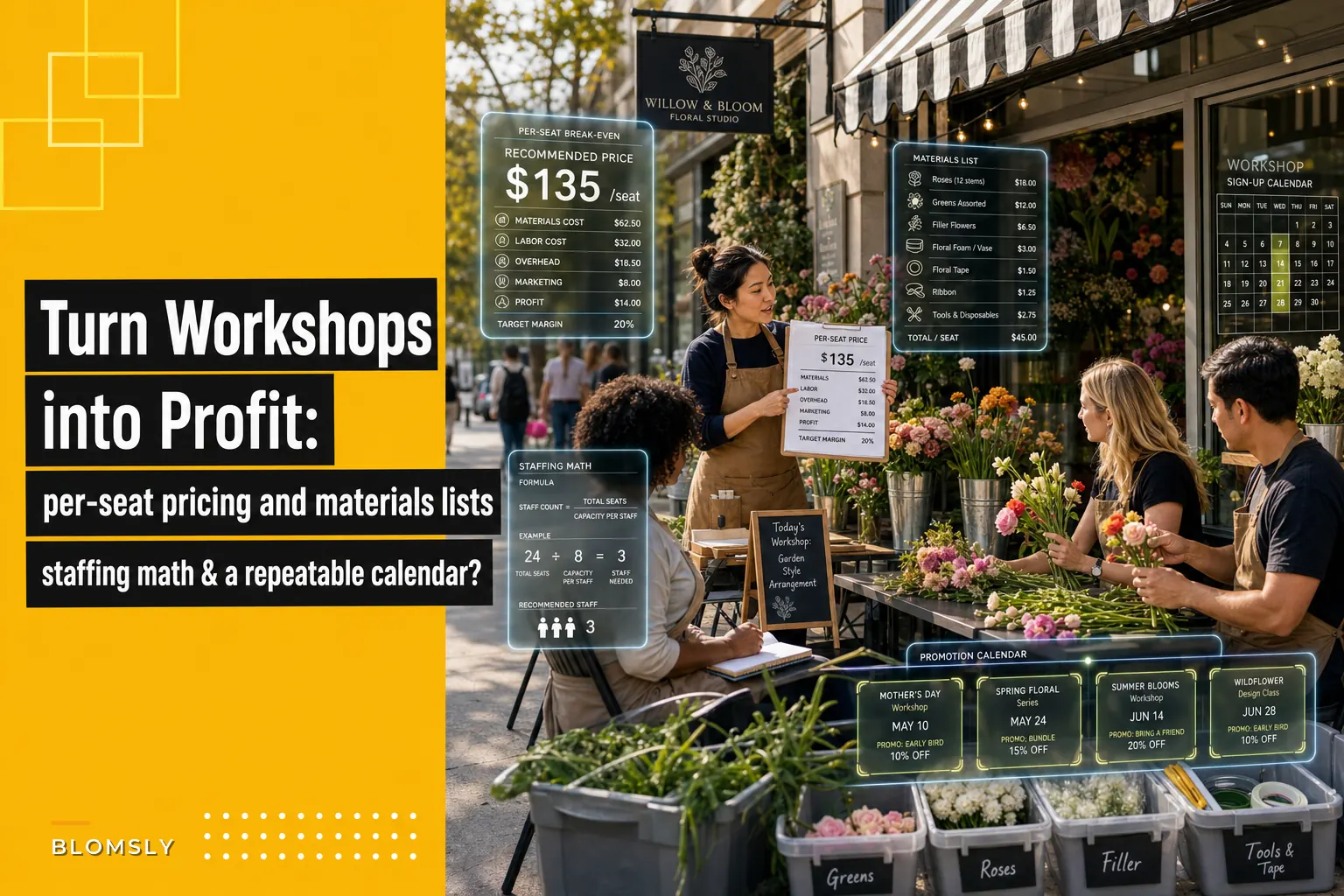

Most flower shops treat workshops like a fun side thing. A wine-and-flowers night, a wreath class before the holidays, a corporate team-building session someone booked over email. The room fills up, everyone leaves happy, the photos look great on Instagram — and then you look at the numbers three weeks later and realize you barely broke even. Sometimes you lost money and didn't notice because it got buried inside a busy week.
The frustrating part is that workshops should be one of the highest-margin things a florist does. You're selling your design expertise, not just stems. But the reason they leak money isn't the pricing sticker on the ticket — it's the math underneath the seat. The per-seat price is basically a guess that felt reasonable at the time, because nobody actually calculated what one seat costs to fill.
This is a walkthrough of how to build that per-seat math from the bottom up, what the materials list should actually look like, how to staff by seat count instead of by habit, and how to schedule workshops so they stop being random events and start being a repeatable revenue stream.
Why "sounds about right" pricing quietly loses money
A typical workshop gets priced like this: the owner remembers seeing a competitor charge $75 for a similar class, rounds it to $85 because their neighborhood skews a little higher-end, and calls it done. Twelve seats at $85 is $1,020. Feels like a good night.
Here's where it falls apart. Stems for a hand-tied bouquet workshop run higher per person than a normal retail bouquet, because you're buying variety and giving people extra so they don't run out mid-class. You're also giving away vases or wraps, twine, snips that sometimes walk out the door, and other consumables. Then there's two hours of instruction, an hour of prep before, 45 minutes of cleanup after, and usually a second person helping. Add the space — even if you own it, that evening the shop isn't doing anything else.
When you actually itemize it, that $85 seat frequently nets $20–$30 after everything. Fill eight seats instead of twelve and you're underwater. The class felt profitable because cash came in the door, but cash-in-the-door and profit are not the same thing, and workshops are where that gap hides best.
Build the per-seat break-even first, price second
The mistake is pricing the seat and then hoping the costs fit underneath it. Flip it. Figure out what one seat costs you, account for labor, then set the price so your break-even seat count is low enough that a half-full room still works.
Never miss a bloom or a delivery.
Blomsly helps you manage orders, track stock, and schedule deliveries effortlessly.
- Unified order management
- Real-time inventory tracking
- Delivery scheduling & notifications
No credit card required
Break your per-seat cost into two buckets: variable cost (scales with each person) and fixed cost (happens whether 6 or 16 show up).
Here's a worked example for a 12-seat hand-tied bouquet class priced at $95:
| Line item | Type | Cost |
|---|---|---|
| Flowers per seat (10–14 stems, mixed) | Variable | $22 |
| Greens + filler per seat | Variable | $4 |
| Vase or kraft wrap + twine | Variable | $6 |
| Snips/consumables/loss allowance | Variable | $2 |
| Refreshments (wine, snacks) per seat | Variable | $5 |
| Variable cost per seat | $39 | |
| Lead designer, 3.5 hrs (prep+teach+clean) | Fixed | $105 |
| Assistant, 2.5 hrs | Fixed | $45 |
| Space/utilities for the evening | Fixed | $40 |
| Marketing (share of ad + email time) | Fixed | $30 |
| Total fixed cost | $220 |
Contribution per seat = $95 − $39 = $56.
Break-even seats = $220 ÷ $56 = 3.9, so you need 4 seats just to cover the night. Sell 8 and you clear roughly $228 profit. Sell all 12 and it's about $452.
That's the number that actually matters: 4 seats to break even out of 12. Now you know a soft night still doesn't hurt you, and you can stop stressing when signups are slow early in the week.
Here's a simple workflow you can visualize to keep the steps straight.
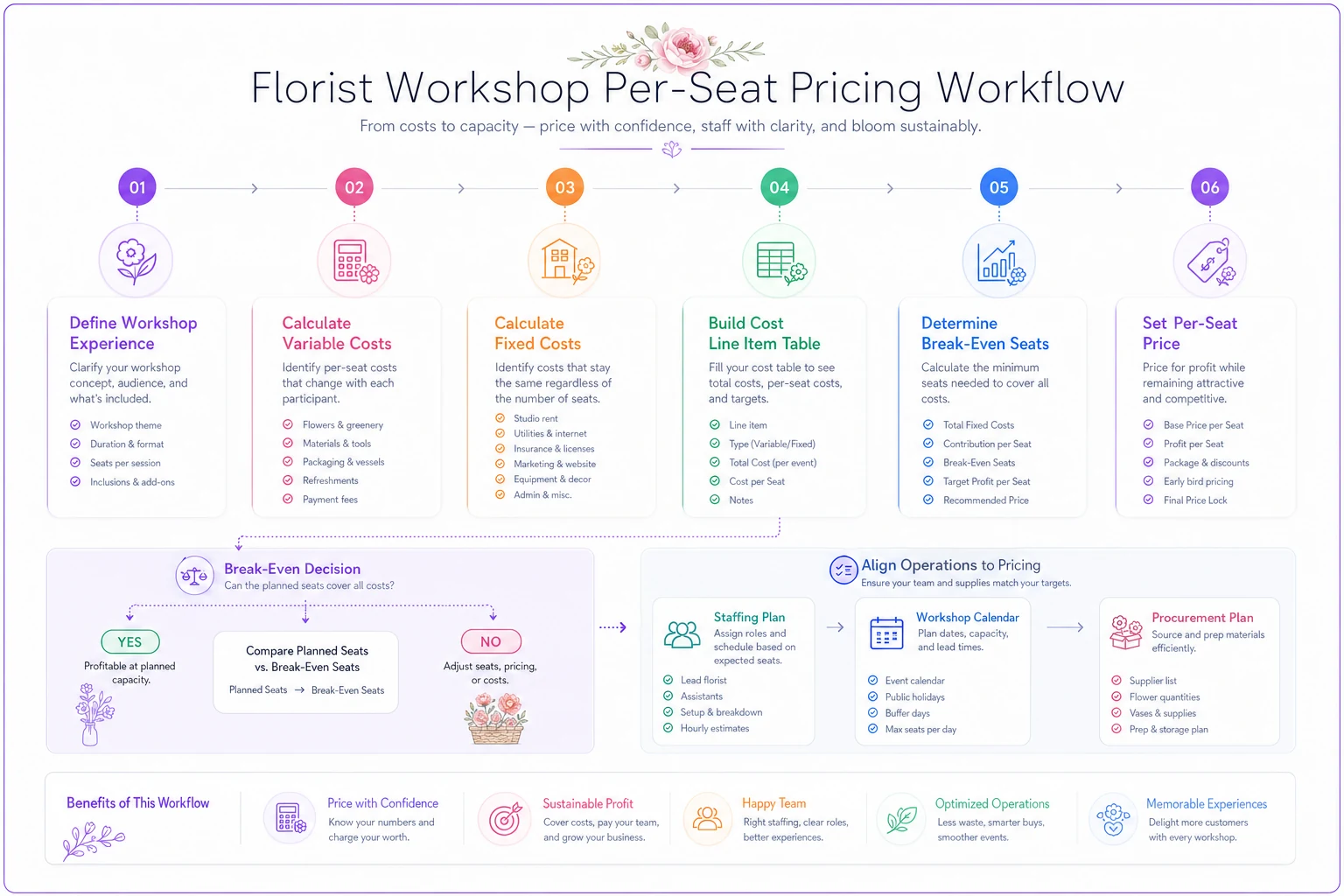
If your break-even lands at 8-out-of-12, your pricing is too thin or your materials are too generous. Either raise the seat price, trim the per-seat flower count, or swap the giveaway vase for a wrap.
The materials list is a procurement document, not a suggestion
Workshops bleed money most through a loose materials list. "Grab enough flowers for 12" turns into ordering for 15 to be safe, which is a 25% overbuy on the most perishable thing in the room. Multiply that across a season of classes and it's real money left in the cooler wilting.
A workshop materials list should read like a purchase order, tied directly to confirmed seats. For each class, build it as:
-
Per-seat stem count, by variety — e.g., 4 focal roses, 3 spray stems, 3 filler, 2 greens per person. Not "roses, some spray, filler."
-
Confirmed seat count as of order cutoff — order to paid seats plus a fixed small buffer, not to capacity.
-
Buffer rule, written down — one extra seat's worth of stems, not "round up generously." One buffer seat on a 10-person class is 8% overbuy; rounding up "to be safe" is often 20–30%.
-
Hard goods count — vases, wraps, twine lengths, tools. These don't perish, so you can carry a small standing stock between classes.
-
Consumables — anything you'll reorder every time, listed so nobody discovers you're out of twine at 6pm.
The rule that saves the most money: set an order cutoff 48–72 hours before the class and only buy against paid seats at that moment.
People who sign up the day before pay a walk-up rate and work from buffer stock. This one change usually cuts workshop flower waste noticeably, because you stop buying for seats that never sell.
If you already track SKUs and perishability tightly for retail, the same logic applies here — your workshop stems are just a small, dedicated order with its own cutoff.
Staffing math per seat, not per event
The other silent cost is staffing by habit. Two people run every class regardless of size, because that's what you did last time. A 6-person wreath class does not need the same crew as a 16-person centerpiece night, but it usually gets it anyway.
A cleaner approach is a seat-to-staff ratio by class type, because messier classes need more hands:
-
Simple classes (wreaths, dried arrangements, low mess)
1 instructor per 8–10 seats, no assistant until you cross 10.
-
Wet/complex classes (hand-tied, compotes, anything with mechanics): 1 instructor per 6–8 seats, add an assistant past 6.
-
Corporate/private groups
staff to the promised experience, not the seat count — these people paid a premium for attention.
Worth noting: understaffing a class doesn't show up as a cost line item — it shows up as a slow, chaotic room where the instructor can't reset for cleanup, the night runs 30 minutes long, and people leave slightly underwhelmed. Overstaffing shows up directly on the P&L. Most shops overstaff small classes and understaff their big ones, which is exactly backwards.
Tie the staffing decision to the order cutoff. When you lock seats 48 hours out, you also lock the crew. If only 5 signed up for a hand-tied class, one designer runs it solo and your fixed cost drops by roughly $45 — which meaningfully changes that night's break-even.
A promotion calendar turns one-offs into a revenue stream
Workshops stay unprofitable partly because they're unpredictable. You announce one when you feel like it, scramble to fill it, and marketing gets crammed into the last week. Irregular promotion means irregular fill rates, which means you can never plan procurement or staffing with any real confidence.
The fix is boring and it works: put workshops on a fixed cadence and market backward from each date.
-
Pick a repeatable slot. Second Thursday evening every month, for example. Same night each time, so regulars learn to expect it.
-
Theme it to the season. Spring bulbs, summer garden style, fall wreaths, holiday centerpieces, Valentine's couples night. Seasonal themes also match what you're already buying for retail.
-
Open registration 3–4 weeks out. That's your window to fill seats and hit your order cutoff with real numbers.
-
Run a fixed promo sequence per class announcement email at 3 weeks, a "half full" nudge at 2 weeks, a last-seats push at 1 week, plus 2–3 social posts spaced through the window.
-
Close signups at the 48-hour cutoff. After that, walk-up rate only, from buffer stock.
Your existing customers are the cheapest seats to fill, and workshop attendees tend to become repeat retail buyers — which is why folding workshops into your broader customer lifecycle and repeat-sales approach does more than sell a class; it feeds the rest of the shop.
Once the calendar exists, the whole operation gets easier to manage. You can batch-order across classes, reuse hard goods between months, and forecast staffing weeks ahead. Some shops track this inside their scheduling and inventory software so seat counts, materials lists, and crew assignments all update together as registrations come in. The point isn't the tool — it's that the per-seat math stops being a spreadsheet you rebuild from scratch every time a new class goes up.
When workshops actually make sense — and when to skip them
They make sense when:
-
You have slow evenings where the shop isn't otherwise earning.
-
Your break-even seat count sits comfortably below half capacity.
-
You've got a designer who's genuinely good at teaching, not just arranging.
-
You want a low-friction way to turn casual buyers into regulars.
They're a bad idea when:
-
Your peak weeks are already maxed — don't burn scarce designer hours on a class during Valentine's or Mother's Day crunch.
-
You can only fill classes by pricing them so low the contribution per seat drops under roughly $40.
-
Nobody on staff actually wants to teach. A resentful instructor kills repeat attendance faster than bad flowers.
Who should probably skip public workshops entirely: a solo operator already stretched thin on same-day orders. For that shop, the better version is private and corporate bookings — fewer, higher-margin, scheduled on your terms. If that's the direction, the pricing and SLA logic in the corporate accounts playbook maps almost directly onto private workshop deals.
A real scenario
A two-person shop ran occasional workshops "when things were slow," pricing seats at $70 with no real cost tracking. Their wreath classes felt fine; their wet hand-tied classes quietly lost money because they over-ordered stems every time and always ran two staff regardless of turnout.
They rebuilt the per-seat math. Hand-tied seats went to $95 with a written 4-seat break-even. Materials orders got tied to a 48-hour paid-seat cutoff with a one-seat buffer. Small classes dropped to solo staffing. They locked in a monthly second-Thursday slot with a three-week promo window.
Over the next several months, flower overbuy on workshops fell noticeably, average fill went from roughly half a room to close to two-thirds, and the classes shifted from breaking even to contributing somewhere in the low hundreds of profit each month. Not life-changing money, but steady, predictable, and finally worth the effort — not just the Instagram photos.
The core idea
The reason florist workshop pricing per seat trips shops up isn't the number on the ticket. It's that the number got set before anyone knew what a seat actually costs.
Build the break-even from variable and fixed costs, tie your materials list to paid seats with a real cutoff, staff to the class type instead of to habit, and put the whole thing on a calendar you can market against. Do that consistently and workshops stop being a fun break-even hobby and start behaving like the high-margin revenue stream they were always supposed to be.
Do that consistently and workshops stop being a fun break-even hobby and start behaving like the high-margin revenue stream they were always supposed to be.
Ready to grow your flower shop business?
Join 500+ flower shops using Blomsly to save time, reduce errors, and delight customers with fresh blooms.