

Walk into any flower shop on a Monday morning and you'll find the same depressing scene—buckets of wilting roses nobody wanted over the weekend, hydrangeas starting to brown at the edges, and that expensive shipment of peonies that just didn't move as fast as expected. Most florists write this off as the cost of doing business with perishables. But floral waste reduction isn't about accepting losses—it's about building systems that turn potential shrink into recovered margin.
The typical flower shop tosses anywhere from 15% to 35% of their weekly inventory. At those rates, a shop doing $400k annually is literally throwing away $60,000 to $140,000 worth of product every year. That's not just lost inventory cost. It's the labor spent processing those stems, the cooler space they occupied, and the opportunity cost of not having fresher product to sell instead.
What makes this particularly frustrating is that most of these stems still have value when they first show signs of aging. A rose that's too old for a premium arrangement might work perfectly in a budget bouquet. Slightly wilted eucalyptus can become dried product. Those peonies nobody bought at full price would have sold at 40% off to walk-in customers looking for a deal. The problem isn't the aging inventory—it's the lack of systematic approaches to capture value before it's completely gone.
Why traditional waste tracking fails in flower shops
Most florists track waste by counting dead stems at the end of the week and recording a dollar amount in their books. This tells you nothing useful. By the time you're counting dead flowers, the opportunity to recover any value has already passed. You're essentially doing an autopsy instead of preventive care.
The real issue runs deeper. Flower shops operate with this weird mix of high-margin special orders and low-margin walk-in sales, premium imports and commodity carnations, products with 3-day lifespans sitting next to ones that last two weeks. Without clear rules for what happens to each product category as it ages, your team makes different decisions every single day. One designer tosses stems that another would use in a mixed bouquet. Your morning shift marks down products differently than your evening crew.
Then there's the psychological barrier. Many florists treat markdowns like admitting failure. They'd rather maintain the illusion of premium pricing while watching inventory die in the cooler. Others go the opposite direction—panic discounting everything the moment it looks less than perfect, training customers to wait for deals instead of buying at full price.
Temperature fluctuations make everything worse. Every time someone props the cooler door open during busy periods, you're accelerating aging across your entire inventory. Those five minutes add up. Combined with improper stem treatment and processing shortcuts during rush periods, you're fighting a losing battle before you even start thinking about salvage strategies.
Daily triage: the morning assessment that changes everything
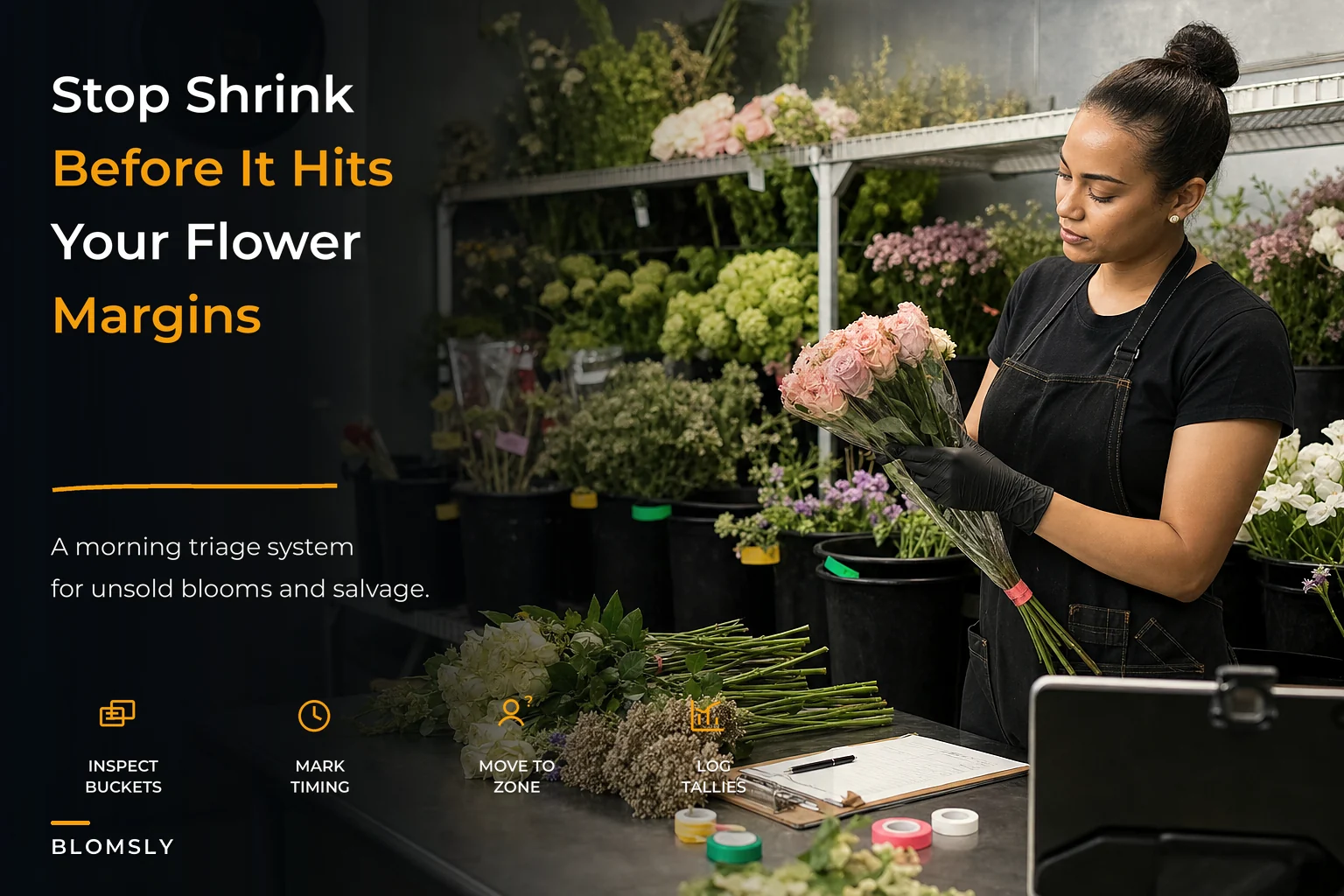
The most successful waste reduction programs start with a simple morning ritual that takes less than 15 minutes but fundamentally changes how inventory moves through your shop. Before any design work begins, before the register opens, one person needs to walk the cooler with a specific checklist.
Never miss a bloom or a delivery.
Blomsly helps you manage orders, track stock, and schedule deliveries effortlessly.
- Unified order management
- Real-time inventory tracking
- Delivery scheduling & notifications
No credit card required
Start with your highest-value inventory. Those garden roses costing $4.50 per stem wholesale? Check every single one. Look for guard petals starting to separate, any browning on edges, stems getting soft. These signs appear 24-48 hours before the rose is truly unusable, giving you a window to act. Mark these stems immediately—physically separate them or use colored tape—so everyone knows their status.
Mark these stems immediately—physically separate them or use colored tape—so everyone knows their status.
Move through each product category with different criteria. Chrysanthemums can look perfect but have stems that are starting to get slimy underwater. Hydrangeas might have one or two florets browning while the rest of the bloom remains pristine. Eucalyptus and other foliage often age beautifully if you let them. The point isn't to be picky—it's to identify which products need to move today versus tomorrow versus next week.
Create three physical zones in your cooler:
-
full-price premium display
-
marked-for-promotion
-
design-only stems
That middle category is critical. These are flowers that look good enough for retail sale but need to move quickly. The design-only section holds stems that shouldn't go in premium arrangements but work fine as filler or in lower-price-point products.
Your triage person needs decision-making authority. Nothing kills this system faster than having someone identify problems but need manager approval for every markdown or salvage decision. Set clear parameters—anything under X days old gets Y% discount, stems showing Z signs move to clearance immediately. Write these rules down. Post them in the cooler.
Track what you find each morning. Not in some complicated spreadsheet, just simple tallies. Monday: 24 roses moved to promotion, 8 to design-only. This data becomes invaluable for adjusting your order quantities for different product categories. If you're consistently moving 30% of your white roses to markdown by day 3, you're either ordering too many or need better storage protocols.
A simple visual of the triage workflow helps teams run it consistently.
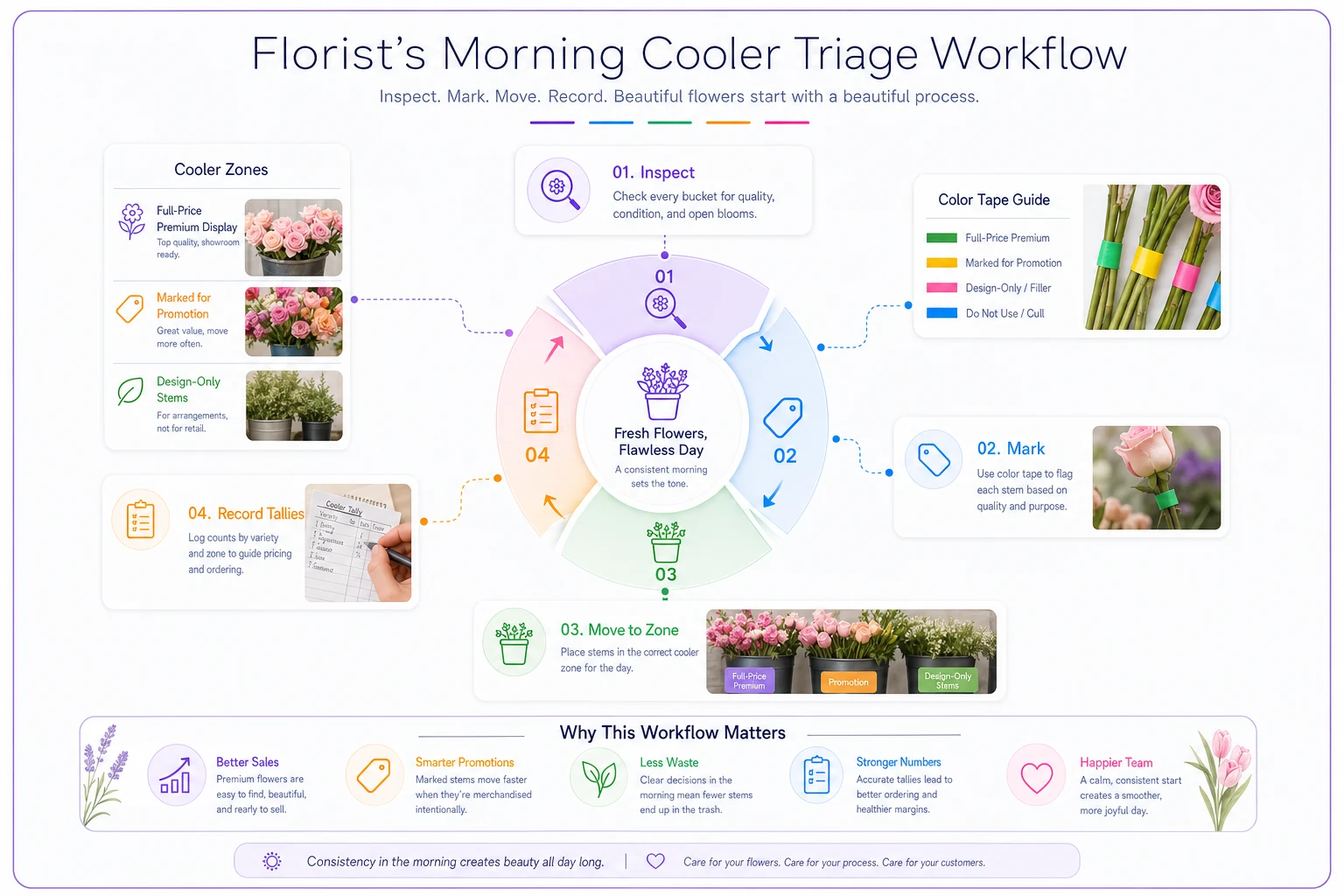
Use this to train staff quickly.
Salvage recipes: turning aging inventory into profitable products
The biggest mistake shops make with aging inventory is trying to hide it in regular products. Customers notice when their $75 arrangement has flowers that look tired. Instead, create specific products designed around secondary-quality stems that still deliver real value at appropriate price points.
"Designer's Choice Budget Bouquets" become your salvage workhorse. Price these at $15-25, explicitly marketed as a great value option. Use a mix of marked-down stems, shorter stems from arrangement prep, and flowers that are beautiful but not pristine. Make plenty of them and display them prominently. Customers shopping for "something nice under $20" will grab these immediately instead of walking out empty-handed.
Build a weekly "Flower Friday" special using whatever needs to move. Every Friday, create 10-15 identical $30 arrangements using your oldest viable inventory. Post them on social media Thursday night, sell them Friday only. Customers start expecting this deal, and you move inventory that would otherwise die over the weekend. One shop moved $400-600 worth of aging inventory every Friday this way—stems that would have gone in the dumpster Monday morning.
Create dried flower products from stems that are aging but not dead. Roses, eucalyptus, lavender, and dozens of other varieties dry beautifully if you catch them at the right stage. Hang them in a back room for a week, then sell dried bunches for $12-18. The labor is minimal—literally just hanging them up—and you're creating a product some customers actually prefer. A shop doing $350k annually can add $15-20k in revenue just from systematically drying the right inventory.
Partner with local restaurants for weekly fresh flower subscriptions using your B-grade stems. Restaurants want flowers but don't need premium quality—they need volume and consistency at a reasonable price. Offer a standing weekly order at 40-50% off retail using your marked-down inventory. You're guaranteeing sales for stems that might not sell otherwise, and restaurants get professional arrangements at prices that make sense for their budget.
Consider "imperfect bunches" sold explicitly as practice flowers for hobbyists or event DIYers. Price these at barely above wholesale—you're competing with grocery stores here—but you're moving volume. Someone planning a DIY wedding will happily buy 10 bunches of slightly imperfect roses at $8 each instead of perfect ones at $25. You just moved $80 worth of inventory that was heading for the trash.
Event and partnership plays that guarantee salvage sales
The random nature of walk-in traffic makes salvage unpredictable. Some days you'll move everything, other days nothing sells despite aggressive markdowns. This variability kills margin recovery because you can't plan around it. The solution is creating structured outlets for B-grade inventory that don't depend on retail traffic.
Nursing homes and assisted living facilities are an obvious starting point. They need flowers for common areas, dining rooms, and resident events, but they're buying on tight budgets. Offer a weekly delivery of "comfort bouquets" at $8-12 each using your aging inventory. A medium-sized facility might take 10-15 bouquets weekly—that's $400-700 monthly in guaranteed sales for flowers you're currently throwing away. The arrangements don't need to last long; they're getting replaced next week anyway.
Corporate offices present another systematic opportunity. Many businesses want lobby flowers but balk at premium prices. Offer a Monday morning refresh service using weekend markdowns. You're delivering arrangements made from flowers that would die in your cooler by Wednesday, but look perfectly professional on Monday. Price these at 50% of normal corporate rates and you'll still maintain healthy margins on inventory with zero retail value otherwise.
Create standing orders with event planners for practice sessions and mockups. Planners constantly need flowers to test designs, show clients concepts, and train staff. They don't need premium quality for this—they need volume and variety at low cost. One planner relationship might absorb $200-300 worth of B-grade inventory monthly. Three or four of these relationships eliminate a meaningful chunk of weekly waste.
Religious organizations often need flowers for multiple services, community events, and social programs. Many operate on donation-based budgets that make premium flowers impossible. Offer a "community support program" where they get significant discounts on aging inventory. You're not just moving product—you're building community relationships that drive word-of-mouth. These organizations talk, and being known as the florist who supports local churches and temples brings full-price business you wouldn't otherwise see.
School partnerships work particularly well for moving seasonal overstock. Elementary schools need flowers for teacher appreciation, parent events, fundraisers, and dozens of other occasions. Create a "school partner program" where they get wholesale pricing on B-grade inventory for any school-related purpose. A single elementary school might move $300-500 monthly in inventory you'd otherwise toss, and there are probably 5-10 schools in your delivery area.
Pricing psychology for blemished and aging stock
The way you price and present marked-down flowers determines whether customers see them as deals or damaged goods. Most shops either hide their clearance flowers in a back corner where nobody sees them, or display them so prominently that customers assume the whole shop sells old flowers. Neither works.
Create a dedicated "value section" that feels intentional, not desperate. Use signage like "Today's Deals" or "Fresh Picks Under $20" rather than "clearance" or "last chance." Position this section where customers pass it naturally—near the register or entrance—but not as the first thing they see. You want deal-seekers to find it easily without suggesting your primary inventory is overpriced.
Price markdowns in tiers based on days until unusable, not arbitrary percentages:
| Days Remaining | Discount |
|---|---|
| 3-4 days left | 25% off |
| 1-2 days left | 40% off |
| Final day | 60% off or $5 grab-and-go bunches |
This systematic approach means customers know what they're getting and staff doesn't need to make judgment calls.
Bundle aged inventory with fresh product to maintain perceived value. A bouquet of slightly older roses looks tired. The same roses mixed with fresh eucalyptus, some commercial mums, and baby's breath looks like a thoughtful mixed arrangement. Price it at $22 instead of $35 and customers feel like they're getting a designed product at a great price, not old flowers you're trying to dump.
Time-based promotions work better than permanent markdowns. "Happy Hour Pricing 3-5 PM" or "Monday Morning Markdowns" create urgency without suggesting desperation. Customers start timing their visits to catch deals, and you're concentrating sales during slower periods when staff has time to move volume.
Never discount your premium products to move them. Instead, create entirely different products at lower price points. That $85 premium rose arrangement that didn't sell doesn't become a $45 rose arrangement—those roses become part of $25 mixed bouquets where their age is less noticeable and the value proposition is different.
KPIs that actually track shrink-to-margin recovery
Measuring waste reduction requires more than just tracking what you throw away. You need metrics that show whether your salvage efforts actually generate profit or just move problems around. The lifecycle tracking systems most shops use miss the critical middle step—the value recovery phase.
Start tracking "salvage capture rate"—the percentage of marked-down inventory that actually sells before disposal. If you're marking down 100 stems weekly but only selling 30, your pricing or presentation needs work. A healthy capture rate runs somewhere in the 60-70% range for most shops. Below 50% means you're marking down too late or pricing too high. Above 80% might mean you're discounting too aggressively and leaving money on the table.
Monitor "days to markdown" by product category. Roses might average 3.5 days before needing markdowns, while chrysanthemums last 6 days. This data directly informs your ordering patterns. If certain products consistently hit markdowns before selling at full price, you're either ordering too much or displaying them poorly.
Calculate "markdown margin" separately from overall margin. If your regular arrangements run 3.2x markup but markdowns only achieve 1.8x, that's still profitable—just less so. The question becomes whether that 1.8x margin beats the 0x margin of throwing flowers away. For most shops, anything above 1.5x on markdowns represents successful value recovery.
"Shrink percentage by category" tells you where to focus efforts. You might discover that 40% of your rose shrink comes from a single variety that doesn't sell well in your market. Or that tropical flowers generate 3x the waste rate of traditional stems. One shop found their annual waste in stargazer lilies alone was running close to $8,000—and simply eliminated the SKU.
Track "salvage revenue per labor hour" to make sure your recovery efforts actually make financial sense. If you're spending 2 hours daily on markdowns and salvage to generate $40 in recovery sales, you're losing money. But if those same 2 hours generate $150 in sales that wouldn't happen otherwise, you're adding $30-40 to daily profit after labor costs. Most efficient shops generate somewhere around $75-100 per hour spent on systematic salvage efforts.
Building the daily routine that stops waste before it starts
Consistent daily actions beat heroic weekly cleanup efforts every time. Your team needs a rhythm that makes salvage and markdown decisions automatic.
Morning cooler walks need to happen before anything else—not after the first customer, not when someone remembers. First thing. This 15-minute investment drives every other decision that day. The person doing this needs to understand both the products and the business impact. They're not just looking for bad flowers; they're identifying opportunities for margin recovery.
Midday adjustments keep inventory moving. Around 2 PM, someone should check what marked-down inventory hasn't sold and make quick decisions. Maybe those $15 bouquets need to drop to $12. Maybe they need to move from the back display to the register area. These micro-adjustments seem minor but dramatically impact capture rates.
End-of-day processing sets up tomorrow's success. Before closing, pull anything that won't survive the night. Make grab-and-go bouquets for tomorrow's morning rush. Move stems to the drying room. Update the markdown board. This prevents the Monday morning massacre where you're throwing away half your cooler because nobody dealt with aging inventory over the weekend.
Weekly pattern reviews with your team turn individual observations into systematic improvement. Every Monday, spend 20 minutes discussing what worked and what didn't. Which salvage recipes sold out? Which markdowns sat? What patterns did people notice? This isn't about blame—it's about refining your recovery systems over time.
The technology piece matters more than most shops realize. Whether it's a simple spreadsheet or an AI-powered operational platform that tracks inventory aging automatically, you need systems that don't rely on memory. Automated alerts when products hit markdown age, digital tracking of salvage results, and clear dashboards showing shrink trends transform waste reduction from an aspiration into an actual operation. The best shops use software that integrates these tracking systems with their POS and supplier scorecards, giving you a complete picture of inventory efficiency from purchase to final sale.
When aggressive salvage programs backfire
Not every shop should run aggressive markdown strategies. If you're positioned as an ultra-premium florist where customers expect perfection and happily pay for it, visible clearance sections might damage your brand. These shops are often better off accepting higher shrink as a cost of that positioning.
Shops in small markets need different approaches than urban stores. If you're the only florist in a 20-mile radius, training customers to wait for markdowns can quietly devastate full-price sales. These markets often benefit more from donation programs—giving aging flowers to hospitals or churches—which builds goodwill without creating discount expectations.
The labor math doesn't always pencil out either. If you're a solo operator or running with minimal staff, spending 2 hours daily on salvage might mean neglecting full-price sales or custom orders. For these shops, simple strategies like partnering with one restaurant or making basic grab-and-go bouquets might be the limit of what's practical.
Some product categories just resist salvage efforts. Delicate flowers like sweet peas or garden roses can go from "slightly past prime" to completely unsellable in a matter of hours. The effort to catch them in that narrow window sometimes exceeds any potential recovery. Track your success rates by category and don't be afraid to abandon salvage efforts for products that consistently fail.
Making this systematic, not heroic
The difference between shops that successfully reduce waste and those that don't isn't effort or intention—it's systems. Every shop owner wants to throw away less product. But wanting something and building operational frameworks to achieve it are completely different things.
Start with one systematic improvement. Maybe it's the morning cooler walk. Maybe it's creating your first Designer's Choice value bouquets. Pick something you can implement tomorrow and stick with for two weeks. Measure the impact. If you're moving even $200 weekly in inventory that would have been trashed, that's $10,000 annually in recovered margin.
Build on what works. Once your morning triage routine is automatic, add the midday adjustment. Once value bouquets are selling consistently, add the restaurant partnership. Each layer makes the next easier because you're building operational muscle memory across your team.
The compound effect of systematic salvage is real. A shop doing $400k annually that reduces shrink from 25% to 15% through salvage programs doesn't just save $40,000 in inventory costs. They free up cooler space for fresher product. They reduce ordering complexity because they're not constantly replacing thrown-away stems. They build customer segments who specifically shop their value products. They strengthen community relationships through donation and partnership programs.
Most importantly, they transform waste from an emotional burden into a manageable operational metric. Instead of feeling guilty every Monday when throwing away flowers, you're executing recovery systems that capture most potential value. Not every stem will sell. But far more will than before, and that margin flows directly to your bottom line.
The shops that have figured this out aren't doing anything magical. They're executing daily systems that prioritize value recovery over wishful thinking. They've stopped accepting shrink as inevitable and started treating aging inventory as an operational puzzle with real solutions. The question isn't whether these systems would work in your shop—it's whether you'll implement them consistently enough to see results.
Ready to grow your flower shop business?
Join 500+ flower shops using Blomsly to save time, reduce errors, and delight customers with fresh blooms.