


Most florists don't lose a cooler all at once. They lose it in slow motion — a fan that's been rattling for three weeks, a door gasket that stopped sealing in August, a condenser packed with dust that nobody's wiped since the shop opened. Then one Friday before a wedding weekend the box drifts up to 52°F overnight, and Saturday morning you're staring at 40 bunches of garden roses with bent necks and open blooms you can't sell.
The frustrating part is that almost none of those failures are surprises. The warning signs were sitting there the whole time. What's usually missing isn't knowledge — it's a cadence. A small, boring, repeatable schedule that catches the slow failures before they become a spoilage event.
This is a tight walkthrough of exactly that: what to check monthly vs quarterly, a temp log that actually gets filled out, the spare-parts kit worth keeping on a shelf, and the escalation rules that tell a 19-year-old on closing shift what to do at 9pm when the cooler reads 48°F.
Why cooler failures sneak up on small shops specifically
Big operations have multiple coolers, so one unit dropping is annoying, not catastrophic. They also usually have a service contract and a maintenance log that somebody actually owns.
A one-to-three person flower shop is a different animal. There's usually a single walk-in or one reach-in and one display case. No redundancy. And the person who notices the cooler "feels warm" is often the same person juggling a phone order, a walk-in, and a delivery driver who's late. Maintenance becomes the thing you do after the busy season — which never actually arrives, because there's always another busy season.
The pattern plays out like this: the compressor works harder and harder to hold temperature as the condenser coils clog. Nobody notices because the box is still cold enough. Then a 95°F day hits, the overworked compressor can't keep up, and the unit either trips or runs continuously and still loses temp. The failure didn't happen that day. It was built over four months of skipped coil cleanings.
The other quiet killer is door discipline. A gasket that's lost its seal, or a door propped open during a big processing session, adds humidity and warm air the unit has to fight constantly. You won't see it on a thermometer glance — you'll see it in roses that age two days faster than they should.
The cadence: what to check monthly vs quarterly
The whole point here is to keep the list short enough that it actually gets done. A 40-item maintenance checklist gets ignored. A 6-item monthly check gets done because it takes ten minutes.
Never miss a bloom or a delivery.
Blomsly helps you manage orders, track stock, and schedule deliveries effortlessly.
- Unified order management
- Real-time inventory tracking
- Delivery scheduling & notifications
No credit card required
| Task | Frequency | Why it matters | Rough time |
|---|---|---|---|
| Wipe/vacuum condenser coils | Monthly (weekly in summer) | Clogged coils are the #1 cause of gradual temp creep | 5–10 min |
| Check door gasket seal (dollar-bill test) | Monthly | A bad seal makes the compressor run constantly | 2 min |
| Confirm temp log is being filled | Monthly review | Catches drift you can't see day-to-day | 5 min |
| Clear/clean condensate drain line | Quarterly | Blocked drains cause leaks and humidity spikes | 10 min |
| Inspect fan blades + listen for bearing noise | Quarterly | Fan failure = no air circulation = hot spots | 5 min |
| Check refrigerant behavior (frost patterns, cycle time) | Quarterly | Early sign of a leak before full failure | 10 min |
| Test backup thermometer against built-in readout | Quarterly | Built-in sensors drift; you need a second opinion | 5 min |
The dollar-bill test on the gasket is worth explaining because almost nobody does it: close the door on a dollar bill so half sticks out. If you can pull it out with no resistance, the seal at that spot is gone. Walk the whole perimeter of the door doing this every few inches. A single soft spot the length of your hand is enough to add several degrees of struggle in July.
On coils — the summer frequency bump is not optional. A condenser in a back room that also handles delivery traffic and cardboard dust will clog noticeably faster than you'd expect. In a dusty shop, monthly isn't enough from June through August.
The temp log that actually gets filled out
Most temp logs fail for the same reason most checklists fail: they ask for too much, so they get backfilled from memory at the end of the week, which defeats the entire purpose.
-
Open (first person in)
-
Midday (anyone, during a slow moment)
-
Close (last person out)
Three numbers, initials, date. The whole thing should fit on a half-sheet taped to the cooler door or live in one spreadsheet tab.
What matters more than the format is the threshold line printed right on the log. Something like:
-
34–38°F normal, no action
-
39–42°F write it down, re-check in 30 min, note if it's a heavy door-traffic day
-
43°F+ escalate (more on that below)
Printing the thresholds on the log turns a passive record into a decision tool. The closer doesn't have to remember what's "too warm" — the sheet tells them.
Printing the thresholds on the log turns a passive record into a decision tool.
A pattern worth watching for: steadily rising close readings over a two-week stretch, even if each individual day looks fine. A close temp that was 36°F and is now consistently 39°F is the compressor telling you it's falling behind. That trend is invisible unless someone glances at the full log monthly — which is exactly what the monthly review line in the cadence is for.
If you're already tracking perishable aging and freshness windows, this connects directly to how you should be classifying stems and setting reporting cadence. The temp log is essentially the upstream input to everything in your lifecycle rules for perishable floral inventory — warmer averages shorten every safety-stock assumption you've made.
The spare-parts kit: what to keep on a shelf
When a cooler acts up, the difference between a 30-minute fix and a lost weekend is almost always whether the part is on-site. A tech can't come out until Monday. The part you needed cost $14 and you could've swapped it yourself.
-
Spare door gasket (or at minimum the gasket size/part number taped inside the control panel so you can order same-day)
-
Condenser fan motor — the single most common mechanical failure, and the one that leaves you dead if it goes
-
A couple of spare fan blades
-
Coil cleaning brush + fin comb
-
Two independent thermometers (one wireless with a phone alert, one dumb analog as a sanity check)
-
A small box fan — ugly but effective for emergency air circulation if the internal fan dies
-
Painter's tape + plastic sheeting for emergency insulation of a propped or broken door
-
Ice packs / gel packs in the freezer at all times — your first line of defense while you figure out what's wrong
The wireless thermometer with phone alerts deserves emphasis. A $30–$50 sensor that texts you when the box crosses 42°F at 2am is the cheapest insurance in the entire shop. The overnight failure is the one that destroys inventory, precisely because nobody's there to see the readout climb. Shops have absorbed a full cooler of product simply because the failure started at 11pm and wasn't discovered until open.
When keeping spare parts is overkill
If you lease your space and the cooler is the landlord's responsibility — or you have a genuine same-day service contract with a response SLA in writing — then stocking a spare fan motor is probably unnecessary. Keep the gaskets, keep the thermometers, skip the motor. The honest question is: how fast can someone actually show up, and what does a weekend of lost stems cost you versus the part sitting on a shelf?
Emergency escalation rules (write these down before you need them)
The worst time to figure out your response plan is at 48°F on a Saturday with a bride's centerpieces in the box. Escalation rules exist so the least-experienced person on shift knows exactly what to do without calling you five times.
-
Reading hits 43°F. Re-check with the backup thermometer to rule out a bad sensor. Confirm the door is fully shut and nothing's propping it. Check that the fan is running.
-
Still 43°F+ after 15 minutes. Move the most perishable, highest-value product first — open roses, anemones, ranunculus, anything already on day 3 — into the display case or a backup reach-in if you have one. Text the owner with the exact reading.
-
Reading climbing or above 46°F. Deploy the emergency kit
box fan for circulation, ice packs/gel packs placed near (not touching) the most valuable buckets, plastic sheeting over the door gap if the seal failed. Call the service tech.
-
No tech available same-day and temp still rising. Triage for a sell-through or salvage plan immediately rather than letting everything die slowly in a warm box. Knowing what's salvageable fast is the whole game here — this is where having a waste-reduction and salvage playbook already in place saves real margin instead of scrambling.
A quick visual of the escalation ladder:
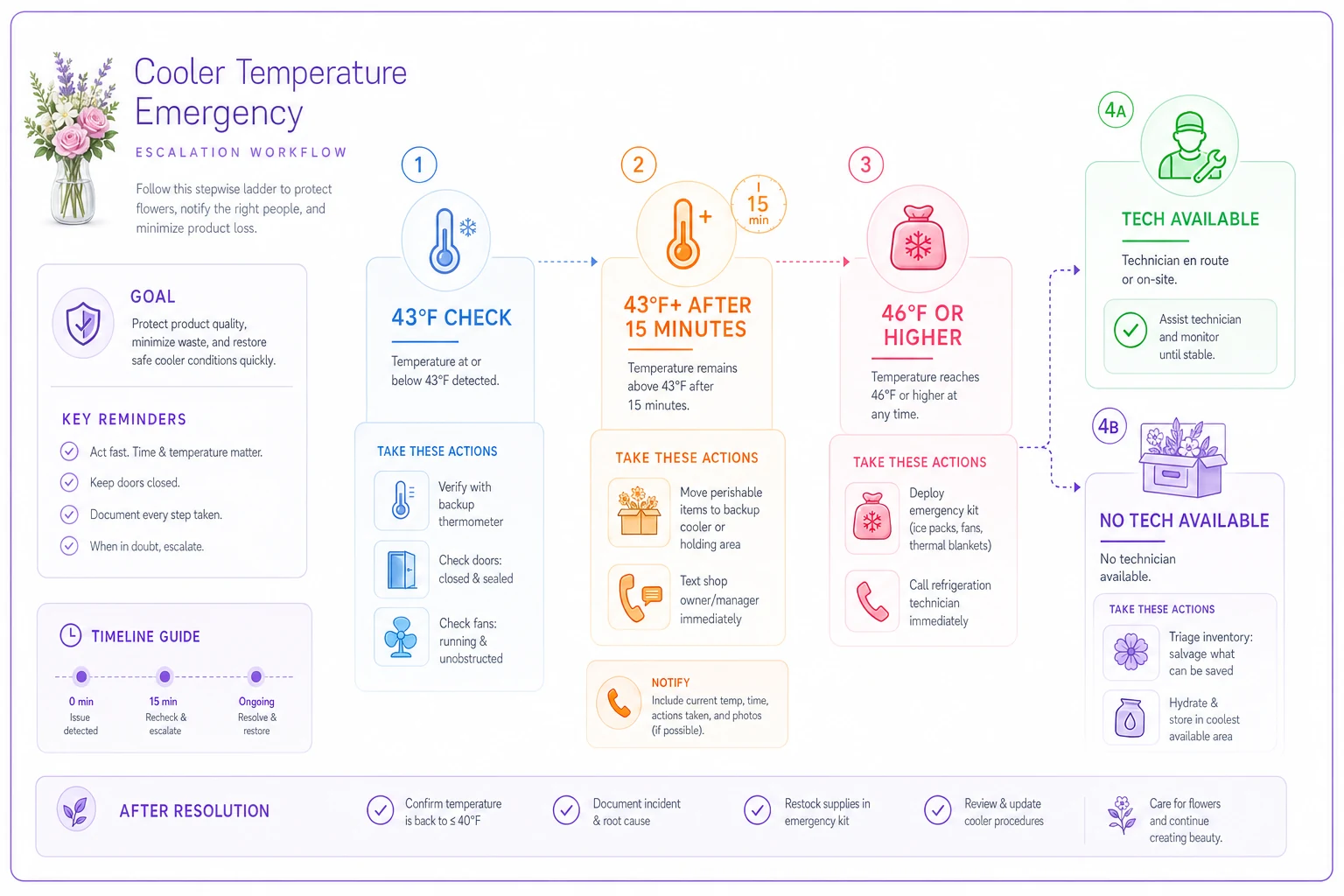
The key design choice: step 1 should be doable by anyone, including a part-timer who's been there three weeks. If your escalation plan depends on the owner answering the phone, it's not a plan.
A real scenario
A two-person shop — owner plus one designer, somewhere around $18k–$22k monthly in sales — had a reach-in with a condenser fan that had been getting louder for about a month. Nobody flagged it; it was still cold. On a hot Thursday in late July the fan seized overnight. By Friday open the box was at 51°F.
They lost most of a standing order of premium roses and a batch of hydrangea staged for a weekend event — somewhere in the $900–$1,200 range of hard product cost, plus the scramble of sourcing emergency replacements at spot prices and a very uncomfortable call with the event client.
The fix afterward cost almost nothing by comparison. They added a quarterly "listen to the fan" check, kept a spare fan motor ($40–$60) on the shelf, and clipped a $35 wireless thermometer inside that texts the owner at 42°F. The next time a fan started to go — the following spring — the alert came in at night, the spare motor was swapped Saturday morning before open, and nothing was lost. The entire prevention system cost less than one-tenth of that single July event.
That's the real math of cooler maintenance. The cadence feels like busywork until the one time it isn't.
Who should NOT over-invest in this
If you're running a display-case-only operation with no walk-in, and you turn inventory in two to three days, a full spare-parts kit is more than you need. Your risk window is short enough that a service call usually beats stocking parts. Keep the thermometers and the temp log — skip the rest.
Similarly, if your cooler is under warranty and newer than a couple of years, focus the cadence on cleaning and door discipline rather than mechanical spares. Coil cleaning and gasket checks prevent the failures warranties don't cover anyway — warranties don't reimburse you for dead roses.
The one thing that makes all of this stick
None of these checks are hard. The reason they don't happen is that nobody owns the calendar. The monthly coil wipe gets skipped because it lives in someone's head, not on a schedule with a name attached.
Shops that actually prevent spoilage treat the cadence like opening and closing duties — a named task, on a recurring schedule, with a box to check. Some use a simple shared calendar with reminders. Others fold the cooler checks into whatever system already runs their daily routines so the task shows up automatically and doesn't depend on memory. The tool matters less than the ownership. What matters is that "clean the coils" is a line item someone is responsible for on a specific date — not a good intention that evaporates the moment the shop gets busy.
Start with the three-read temp log and the monthly gasket-and-coil check. Those two habits alone catch most of the slow failures before they turn into a warm box and a ruined weekend. Everything else — the spare parts, the escalation ladder — is just making sure that on the day something does break, you're swapping a $50 part instead of calling your event clients to apologize.
Start with the three-read temp log and the monthly gasket-and-coil check. Those two habits alone catch most of the slow failures before they turn into a warm box and a ruined weekend. Everything else — the spare parts, the escalation ladder — is just making sure that on the day something does break, you're swapping a $50 part instead of calling your event clients to apologize.
Ready to grow your flower shop business?
Join 500+ flower shops using Blomsly to save time, reduce errors, and delight customers with fresh blooms.