


Most florists treat unsold flowers as a loss to be minimized. You count the buckets that didn't sell, you sigh, you compost or dump them, and you move on. That framing is the problem. What you actually have at the end of most weeks isn't waste — it's raw inventory with a shortened shelf life and no real channel to move it through.
The shops that recover real money from this don't do it by discounting harder. They build a small set of separate revenue channels designed specifically for near-end-of-life product, event overstock, and byproduct like stripped foliage and stem trimmings — and they design those channels so they generate margin without eating into full-price bouquet sales.
This is where most "sell your leftovers" advice falls apart. Any salvage channel that overlaps with your core customer will slowly train that customer to buy the cheaper thing. So the whole framework has to start from the business model — who buys, at what price, through which door — and only then move to logistics.
Why salvage revenue usually fails (and it's not the flowers)
The failure is almost never product quality. Flowers two or three days from peak still photograph fine, still work in arrangements, still make someone's kitchen table look good. The failure is channel design.
Here's a pattern that shows up constantly in small shops:
A florist starts marking down day-old bouquets in the front cooler. Sales of those bouquets go up. Looks good, right? Except within six to eight weeks, a chunk of regular walk-ins have quietly shifted their buying rhythm. They come in later in the week. They ask "do you have any of the marked-down ones?" You've converted full-margin buyers into discount buyers, and the "found money" from salvage is now being paid for by cannibalized full-price sales.
The opposite failure is also common: florists get so scared of cannibalization that they do nothing and just keep eating the shrink. Both extremes cost money.
The way out is treating salvage as its own product line sold to different people through different doors. Your Tuesday walk-in customer and your compost-pickup subscriber are not the same person, and they should almost never see the same offer. If you want the deeper mechanics on timing promotions so they don't retrain your base, that's already broken down in the channel-safe salvage promotions calendar — this article builds the business models that sit on top of that discipline.
The four channels, and who each one is actually for
Think of circular revenue as four distinct channels, each aimed at a buyer who would not otherwise buy your full-price product. The florist sustainability salvage revenue that actually sticks comes from running two or three of these well — not all four badly.
Never miss a bloom or a delivery.
Blomsly helps you manage orders, track stock, and schedule deliveries effortlessly.
- Unified order management
- Real-time inventory tracking
- Delivery scheduling & notifications
No credit card required
| Channel | Who buys | What they get | Cannibalization risk | Margin profile |
|---|---|---|---|---|
| Partner reuse (B2B) | Cafés, salons, real estate stagers, small hotels | Standing weekly delivery of "designer's choice" arrangements from surplus | Very low | Low per-unit, high volume, predictable |
| Paid compost pickup | Eco-minded households & small businesses | Scheduled pickup of their organic waste (and yours) | None | Recurring subscription, near-zero product cost |
| Curated salvage bundles | Deal-seekers, hobby crafters, DIY event people | Mixed grab-bags of stems past prime for full retail | Medium — needs rules | Decent, but must be gated |
| Event overstock resale | Second-event clients, community orgs | Post-wedding installs re-sold or re-homed | Low | High, but irregular |
Notice the risk column. That's the whole game. Compost pickup and B2B reuse carry almost no cannibalization risk because those buyers were never going to walk in and buy a $75 arrangement. Salvage bundles are the profitable-but-dangerous one, which is why they need the tightest rules.
Channel 1: Paid compost pickup (the one everyone ignores)
This is the most underrated model because florists assume compost is a cost, not a product. But you're already generating organic waste, you already know the neighborhoods you deliver to, and there's a real base of households and small businesses who want their organic waste handled and will pay a modest recurring fee for it.
The model works like this: you offer a small subscription — somewhere around $18–$28/month — for weekly or biweekly compost pickup. Subscribers get a labeled bin. On your existing delivery route, a driver swaps full bins for empty ones. Your own floral waste goes into the same stream, and you run it to a municipal composter, a local farm, or a community garden partner.
The reason this pencils out is that you're piggybacking on delivery infrastructure you already pay for. If your van already passes forty houses on a Thursday route, adding six compost stops adds maybe 20–25 minutes. Six subscribers at $22/month is roughly $130/month in near-pure recurring margin, and it grows by word of mouth in exactly the eco-conscious segment that also tends to buy flowers for gifting.
Start with a small pilot of 3–6 subscribers on an existing route to validate timing and margin before scaling.
When this makes sense: you already run your own delivery, you have a composting endpoint lined up, and you serve a neighborhood that cares about sustainability.
When it's a bad idea: you outsource all delivery to a third party, or you'd have to make dedicated trips. Dedicated compost runs kill the economics instantly.
Channel 2: B2B reuse flows (the quiet workhorse)
This is where the steadiest money comes from. Cafés, hair salons, boutique hotels, real estate stagers, even dentists' offices — they all want fresh flowers on a counter or table, but very few want to pay full florist retail for a designed arrangement every week. They want "nice flowers, consistently, at a price that makes sense."
That's a perfect home for surplus and slightly-aged stems. You commit to a standing weekly delivery of a designer's choice arrangement — meaning you control what goes in it based on what you have. The client gives up choice; you give up nothing you'd otherwise sell at full price, because these arrangements are built primarily from stems that wouldn't survive to next week's walk-in sales anyway.
-
Café pays $35/week for a mid-size counter arrangement, standing order
-
Your cost in surplus stems plus about 12 minutes of design time ≈ $12–$15
-
Net margin ≈ $20/week per account
-
Ten accounts ≈ $200/week, roughly $800–$900/month of margin from product you were otherwise composting
The coordination challenge is real. Standing B2B orders have to be built first on delivery mornings, before same-day retail chaos hits, or they get forgotten. This is the same batching and reliability discipline that separates profitable corporate accounts from money-losing ones, and it depends on knowing your true surplus each morning before the day runs away from you.
A simple partner agreement template
-
Delivery cadence — day and rough time window (e.g., "Thursdays, 8–10am")
-
Product definition — "designer's choice seasonal arrangement, mid-size, in provided vessel"
-
Price and billing — flat weekly rate, billed monthly, auto-renew
-
Vessel handling — you swap and reclaim vessels each visit
-
Pause/skip policy — 48-hour notice to skip a week
-
Quality standard — a clear promise ("fresh, full, replaced free if unsatisfactory")
That quality clause matters. B2B reuse only stays low-cannibalization if the client never feels they're getting "the leftovers." The framing is designer's choice, not discount. Same flowers, completely different story.
Channel 3: Curated salvage bundles (profitable, but leash it)
This is the one that makes money fast and cannibalizes fastest if you're careless. A curated salvage bundle is a mixed grab-bag — maybe 25–40 assorted stems past their retail prime — sold at a flat price to people who want cheap flowers to work with: hobby crafters, DIY event folks, people who just like having flowers around and don't need perfection.
Sold right, a $20–$25 bundle costs you almost nothing in product and clears a whole cooler shelf. Sold wrong, it teaches your regulars to wait.
-
Never sell bundles at the front counter during peak retail hours. Back door, separate pickup window, or online-only with scheduled pickup.
-
No occasion messaging. Bundles are "designer's surplus for crafters," never "roses for your anniversary at half price."
-
Cap availability and randomize timing. If bundles drop every Friday at 4pm, you've created a discount routine. Vary it.
-
Different visual identity. Plain kraft wrap, no branded ribbon, no arrangement. It should not look like your retail product.
The deeper waste-recovery logic behind bundling — what to salvage, what to toss, and how to value it — connects directly to the florist waste-reduction playbook. Bundles are the sales channel; the playbook is how you decide what's worth bundling in the first place.
Who should NOT run salvage bundles: a small shop with a heavily local, repeat walk-in base and no back-door pickup option. If your only sales surface is the front counter, the cannibalization risk is too high to manage cleanly. Focus on B2B and compost instead.
A worked P&L: one shop, three channels
Here's a realistic picture for a single-location shop doing roughly $22k–$26k in monthly retail, previously composting or dumping most of its surplus.
Before (no salvage system):
-
Weekly shrink from unsold product
roughly $180–$240 in COGS thrown out
-
Monthly waste cost
about $800–$950
-
Salvage revenue
$0
After (compost + B2B reuse + gated bundles, around 4 months in):
| Channel | Monthly revenue | Monthly cost | Net margin |
|---|---|---|---|
| Compost pickup (9 subs) | ~$200 | ~$40 | ~$160 |
| B2B reuse (8 accounts) | ~$1,120 | ~$430 | ~$690 |
| Salvage bundles | ~$340 | ~$60 | ~$280 |
| Total | ~$1,660 | ~$530 | ~$1,130 |
On top of that, actual dumped-product shrink drops because more surplus now flows into channels instead of the bin — call it another $300–$400/month recovered. So the swing is roughly $1,400–$1,500/month in combined recovered margin and new revenue, against maybe 3–4 extra hours of weekly labor. Not life-changing, but it's real money pulled from something that was pure loss.
And critically — full-price retail didn't move, because none of these channels touched the full-price customer.
The coordination problem nobody warns you about
Here's what breaks first as this scales: knowing what you actually have to sell.
Salvage channels live or die on an accurate daily read of surplus. If you don't know you've got 60 aging tulips and a bucket of ranunculus that won't make the weekend, you can't fulfill your B2B standing orders from surplus — you end up building them from fresh stock instead, and now you're genuinely cannibalizing. You're spending fresh inventory on discount-margin accounts. That's the silent way this system flips from margin-recovery into margin-leak.
The workflow that keeps it honest:
-
Morning surplus count — before same-day orders start, someone flags every SKU that won't make it to full-price sale.
-
Allocate surplus to channels in priority order — B2B standing orders first (they're committed), then bundle inventory, then compost stream.
-
Fresh stock only fills the gap — you only pull fresh product for B2B if surplus genuinely can't cover it, and you flag it when you do so you can spot the leak.
-
Reconcile weekly — how much surplus flowed to revenue vs. how much still hit the bin.
Most shops try to run this in someone's head, and it works until you hit five or six standing accounts. Then a busy Saturday means the B2B café gets skipped or gets fresh flowers by mistake, and the whole margin logic quietly inverts. This is exactly where centralizing your inventory status — what's fresh, what's aging, what's committed to which channel — inside your operational software pays off.
Here's a simple visual that shows how the morning surplus workflow should move between counting, allocating, filling gaps, and reconciling.
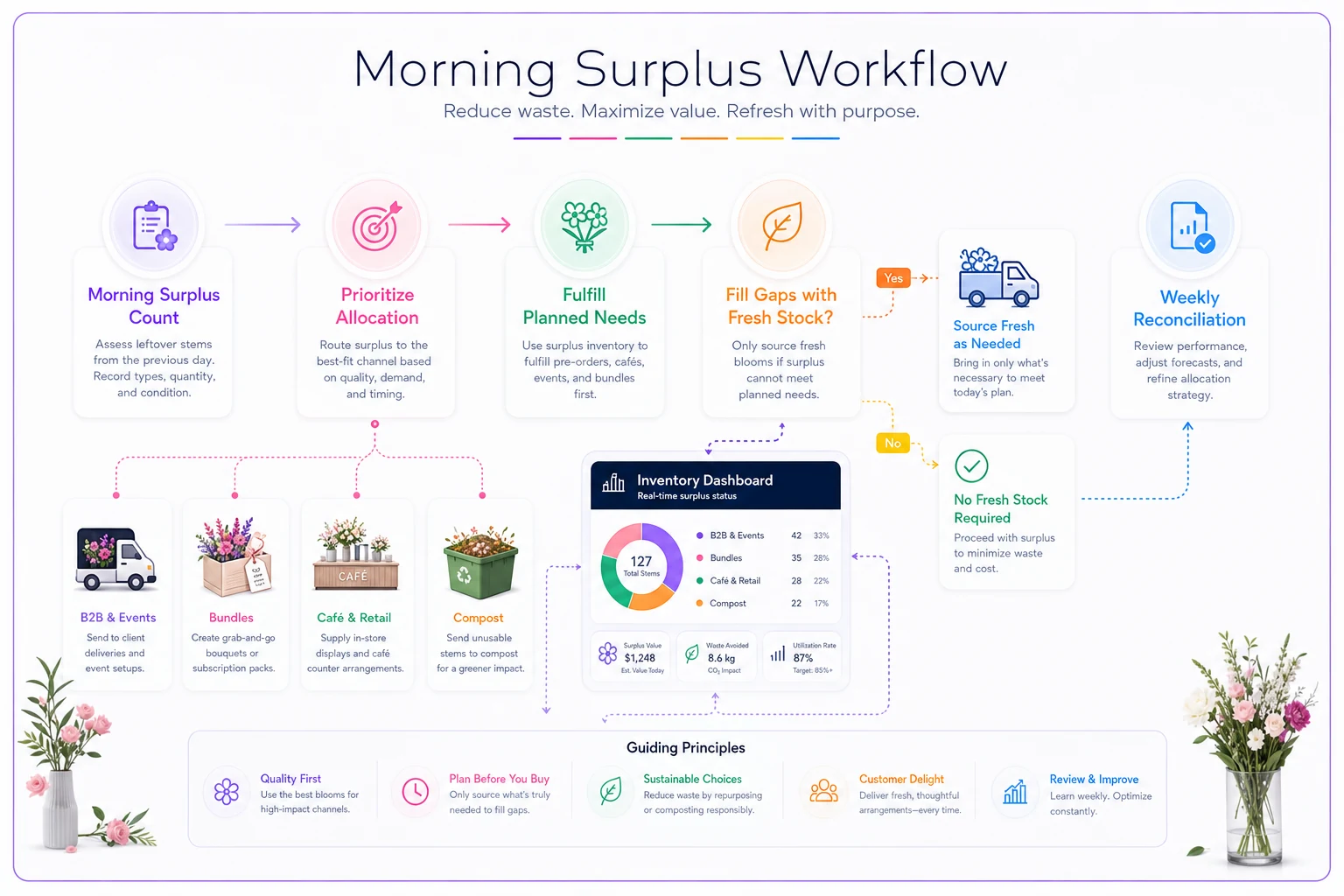
When surplus flags and channel allocation live in the same system your team already uses for orders, the morning decision takes minutes instead of guesswork, and you can actually see whether salvage is recovering margin or quietly leaking it.
Where supplier quality quietly decides your salvage math
One thing people miss: your salvage economics are downstream of your buying quality. If a supplier consistently ships stems with shorter vase life, more of your inventory drops into "salvage" territory faster — which sounds like it feeds these channels, but it actually just means you're losing full-price sales earlier and backfilling low-margin channels with product you should have sold at retail.
Salvage revenue should come from natural end-of-cycle surplus and event overstock, not from bad stems failing early. If you're constantly overflowing your salvage channels, that's a signal to look upstream. Tracking fill rates and vase-life consistency with a supplier scorecard tells you whether your salvage volume is healthy circular flow or a symptom of buying the wrong stems from the start.
When circular revenue makes sense — and when to skip it
It makes sense when:
-
You already run your own delivery route
-
You have consistent, predictable surplus (not wild week-to-week swings)
-
You have a back-door or off-peak pickup option
-
You have a composting or reuse endpoint within reasonable distance
It's a bad idea when:
-
Your shrink is already near zero (nothing to recover — fix demand forecasting instead)
-
Every sale happens at one front counter with no way to segment channels
-
You're already underwater on labor and can't spare 3–4 hours weekly
-
Your surplus is too erratic to promise B2B accounts reliable delivery
The mistake worth warning against most: launching all four channels at once. Pick the lowest-cannibalization one — usually B2B reuse or compost pickup — prove it for a couple of months, get your morning surplus workflow tight, and only then add the higher-risk bundle channel.
Real scenario: a two-person neighborhood shop
A small shop — owner plus one designer, roughly $24k monthly retail — was composting nearly all its Sunday-Monday surplus and treating it as unavoidable. They started with just B2B reuse: four standing accounts (two cafés, a salon, a real estate stager) at $30–$40/week each, all built from surplus every Tuesday and Friday morning before retail opened.
The first month was rough. Twice they forgot standing orders during a busy stretch and had to scramble with fresh stock, which killed the margin those weeks. Once they added a simple morning surplus-flagging step to their existing order routine, the misses stopped.
Four months in they were running eight B2B accounts plus a small once-a-week bundle drop by online pickup. Recovered margin landed around $900–$1,100/month, dumped-product waste fell by more than half, and — the part they cared about most — walk-in full-price sales were flat, meaning none of it came out of their core business.
The real takeaway
Circular revenue isn't a sustainability gesture you bolt on for good PR. Done properly, it's a set of distinct sales channels aimed at buyers you'd otherwise never serve, built from inventory you'd otherwise throw away. The margin is real but modest — and it stays real only as long as the channels stay separated from your full-price customer and your surplus allocation stays disciplined.
Get the business model right first: who buys, at what price, through which door. Get the morning surplus workflow tight so committed channels get fed from surplus, not fresh stock. Then the flowers you used to compost start quietly paying part of your rent.
Circular revenue isn't a sustainability gesture you bolt on for good PR. Done properly, it's a set of distinct sales channels aimed at buyers you'd otherwise never serve, built from inventory you'd otherwise throw away. The margin is real but modest — and it stays real only as long as the channels stay separated from your full-price customer and your surplus allocation stays disciplined.
Ready to grow your flower shop business?
Join 500+ flower shops using Blomsly to save time, reduce errors, and delight customers with fresh blooms.