



There's a moment every florist knows too well. A batch of hydrangea came in a little soft, the peonies opened two days early, and you've got a cooler shelf that's going to be worthless by Thursday. So you do the obvious thing — post a flash sale on Instagram, maybe email your list, slap "50% off" on a sign near the register.
It works. The stock clears.
And then the following month, your Tuesday walk-in customers start asking, "Is there a sale coming up?" Your online orders soften in the days before you'd normally run a promo. You've accidentally trained your audience to hunt for markdowns — and now full-price sales are leaking to buyers who would have paid full price anyway.
That's the trap. The salvage discount that saved this week's margin quietly erodes next month's. A floral salvage promotion calendar exists to solve exactly that: clear the aging stock, protect the full-price base, and never let one channel bleed into another.
The real mechanism behind "trained" customers
The problem isn't discounting. It's predictable, broadcast discounting.
When you clear salvage stock through the same channels you use to sell full-price arrangements — your main Instagram feed, your general email list, the front counter — you're teaching your entire audience your markdown rhythm. Customers are pattern-matching machines. Run a Wednesday flash sale three weeks in a row and a chunk of your regulars will simply start waiting for Wednesday.
In practice, this usually shows up as a slow drift, not a cliff. Full-price online conversion dips a few points. Your average order value on walk-ins softens because people ask "what's discounted today?" before they ask what's fresh. You don't notice it in any single week. You notice it when you look back over a quarter and full-price velocity has quietly slipped.
-
Channel separation — salvage offers go out through channels your full-price buyers don't monitor for deals
-
Time-boxing — every clearance has a hard start and stop, so there's no standing "sale section" to anchor to
-
Discount caps — you set a ceiling per SKU class so you're never bleeding more margin than the stock is actually worth
The fix has three levers, and they all live inside the calendar:
Why blasting your main list is the expensive mistake
Your email list and main social feed are your highest-intent, highest-value channels. They're where your repeat buyers and occasion shoppers live — the people ordering anniversary arrangements and sympathy work at full price without blinking.
Never miss a bloom or a delivery.
Blomsly helps you manage orders, track stock, and schedule deliveries effortlessly.
- Unified order management
- Real-time inventory tracking
- Delivery scheduling & notifications
No credit card required
Putting salvage discounts in front of that audience is like running a fire sale in the front window of a jewelry store. You reach the wrong people. The person who was going to spend $85 on a Friday bouquet sees "40% off select stems" and either waits or downtrades.
What we've seen across a lot of small shops is that salvage clears just as fast — sometimes faster — through narrower, lower-intent channels. The buyers who love a deal are motivated to go find one. You don't need to interrupt your premium audience to reach them.
Here's the channel logic laid out:
| Channel | Best used for | Salvage-safe? | Why |
|---|---|---|---|
| Main email list | Full-price occasions, subscriptions | ❌ No | Highest-value buyers; trains them to wait |
| Main Instagram/FB feed | Brand, fresh product, occasions | ❌ No | Broadcasts markdown rhythm to everyone |
| Instagram Stories (24hr) | Time-boxed salvage flashes | ✅ Yes | Disappears; no standing "sale section" |
| Segmented "deal seeker" email tag | Clearance-only offers | ✅ Yes | Opt-in bargain hunters, not full-price base |
| Walk-in "today only" cooler tag | End-of-day salvage | ⚠️ Limited | Only for genuinely aging stock, capped |
| Local partner (café, salon, gym) | Bulk salvage handoff | ✅ Yes | Off your channels entirely |
| Wholesale/event florist resale | Volume blemished stems | ✅ Yes | B2B; zero retail visibility |
The Stories channel is underrated here. Because a Story vanishes in 24 hours, there's no permanent discount shelf for customers to anchor to. You get reach without building a habit.
Building the calendar: time-boxing that actually holds
The word "calendar" matters. Salvage promotions fail when they're reactive — you notice soft stock, you panic, you discount. Every panic markdown is a chance to overshoot the cap and leak into a full-price channel because you didn't plan ahead.
A time-boxed calendar flips this. You decide in advance which windows are salvage windows, which channels they run through, and what the discount ceiling is for each SKU class. When soft stock appears, you don't invent a promo — you slot it into the next scheduled window.
If you don't already classify SKUs by remaining life, do that before scheduling salvage windows.
A workable weekly rhythm for a small shop:
-
Monday — audit the cooler against your aging list. Flag anything with 2–3 days of sellable life left. (If you don't already classify SKUs by remaining life, that's step zero — worth sorting out before you build the calendar.)
-
Tuesday–Wednesday — no salvage promos on any channel. This protects your mid-week full-price base.
-
Thursday evening — first salvage window
Stories flash + deal-seeker email segment only. Time-boxed to Friday close.
-
Saturday afternoon — walk-in "today only" cooler tags for anything not moving, capped per SKU class.
-
Sunday — anything left goes to partner handoff or B2B resale, not another retail discount.
Full-price channels never carry a markdown. The salvage windows are fixed, so there's no "when's the next sale" guessing game for your premium buyers — they don't even see the salvage channels. And the discount escalates in a controlled way: modest early in the window, deeper only at the very end, capped throughout.
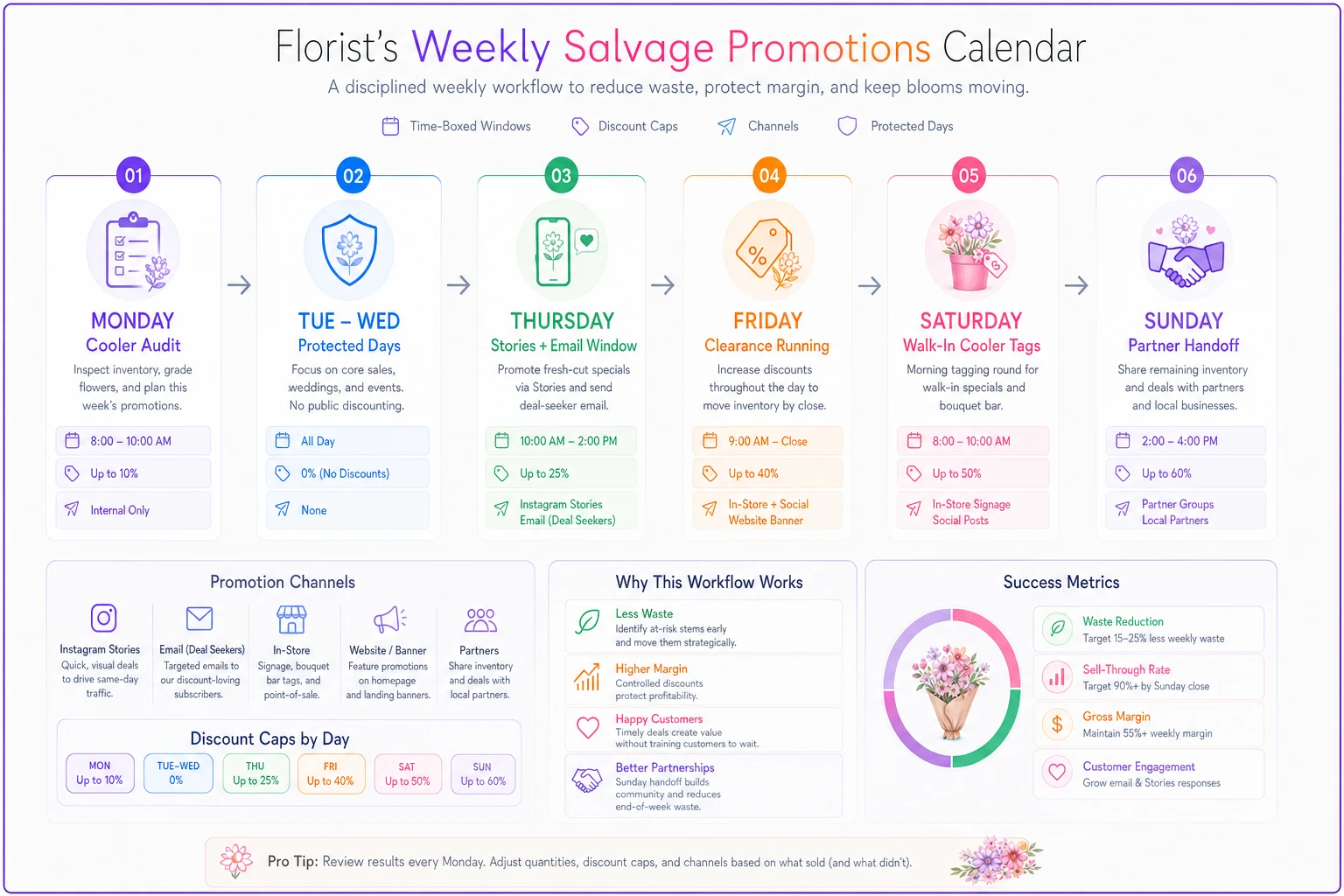
This visual lays out the weekly flow and shows which channels run in each time-boxed window.
Discount caps by SKU class
A flat "everything's 30% off" is lazy and expensive. A rose with three days of vase life left is worth discounting differently than a filler green that's already tired. Cap your discounts by how much sellable value is actually left.
-
Premium focal stems (roses, peonies, orchids) with 2–3 days left: cap at 25%. These still have real value; don't give it away.
-
Standard stems and mixed bunches with 1–2 days
cap at 40%.
-
Greens, fillers, single-day stock
cap at 50–60%, and prioritize partner handoff over retail discount.
-
Blemished-but-usable accessories (vases, ribbon, wraps)
bundle, don't discount. Attach to a full-price arrangement as a "designer's choice add-on."
The caps do two jobs. They stop you from overshooting in a Friday-night panic, and they keep your salvage margin recoverable. Clearing at 25% still returns meaningful margin. Reflexively going to 50% on stock that would've cleared at 25% is money left on the cooler shelf. For the bigger picture on recovering value from stock that's about to turn, the florist waste-reduction playbook pairs well with this — the calendar is the demand side, waste reduction is the supply side.
Partner offers: the channel most florists skip
The cleanest salvage channel is the one that never touches your retail audience at all.
Local businesses buy flowers constantly and rarely care about a small blemish. A café wants a few fresh arrangements for the counter. A salon likes fresh stems in the waiting area. A gym, a real estate office staging a listing, a restaurant hostess stand — all of these can take blemished-but-fresh stock at a standing discount, and none of it shows up on your Instagram.
-
A weekly "designer's surplus" bundle at a flat rate, whatever's aging that week
-
First-refusal texts on Sunday for whatever didn't clear
-
A small monthly minimum so it's predictable for both sides
Partner offers don't train anyone to wait, because your retail customers never see them. You're moving stock through a completely separate demand channel. Over time these relationships also become referral sources — the café's customers ask where the flowers came from.
Messaging templates that protect full‑price perception
How you word a salvage offer matters as much as where you send it. The wrong language ("50% off everything!") signals your whole store is discountable. The right language frames the offer as scarce, specific, and temporary.
Stories flash (Thursday):
> "Designer's cooler clearout — a handful of Friday-only bunches at a special price. First come, first served, gone at close. DM to grab one."
Deal-seeker email segment:
> "You're on our clearout list, so you get first look: a small batch of gorgeous, slightly-early blooms available Thursday–Friday only. Limited quantity, not restocked."
Walk-in cooler tag:
> "Today's designer special — beautiful stems with a shorter vase life, priced to enjoy this weekend."
Every one of these makes clear this is a specific, limited batch — not a store-wide policy and not a recurring event. The words "this batch," "today only," and "not restocked" quietly protect the idea that your normal prices are your normal prices.
Avoid words that generalize: "everything," "always," "every week," "sale." Those are the words that build the wait-for-the-discount habit.
When this makes sense — and when it doesn't
This makes sense when: you have recurring, predictable salvage volume — a shop doing steady daily walk-in and online business where a few SKUs age out every week. The calendar structure pays off precisely because the problem is chronic.
This is a bad idea when: your salvage volume is tiny and occasional. If you're throwing out one bunch a week, don't build a machine for it — hand it to a partner or comp it to a loyal customer and move on. Structure has overhead; don't over-engineer a small problem.
Who should NOT do this: shops that haven't yet fixed their upstream ordering. If you're generating heavy salvage stock every week, the promotion calendar is treating a symptom. Tighten your order quantities and perishability classification first, then build the calendar for the unavoidable remainder. Clearing 40% of your cooler at markdown every week isn't a promotions problem — it's a purchasing problem wearing a costume.
A real scenario
A two-person neighborhood shop was clearing aging stock the reactive way — a flash email whenever the cooler looked heavy, usually 40–50% off, blasted to their full list. It cleared the flowers fine. But over about a quarter, their full-price online orders in the two days before each email had visibly softened. Regulars were emailing to ask when the "next flower sale" was.
They restructured around a fixed weekly calendar. Salvage moved entirely off the main email and feed — into 24-hour Stories, a small opt-in deal segment, and a standing arrangement with two nearby cafés. Discount caps went in by SKU class, topping out at 25% on premium stems instead of the reflexive 50%.
Within a couple of months the "when's the sale?" emails basically stopped. Salvage still cleared — actually a bit faster through the café handoffs — and the recovered margin on premium stems added up to somewhere in the range of a few hundred dollars a month they'd previously been giving away. Full-price mid-week velocity recovered because the discount signal was gone from the channels those buyers watched.
Where the calendar connects to the rest of your operation
The salvage calendar isn't a standalone tactic — it sits at the intersection of your inventory aging data and your customer channels. That's exactly why it's worth systematizing rather than running from memory. The Monday cooler audit depends on knowing remaining vase life per SKU. The channel routing depends on having your customers segmented — a "deal seeker" tag separate from your full-price base, which ties directly into how you manage the customer lifecycle so the right offer reaches the right person.
When those pieces are tracked in one place — aging stock on one side, segmented channels on the other — the calendar mostly runs itself. You flag soft stock, it routes to the next scheduled window, through the right channel, capped correctly. The whole point is to remove the moment of panic where you'd otherwise overshoot the discount and dump it on the wrong audience.
Clear the stock. Protect the base. Keep the two apart. That's the entire job of a salvage calendar, and once it's built, it's one of the least glamorous, most reliably profitable systems a small flower shop can run.
Ready to grow your flower shop business?
Join 500+ flower shops using Blomsly to save time, reduce errors, and delight customers with fresh blooms.