



Wire orders feel like free money until you actually do the math on one that went wrong. A shop takes a $75 arrangement through FTD, a walk-in buys the last three garden roses you were counting on for it, and now your designer is improvising with substitutions that either upset the sending florist or blow the recipe cost past the payout. Multiply that across a busy Valentine's week and the "extra revenue" from wire starts looking like a slow bleed nobody's tracking.
The core issue with a florist wire service workflow isn't the wire service itself. It's that most shops run wire, retail, and subscription orders out of the same bucket of flowers with no rules about who gets first claim, what price protects margin, and when an order is too late to accept safely. Everything works until two channels reach for the same stems on the same morning.
This post is only about that collision — the reservation logic, the pricing guardrails, and the cutoffs that stop double-sells and keep wire from quietly eating your margin.
Why wire orders leak money in ways retail never does
Retail is simple: someone pays your price, you make the thing, you keep the difference. Wire is a different animal because you don't control the price the customer paid, and a chunk of that price never reaches you.
A typical incoming wire order works like this. The sending florist collects, say, $80 from their customer. The wire network takes its clearinghouse cut. The sending shop keeps roughly 20% as their commission for taking the order. What lands in your shop as the filling florist is usually around 70–73% of the stated value — and out of that you still pay for flowers, labor, container, and delivery.
So when a customer sees "$80 arrangement," you're actually building against something closer to $56–$58 in real revenue. If recipe cost creep or a last-minute substitution pushes flower cost up by even $6–$8, the whole order tips from thin margin to break-even. Retail hides this because your posted price already accounts for full markup. Wire strips a layer off the top before you ever touch it.
The double-sell problem stacks on top of that. When the same rose count is promised to a retail buyer and a wire order, one of them gets substituted. If it's the wire order, you risk a complaint or a fill-quality ding from the sending florist. If it's the retail order, you're disappointing a customer standing in your own shop. Either way, the flowers you already paid for are producing less than they should.
The reservation hierarchy that prevents the collision
The fix starts before pricing — it's about deciding, on paper, which channel has priority claim on scarce inventory. Most shops never make this decision consciously, so it gets made by whoever's loudest at 9am.
Never miss a bloom or a delivery.
Blomsly helps you manage orders, track stock, and schedule deliveries effortlessly.
- Unified order management
- Real-time inventory tracking
- Delivery scheduling & notifications
No credit card required
-
Committed subscription deliveries get first claim. These are prepaid, recurring, and a missed one costs you a churned customer worth months of revenue, not one sale.
-
Prepaid retail and event pickups with a specific recipe come next, because the customer chose exact items and expects them.
-
Incoming wire orders slot in third — with a critical exception below.
-
Open-stock retail and walk-ins last, because these are the most flexible and easiest to redirect to substitutes.
The exception: wire orders with a hard delivery window and no substitution allowance jump ahead of flexible retail. A wire order marked "no substitutions, deliver by noon for a funeral" is functionally more rigid than a walk-in who'll happily take pink instead of coral.
This hierarchy only works if inventory is actually reserved against it, not just mentally noted. The moment a subscription batch is confirmed for the week, those stems should be pulled from available count — same way an event order gets stems allocated the day before. Shops that keep subscriptions in a separate cooler zone almost never double-sell them. Shops that leave everything in one pool and "remember" what's spoken for are the ones improvising by Thursday.
Channel pricing rules so wire never undercuts your own shop
Because you don't set the retail price on wire, the danger is filling wire orders at a value that doesn't cover your real cost — and worse, doing it with premium inventory that a full-margin retail customer would have paid top dollar for.
A practical rule: build wire orders to a cost ceiling, not to the stated dollar value. If a wire order comes in at $65 stated value, your real revenue is around $46. Decide in advance that flower cost on that order cannot exceed a fixed percentage — many shops hold flower cost to roughly 28–32% of actual received revenue, which on that order means about $13–$15 in stems. That forces designers to build to a recipe, not to a vibe.
Here's how the three channels compare once you strip it down:
| Factor | Retail | Subscription | Wire (incoming) |
|---|---|---|---|
| You set the price | Yes | Yes | No |
| Real revenue vs. stated | 100% | ~95% (after processing) | ~70–73% |
| Substitution flexibility | High (talk to customer) | High (curated) | Low (network rules) |
| Inventory priority | Flexible | Highest | Rigid if no-sub |
| Best-margin stems? | Yes, if they pay | Controlled cost | Never default here |
Your best premium stems — the imported peonies, the specialty orchids — should default to retail and events where you capture full markup. Wire should be filled from reliable, well-costed workhorse inventory. When you flip that and dump premium flowers into a wire order to "make it look nice," you're giving away margin the sending florist already skimmed.
One more pricing discipline: track fill quality separately from margin. It's tempting to under-fill wire orders to protect margin, but consistent under-filling gets you flagged in the network and can cost you future incoming volume. The goal isn't to cheap out — it's to build to a disciplined recipe that looks full because it's designed well, not because you overspent on stems.
Cutoffs: the single most ignored control
Almost every wire double-sell and same-day scramble traces back to a missing or fuzzy cutoff time. A shop accepts a same-day wire order at 2:45pm, discovers at 3:10 the delivery route already left, and now someone's making a special run that eats any margin the order had.
Cutoffs need to be channel-specific because each channel has different lead-time realities:
-
Wire same-day cutoff should sit earlier than your retail same-day cutoff, because you have zero control over the recipe complexity coming in and you're on the hook for the sending florist's expectations.
-
Subscription cutoffs are about the build batch, not the delivery — decide the last moment a change can be made before the batch is assembled.
-
Retail same-day can run latest since you control both the recipe and the promise you're making.
A workable set of defaults for a small shop with one delivery run per day:
-
Wire same-day accept
cut off ~2 hours before the delivery vehicle loads
-
Retail same-day
cut off ~1 hour before load
-
Subscription changes
cut off end of business the day prior to build
Enforce cutoffs by requiring manager approval for any override.
The failure worth flagging: most shops set a cutoff and then override it constantly "just this once." Every override trains your team that cutoffs are suggestions, and within a month you're back to accepting anything. The cutoff only protects you if it's enforced even on slow days when breaking it feels harmless — the habit is what carries you through the busy days.
A simple daily workflow that ties it together
None of this needs software to start. It needs a repeatable morning sequence that keeps the three channels from colliding.
Each morning, before designers touch anything, someone reconciles the day's committed volume. Subscription deliveries for the day get pulled and staged first — physically separated. Then confirmed prepaid retail and event recipes get their stems allocated. Whatever remains is your true available pool for incoming wire and walk-ins. That number gets written somewhere visible, and it's the only number that matters when accepting new same-day orders.
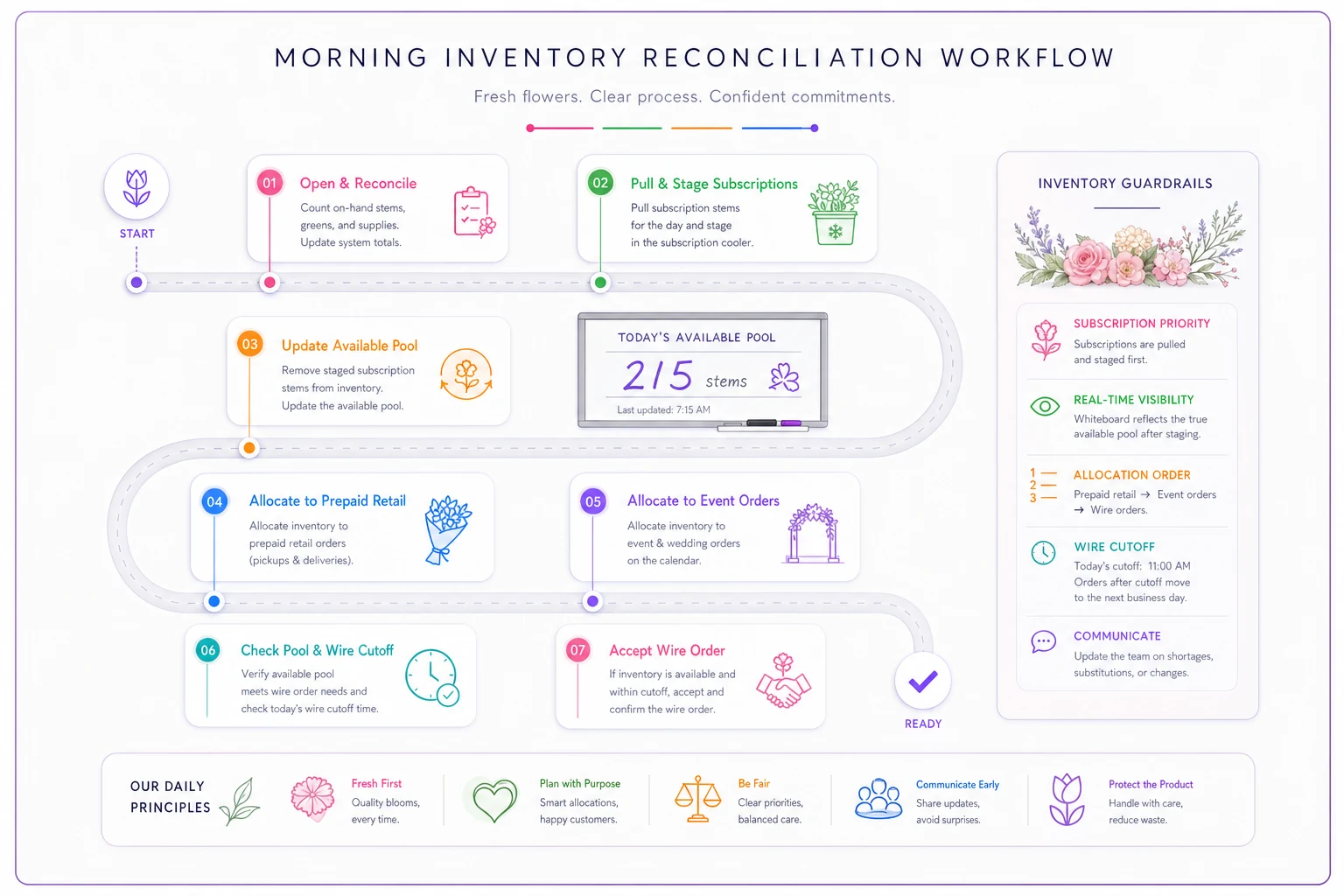
Visualizing the morning reconciliation can help teams follow the same steps.
When a wire order comes in, the person accepting it checks two things: is there still available inventory in the pool, and are we before the wire cutoff? If both are yes, accept and deduct from the pool. If either is no, decline or push to next-day. That single discipline — deducting from a visible pool at the moment of acceptance — is what kills double-sells.
The friction, of course, is that a busy shop has orders arriving through the website, the phone, the wire terminal, and walk-in traffic all at once. Keeping one accurate "available pool" number across all of them by hand is where things fall apart. It's the same coordination problem behind most order chaos, and it's why keeping your channels genuinely in sync matters more than any single rule — worth reading alongside the small-shop tech and data-integration playbook if you've ever had two systems disagree about what's actually in stock. Platforms that centralize channel orders and deduct against a shared inventory count in real time remove the manual reconciliation, but the rules above have to exist first — automation just enforces the decisions you've already made.
A real scenario: a two-designer shop untangling wire
A neighborhood shop running about 40 wire orders a week alongside retail and a small subscription base of roughly 30 weekly deliveries. Before tightening things up, they were substituting on close to a third of wire orders because retail walk-ins kept claiming stems earmarked elsewhere, and their fill-quality rating had slipped enough to reduce incoming volume from the network.
The changes were unglamorous: subscriptions staged in a separate cooler section first thing every morning, a written "available pool" number on a whiteboard updated as orders came in, a wire same-day cutoff set two hours before the van loaded, and a standing rule that no wire order gets premium imported stems.
Over the following couple of months, substitutions on wire dropped to roughly one in ten — mostly genuine stock-outs rather than double-sells. Fill-quality standing recovered, incoming wire volume climbed back, and — the part they didn't expect — designer stress dropped because the morning wasn't a guessing game anymore. Margin on wire didn't skyrocket, but it stopped leaking, which on 40 orders a week added up to a few hundred dollars a month that used to vanish into substitutions.
When tight wire rules make sense — and when they don't
This level of structure is worth it if wire is more than an occasional trickle, if you run subscriptions or events that compete for the same inventory, or if you've been dinged on fill quality. The collision only exists when multiple channels draw from a shared, limited pool during the same window.
If you fill maybe a handful of wire orders a month and rarely run out of anything, formal reservation hierarchies are overkill — you'll spend more time maintaining the system than you lose to the rare double-sell. Same if your inventory turns fast and deep enough that scarcity is never really the problem.
Who should genuinely reconsider taking wire at all: a shop whose real revenue after the network's cut consistently fails to clear flower plus labor plus delivery cost. If the math on incoming wire is structurally underwater even with disciplined recipes, no cutoff or reservation rule saves you — the channel itself isn't paying, and that's a bigger allocation decision worth thinking through alongside your whole omnichannel channel-allocation strategy.
Wire double-sells and margin leaks aren't a discipline failure by your designers. They happen because three channels with different economics and different rigidity are quietly fighting over the same cooler, and nobody wrote down who wins. Set a reservation order, build wire to a cost ceiling instead of a stated value, hold channel-specific cutoffs even when breaking them feels harmless — and the collisions mostly disappear. The flowers you already paid for start producing what they should, and wire goes back to being a decent side of the business instead of a hidden drain on it.
Ready to grow your flower shop business?
Join 500+ flower shops using Blomsly to save time, reduce errors, and delight customers with fresh blooms.