
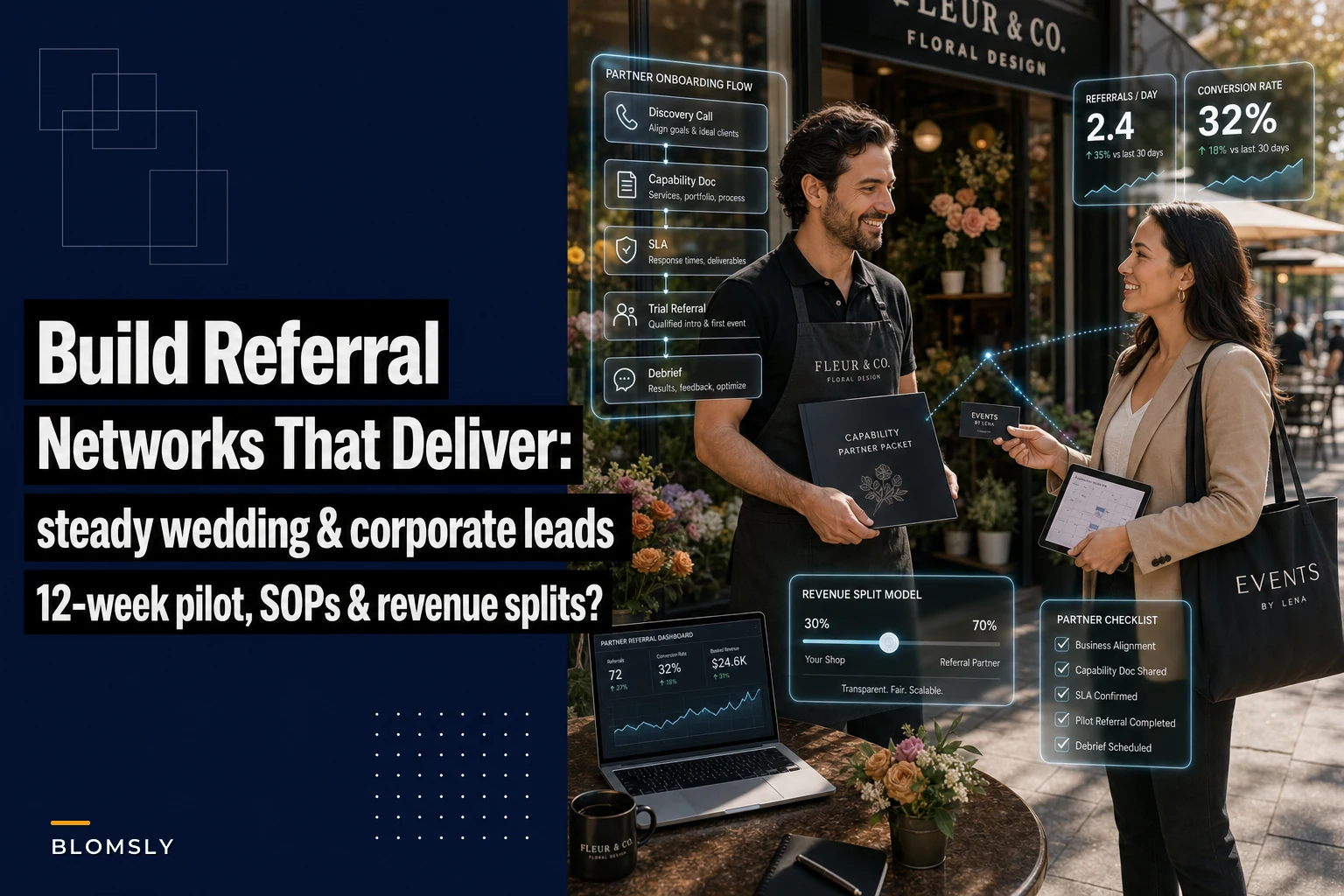

Most florists don't have a lead problem. They have a consistency problem. A wedding planner sends you two couples in March, then goes quiet until September. An office manager orders centerpieces for one holiday party and you never hear from them again. The flowers were beautiful, the client was happy, and nothing repeatable came out of it.
That gap between "they liked us" and "they send us business on a schedule" is where most referral relationships die. Not because the work was bad, but because nobody built the plumbing to keep it flowing.
This is the part of a wedding vendor referral playbook for a florist that almost nobody writes down: the onboarding steps, the service-level promises, the revenue-split math, and a short pilot that tells you whether a partner is worth keeping.
Why most referral relationships stay sporadic
The pattern repeats constantly. A florist does one great wedding. The planner mentions it to a colleague. A new inquiry trickles in. Everyone calls this "word of mouth" and treats it like luck.
It's not luck. It's an unmanaged relationship. And unmanaged relationships drift toward zero.
Three things are usually missing:
-
No clear ask. The florist never actually told the planner what kind of work they want, how many events they can handle per month, or what makes an ideal referral.
-
No reliability signal. The planner has no idea if you'll respond in two hours or two days, so they hedge by spreading referrals across four florists instead of leaning on one.
-
No incentive structure. There's no reason for the partner to send you the next client instead of whoever happens to ask them first.
A planner's entire reputation rides on the vendors they recommend. If they can't predict how you'll behave, they'll never make you their default. Predictability is the product you're actually selling to a referral partner — the flowers are almost secondary.
The onboarding SOP: treat a new partner like a new hire
When you bring on a referral partner — a wedding planner, a venue coordinator, an office manager at a company that hosts regular events — run them through an actual onboarding process. Not a coffee and a vague "let's work together."
Never miss a bloom or a delivery.
Blomsly helps you manage orders, track stock, and schedule deliveries effortlessly.
- Unified order management
- Real-time inventory tracking
- Delivery scheduling & notifications
No credit card required
Here's a simple onboarding sequence that works:
-
Discovery call (30 minutes). Find out their event volume, their average client budget, their pain points with current florists, and how they prefer to communicate. A venue coordinator who books 40 weddings a year is a completely different partner than a corporate office that does four events.
-
Capability doc handoff. Send a one-page sheet covering what you do well, your lead-time requirements, your minimum spend for events, and photos that match their client type. A planner working luxury weddings doesn't want to see your grocery-style bouquets.
-
Response protocol agreement. Tell them exactly how fast you'll reply to a referral and who the point of contact is. This is the single biggest trust-builder.
-
Trial referral. Ask for one specific, low-stakes referral to prove the workflow before committing to anything formal.
-
Debrief after the first job. Sit down (or call) after the first event and fix whatever broke. Partners who see you self-correct trust you faster.
The mistake florists make is skipping straight to step four — wanting the referrals before giving the partner any reason to prioritize them. Onboarding is what separates "a florist I know" from "my florist."
Here's a quick visual of the onboarding flow.
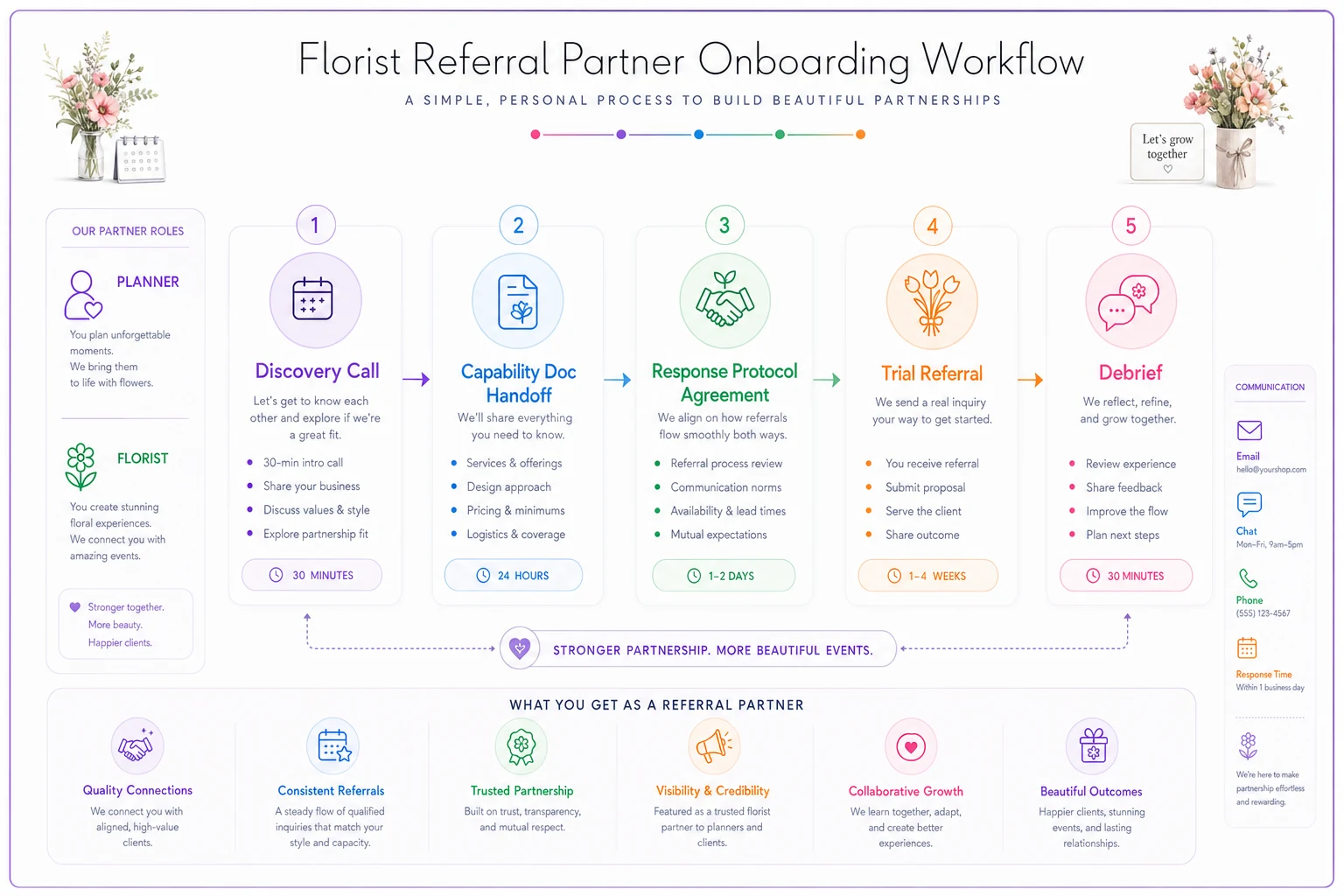
Onboarding gives partners a reason to prioritize you and creates a predictable path from introduction to booking.
Setting SLA expectations before anything goes wrong
An SLA — service-level agreement — sounds corporate, but for a referral partner it's just a short list of promises you can actually keep. The point isn't to sound professional. It's to give the partner numbers they can repeat to their own clients with confidence.
The partners who send the most business are the ones who can tell a bride, "I'll have the florist back to you by tomorrow morning." If you've given them that promise in writing, they'll make it on your behalf.
Here's a realistic SLA structure for referral partners:
| Commitment | Wedding Partner SLA | Corporate Partner SLA |
|---|---|---|
| First response to a referral | Within 4 business hours | Within 2 business hours |
| Full proposal/quote | Within 2 business days | Within 1 business day |
| Lead time required to book | 6+ weeks preferred | 5 business days minimum |
| Day-of contact person | Named lead designer | Named account owner |
| Post-event follow-up | Within 48 hours | Within 24 hours |
Keep SLA timeframes achievable — a promise you miss is worse than a slower promise you always hit.
Two things matter here. First, keep the SLA achievable. A promise you miss is worse than a slower promise you always hit. Second, make the corporate SLA tighter — corporate clients plan on shorter cycles and judge you on speed, while wedding partners care more about reliability over months.
If you're already handling corporate work or want to, the operational side of that — batching, pricing, and consistent delivery — is worth getting right first. Our deeper breakdown on how to win and operationalize local corporate accounts covers the fulfillment mechanics that make these SLAs survivable when volume spikes.
Revenue-split templates that don't feel sleazy
This is where florists get squeamish, and honestly it makes sense. Flowers for weddings carry real cost and real labor, so handing a planner a cut can feel like giving away margin you don't have.
But the alternative — no incentive — means competing purely on taste and timing. A small, clear split turns a passive contact into an active salesperson for your shop.
There are three common structures, and they serve different partner types:
-
1. Flat referral fee. You pay a set amount per booked event — somewhere in the $75 to $150 range depending on event size. Clean, predictable, easy to explain. Works best for corporate office managers who just want a thank-you and don't want to track percentages.
-
2. Percentage of floral spend. Typically 8%–12% of the floral budget, paid after the client pays you. This aligns incentives — bigger events, bigger thank-you. Works well with wedding planners who understand they're influencing budget size.
-
3. Reciprocal referral (no cash). You send them business, they send you business, nobody exchanges money. This is underrated. Venues, photographers, and planners often prefer it because cash referral fees can create awkward conflicts with their own client contracts.
A quick note on the percentage model: always calculate the split on floral spend, not the total invoice. If you include delivery, setup labor, and rental hardware in the base, you're paying commission on costs that carry almost no margin. A $4,000 wedding invoice might only have $2,600 in actual floral product. Pay 10% on the $2,600, not the $4,000, and you've saved yourself around $140 per event without the partner noticing or caring.
Whatever structure you choose, write it down. A one-paragraph agreement stating the split, when it's paid, and what counts as a qualifying referral prevents most of the friction that kills these relationships.
The 12-week pilot: scale or stop
Most florists skip this entirely. They either commit to a partner forever or never commit at all. Neither is smart. You want a defined window to test whether a partner actually produces — and the discipline to walk away if they don't.
Twelve weeks gives you enough events to judge without locking yourself into a dud relationship for a year.
What to track during the pilot
-
Qualified referrals sent — not just mentions, but actual inquiries where the client reached out.
-
Conversion rate — of those referrals, how many booked?
-
Average floral spend per booked event — tells you if the partner sends your ideal client or budget shoppers.
-
Response-and-fulfillment compliance — did you hit your own SLA every time? (If you didn't, the pilot results are about you, not them.)
The decision rule
| Outcome | Signal | Action |
|---|---|---|
| 3+ qualified referrals, 50%+ converted | Strong partner | Formalize, raise your priority for them |
| 1–2 referrals, decent conversion | Slow starter | Extend pilot 6 weeks, re-engage |
| Referrals but tiny spend | Wrong client type | Keep casual, don't invest more |
| Zero qualified referrals | No real pipeline | Stop, reallocate effort |
The hardest call is the "zero referrals" partner who's genuinely lovely to work with. You like them. You had great conversations. But likeability isn't pipeline. If 12 weeks produced nothing, stop spending energy there and put it into a partner who actually moves clients.
A real scenario
A single-location shop doing roughly $380k a year had built up a loose network of seven or eight wedding contacts over time. Referrals came in, but unpredictably — some months two or three, some months nothing. No tracking, no agreements.
They ran a structured pilot with four of those contacts. Clear SLA, a simple 10% floral-spend thank-you for two of them, reciprocal referrals for the other two. Over 12 weeks, two partners produced almost nothing. One venue coordinator sent four qualified couples, three of whom booked at an average floral spend around $3,100. The fourth contact sent smaller corporate orders consistently.
The shop dropped the two dead partners without guilt, doubled down on the venue relationship, and went into the next season with two reliable sources instead of eight uncertain ones. Wedding revenue didn't spike overnight, but it got predictable — and predictable is what lets you staff and buy inventory with confidence.
Keeping the pipeline from overwhelming fulfillment
A good referral network creates a new problem: clustered demand. Wedding partners often send inquiries for the same season, and corporate partners cluster around holidays. If you land five referral events in the same three-week window, fulfillment can buckle.
This is partly why the pilot tracks your own SLA compliance. A partner who sends great clients is worthless if you blow the delivery and damage the relationship anyway.
If you're managing localized demand — referral clusters often behave like neighborhood surges — the same discipline around capping volume and protecting fulfillment applies. The approach in our piece on running neighborhood offers without stockouts translates directly to managing referral spikes: know your ceiling, cap intake, and don't promise capacity you can't cover.
When this makes sense — and when it doesn't
This works well if: you already deliver consistent quality, you have (or can build) capacity for repeat event work, and you're willing to track partners honestly instead of keeping everyone around out of politeness.
This is a bad idea if: your fulfillment is still shaky on regular orders. Referral partners amplify your reputation — good and bad. If your day-of execution isn't reliable yet, a strong referral network will just spread the bad experience faster.
Who should hold off: a shop that's underwater on staffing during peak season with no slack. Bringing on new high-touch event partners right before your busiest stretch is how you burn both the partner and your team. Build the network in your slow season, test it in a shoulder season, and let it run during peak.
The real shift here
Sporadic referrals feel like weather — something that happens to your shop.
They're not. They're a relationship you either manage or let drift. The florists who get steady wedding and corporate leads aren't more charming or more talented. They've built an onboarding process, made reliable promises, tied in a small incentive, and run a short pilot to cut partners who don't produce.
Start with one partner. Onboard them properly, set a clear SLA, agree on how you'll say thank-you, and give it 12 weeks. Then look at the numbers and decide. Do that a few times and you'll stop wondering where next month's events are coming from — you'll already know.
Ready to grow your flower shop business?
Join 500+ flower shops using Blomsly to save time, reduce errors, and delight customers with fresh blooms.