

Most florist contracts aren't really contracts. They're an email thread, a verbal "yeah we can do that," and a standing order that quietly renews every Monday. That works fine until the roses show up open, the ranunculus gets substituted with something half the value, or a cooler truck breaks down the Thursday before Valentine's and nobody's on the hook for it but you.
For low-volume shops especially, the problem isn't that you don't negotiate hard enough. It's that the few things worth nailing down in writing never actually make it into writing. You don't have the order volume to throw your weight around, so your leverage has to come from clarity — knowing exactly which three or four clauses protect your margin and being willing to walk when a vendor won't give them.
The three clauses that actually matter for a small shop
You can ask a supplier for twenty things. Most of them don't move the needle. On low volume, three clauses do almost all the protective work: substitution rules, holdback/credit terms, and cold-chain penalties. Everything else is nice-to-have.
| Clause | What it protects | What vendors usually offer | What you actually want |
|---|---|---|---|
| Substitution | Value and look of the order | "We'll sub a comparable item" | Equal-or-greater value, same color family, your approval for anything over X% of line value |
| Holdback / credit | Your cash and recourse | Credit on next order | Credit issued within 7 days OR deducted from current invoice |
| Cold-chain | Freshness on arrival | Nothing, or "inspect on delivery" | Named temperature threshold + documented penalty for breach |
Vendors default to vague language — "comparable," "next order," "inspect on delivery" — because vague favors them. Your job is to replace every soft word with a number or a deadline.
Substitution: the clause that quietly drains margin
Substitution is where most small shops get nicked, and it's death by a thousand cuts rather than one big loss. You ordered garden roses at a certain stem cost, they ship you standard roses "because that's what was good this week," and the invoice stays the same. You just paid premium price for a mid product, and the customer who ordered the upgraded arrangement notices.
Never miss a bloom or a delivery.
Blomsly helps you manage orders, track stock, and schedule deliveries effortlessly.
- Unified order management
- Real-time inventory tracking
- Delivery scheduling & notifications
No credit card required
The weak version most vendors write (or imply): "Seller may substitute comparable product when ordered items are unavailable." The word "comparable" is doing a lot of damage there. Comparable to whom?
> "Substitutions require equal or greater market value and must match the ordered color family. Any substitution exceeding 15% of the line-item value requires buyer approval before shipment. Unapproved substitutions may be refused at delivery with no restocking charge."
That 15% threshold is the part people skip, and it's the most important part. Without a trigger number, "we'll check with you first" means they check with you when they feel like it. With it, you've drawn a bright line: small swaps go through, meaningful ones need a text first.
A realistic case: a two-person shop running maybe 25–30 orders a week was getting quiet substitutions on roughly one in six deliveries during off-peak. Most were small. But two or three a month were real value gaps — premium charged, standard delivered. Rough math put the bleed somewhere around $180–$240 a month. Not catastrophic on its own, but that's real money over a year, walking out the back door on a line item nobody was watching.
Negotiation line that works: "I'm fine with small subs happening automatically — I don't need a call over a stem count. What I need is a value floor and a heads-up on anything that changes the look of the arrangement. Equal-or-greater value, same color family, and you text me before shipping anything that swaps more than about 15% of a line. That's the whole ask."
Holdback and credit terms: stop floating the vendor's mistakes
A box arrives short or damaged. You flag it. The rep says "no problem, I'll credit you." Then the credit shows up as a discount on your next order — which means you've effectively paid full price for a short box and loaned the vendor that money until you order again.
> "Credits for short, damaged, or non-conforming product will be issued within 7 business days of documented claim, or at buyer's option deducted from the current invoice. Credits applied only to future orders are not acceptable as sole remedy."
The phrase "at buyer's option" is the lever. It puts the choice in your hands, not theirs.
Negotiation line: "When something's wrong with a box, I need the credit to hit within a week or come off what I owe right now — not ride along to my next order. If I'm the one who caught the problem and documented it, I shouldn't be fronting you the money until I happen to order again."
Pair this with actual documentation habits. A credit clause is only as good as your proof. Photos of the damaged box, a timestamp, the invoice line — thirty seconds at the receiving table. This ties directly into how you track supplier reliability over time; if you're already building a floral supplier scorecard, your claim records feed straight into it and you'll spot the vendors who "forget" credits more than others.
Cold-chain penalties: the clause nobody writes until it's too late
This is the one small shops almost never put in writing, and it's the one that can take out a whole day's orders at once. Flowers that travel warm arrive with a shortened vase life you can't see until day three — right when your customer's arrangement is wilting and they're calling you, not the vendor.
The challenge is that "fresh" is subjective and hard to prove after the fact. So the clause has to anchor to something measurable: temperature and timing.
> "Product must be maintained below 40°F throughout transit. On any delivery where cold-chain breach is evident (condensation, warm boxes, premature wilt within 48 hours), buyer may document and claim full credit on affected product. Seller to provide transit temperature confirmation on request."
You won't always get the temperature-logging piece from a smaller wholesaler — that's fine. Even without it, the "premature wilt within 48 hours = documented credit" language gives you recourse you otherwise wouldn't have. The 48-hour window is the practical compromise: long enough to actually observe the problem, short enough that they can't blame your cooler.
Negotiation line: "I'm not asking you to guarantee vase life for a week — that's on me once it's in my cooler. But if product shows up with a broken cold chain and it collapses inside two days, I need to be able to document it and get credited. Fair to both of us."
The "fair to both of us" framing isn't fluff. Cold-chain is the clause reps resist most because it feels open-ended to them. Capping it at 48 hours and putting the handoff responsibility on you after that is what makes them say yes.
The one-page scorecard: your walk-away thresholds
Negotiation without a walk-away number isn't negotiation — it's hoping. Before any supplier conversation, you should already know the point at which you stop talking and look elsewhere. For a low-volume shop, these are the thresholds that actually matter. Score each vendor and keep it to a single page.
-
Substitution terms — Will they put a value floor and approval trigger in writing? Walk-away: refuses any written substitution limit.
-
Credit timing — Credits within 7 days or current-invoice deduction? Walk-away: insists all credits apply only to future orders.
-
Cold-chain recourse — Any documented-breach credit path? Walk-away: zero recourse offered on arrival quality.
-
Fill rate honesty — Will they tell you actual recent fill rates, not aspirational ones? Walk-away: dodges the question entirely.
-
Minimum order fit — Does their minimum match your real weekly volume without forcing overbuy? Walk-away: minimum forces 20%+ more than you can sell.
-
Lead time reliability — Consistent cutoffs you can build orders around? Walk-away: cutoffs shift week to week with no notice.
Quick scoring checklist to run before you sign anything:
-
Substitution value floor written, with an approval trigger percentage
-
Credit remedy includes a 7-day or current-invoice option
-
Cold-chain breach has a documented credit path
-
You've seen or asked for recent fill-rate numbers
-
Minimums match your actual sell-through, not their target
-
Cutoffs and lead times are stated in writing, not implied
-
You know your backup vendor for this category if this one fails
If a vendor clears four of the first six and you have a backup lined up, that's usually workable. Fewer than four means you're signing up to absorb their mistakes — and on low volume, you don't have the margin cushion to do that quietly.
Here's a quick workflow for using the scorecard during a supplier conversation.
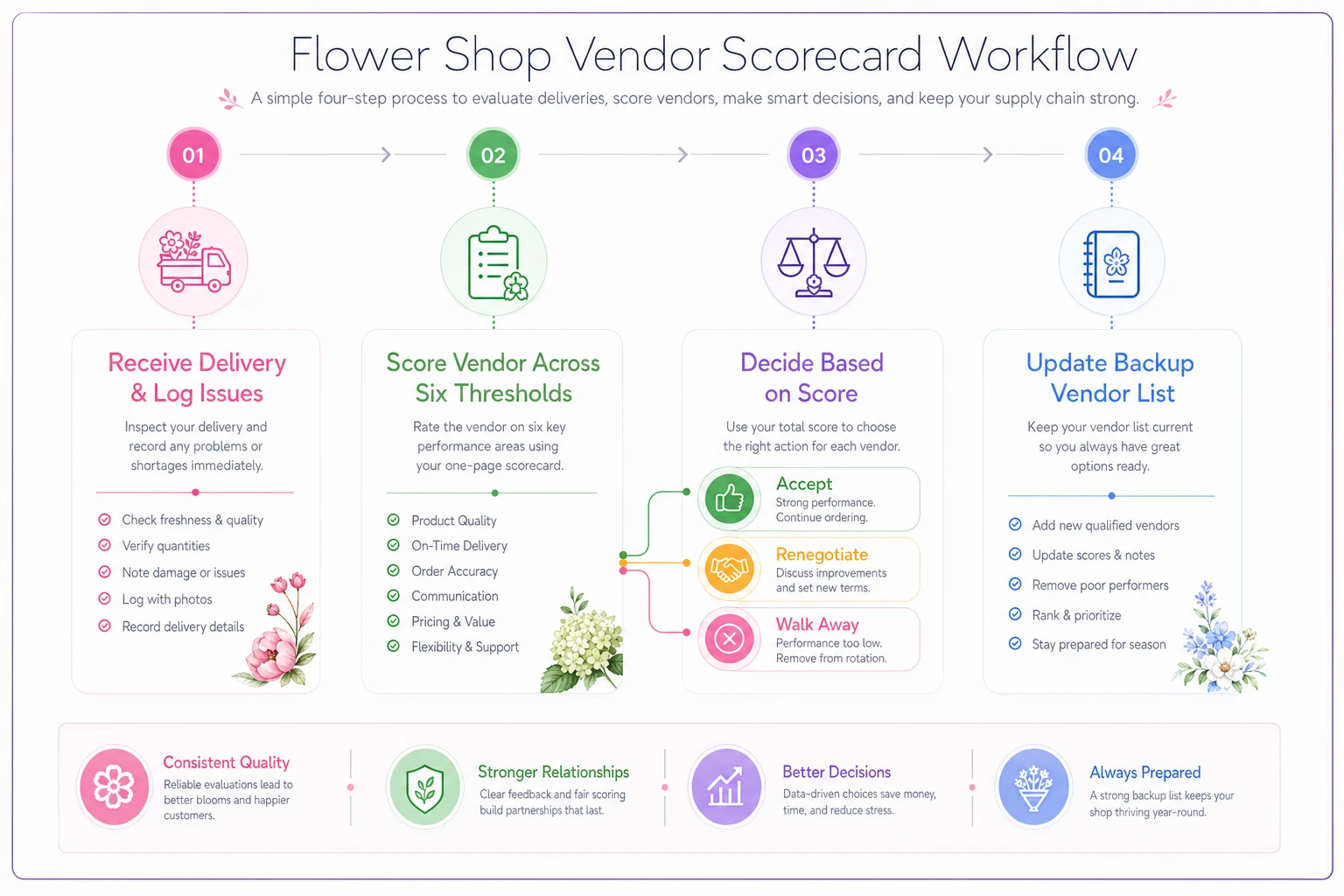
Keep a running log of claims and scores so patterns become obvious before you need to switch vendors.
If a vendor clears four of the first six and you have a backup lined up, that's usually workable. Fewer than four means you're signing up to absorb their mistakes — and on low volume, you don't have the margin cushion to do that quietly.
A real scenario: swapping one clause, not the whole vendor
A single-location shop doing roughly 110–130 orders a month was frustrated with their main wholesaler but didn't want the hassle of switching. Sourcing a new reliable supplier mid-season is its own risk. So instead they renegotiated exactly two things: a substitution value floor with a 15% approval trigger, and credits deducted from the current invoice rather than rolling to the next order.
The rep pushed back on the cold-chain language but agreed to both of the first two without much fight — because both were reasonable and specific. Over the following couple of months the quiet premium swaps essentially stopped once there was a written floor, and the credit timing change freed up a few hundred dollars that used to sit as vendor float during slow weeks.
Nothing dramatic. No vendor switch, no leverage play, no volume they didn't have. Two vague phrases replaced with two numbers. That's the whole move.
When to push, and when to let it go
Not every clause is worth a standoff on every account.
Push hard when: the vendor is your primary source for a high-volume category, when you've already documented repeat problems, or when you're signing a standing order that'll renew automatically. Standing orders are exactly where vague terms compound, because nobody revisits them.
Let it go when: it's a backup vendor you use occasionally, when the category is low-value, or when you genuinely have no alternative and the relationship is otherwise solid. A cold-chain clause on a once-a-month greens order isn't worth risking a good supplier over.
Don't bother negotiating at all when: you haven't done the receiving documentation to back up a claim. Clauses you can't enforce are decoration. Get your receiving process tight first — the photos, the timestamps, the matched invoice lines — because that's what turns a written clause into actual money back. The same discipline applies to how you structure orders in the first place; clean, perishability-matched purchase order templates make it obvious when a delivery doesn't match what you ordered, which is half the battle in any credit claim.
The short version
Low-volume florists don't win vendor negotiations on leverage. You win on clarity. Three clauses — substitution with a value floor and approval trigger, credits that hit within a week or come off the current invoice, and a documented cold-chain recourse path — cover almost every way sourcing quietly costs you. Attach a one-page scorecard with real walk-away numbers, keep your receiving documentation tight enough to enforce what you sign, and you've replaced a pile of vague emails with a handful of terms that actually hold.
You don't need a lawyer or a thick contract. You need four or five specific sentences, the willingness to say them out loud, and a number in your head for when to walk.
Ready to grow your flower shop business?
Join 500+ flower shops using Blomsly to save time, reduce errors, and delight customers with fresh blooms.