

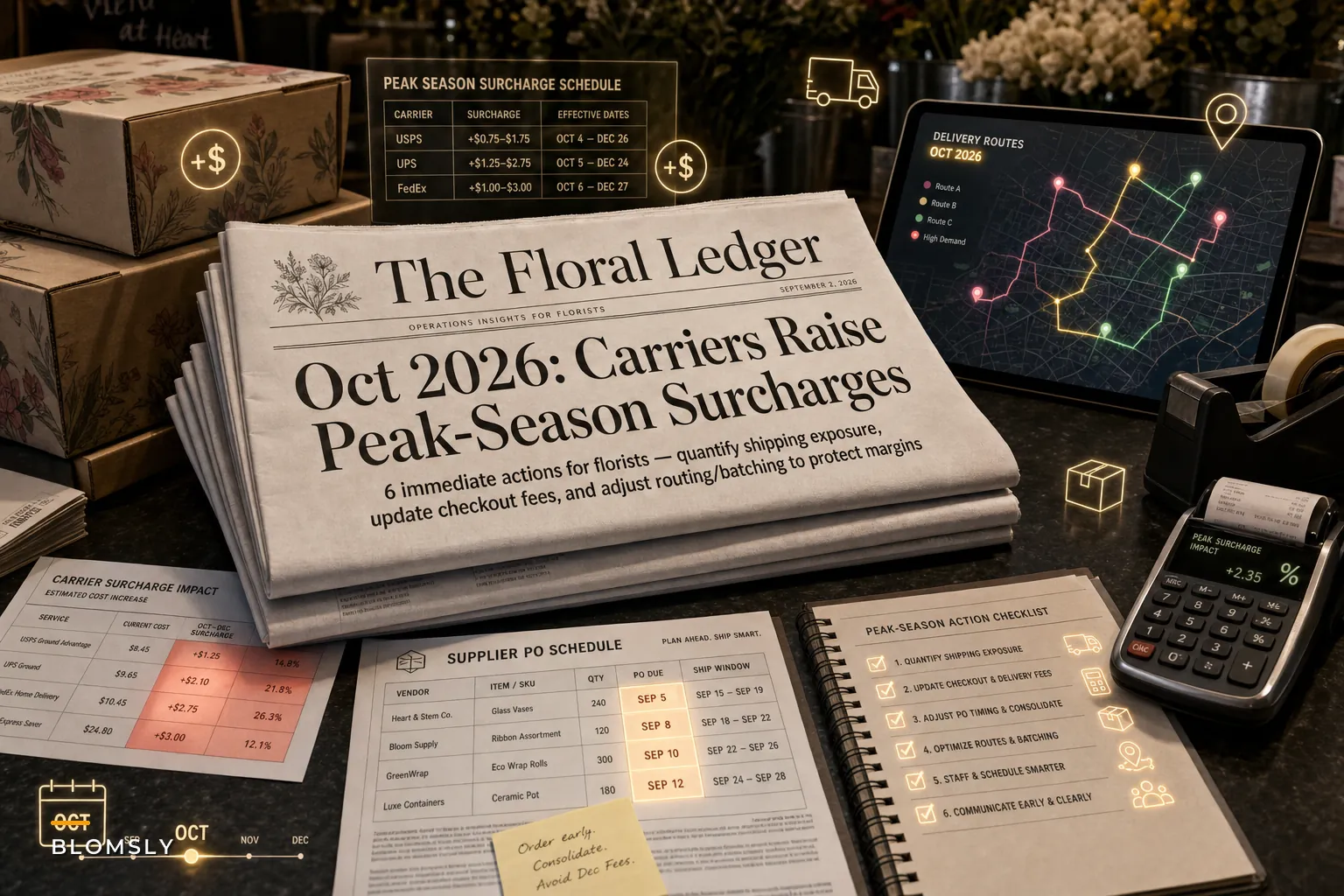

If you ship arrangements to customers or lean on carriers for inbound stems and hard goods, your cost per box is about to climb right when your volume peaks. USPS filed a temporary holiday price change running from early October through mid-January, and the private carriers followed with their own peak surcharge schedules. This isn't a surprise anymore — it happens every year — but the 2026 numbers landed higher than a lot of shops budgeted for.
The mistake most florists make isn't ignoring the surcharges. It's reacting to them in mid-November, after the boxes are already going out and the margin is already gone.
There's still runway to fix that. Use it.
What's actually happening
USPS announced a temporary rate bump for the holiday shipping window, effective roughly Oct. 4 through Jan. 17. According to Retail Dive's summary of the filing, the increase sits around 6% across most package tiers during that window. UPS and FedEx published their own peak-season surcharge schedules, and Supply Chain Dive's coverage of the UPS schedule lays out effective dates that ramp up as you get closer to December.
The detail that catches florists off guard: these surcharges stack. Residential delivery, additional handling — which fragile floral boxes trigger more often than people expect — and peak fees all layer on top of each other. A box that costs $11 to ship in September can quietly become $16–$18 in the second week of December. That's before anyone factors in inbound cost increases on supplier deliveries.
That's the entry point. The bigger issue is what these surcharges reveal about how most shops have been pricing and planning shipping all along.
The deeper problem: most florists never actually priced shipping — they absorbed it
The pattern shows up constantly. A shop sets a flat shipping fee at checkout — say $14.99 — sometime a couple years back. Made sense then. Nobody's touched it since. Meanwhile carrier costs crept up, peak surcharges got steeper, and the math quietly broke.
Never miss a bloom or a delivery.
Blomsly helps you manage orders, track stock, and schedule deliveries effortlessly.
- Unified order management
- Real-time inventory tracking
- Delivery scheduling & notifications
No credit card required
So what happens during the holidays? The flat fee stays at $14.99 while the real cost to ship that box hits $17. Every shipped order during peak loses money on freight, and because volume is highest exactly then, the bleed is worst when you can least afford it.
The surcharge news is really just a spotlight on a decision most shops never revisited. Shipping got treated as a fixed background cost instead of a live, seasonal line item that moves. Fixing that mindset is worth more than any single tactic in this list.
Action 1: Reprice your shipping tiers by weight and zone before October 4
Flat-rate shipping is comfortable and quietly expensive. A single hydrangea box and a large mixed sympathy arrangement do not cost the same to ship, and treating them the same means you're either overcharging on small orders and losing those sales, or undercharging on heavy ones and eating the difference.
Pull your last 60–90 days of shipped orders and sort by actual carrier cost. There are usually three natural clusters:
| Box profile | Typical real ship cost (peak) | Suggested customer tier |
|---|---|---|
| Small — single bouquet, 3–5 lbs | $12–$14 | $15.99 |
| Medium — mixed arrangement, 6–9 lbs | $15–$18 | $19.99 |
| Large — premium/sympathy, 10+ lbs or oversized | $19–$24 | $26.99+ |
The point isn't these exact numbers — yours will differ by region and carrier mix. The point is that a single flat fee is almost always wrong in both directions. Tiered shipping protects margin on the heavy boxes and keeps the small ones competitive.
When flat rate still makes sense: if 90% of your shipped volume is nearly identical — a subscription that always goes out in the same box, for example — flat rate is fine. Just make sure the number reflects peak cost, not what you were paying in August.
Action 2: Set a hard peak surcharge line in your pricing — and be transparent about it
Some shops hate the idea of a visible surcharge. But customers shipping flowers in December already expect holiday shipping to cost more — they see it everywhere they shop online. A clearly labeled "holiday delivery fee" that applies Nov. 15–Dec. 24 is cleaner than silently raising product prices or, worse, eating the cost entirely.
A realistic approach: a modest peak delivery fee somewhere around $3–$5, switching on automatically during the surcharge window and switching off after. This keeps your everyday pricing intact and isolates the holiday cost pressure to the period that actually causes it.
One thing to watch: don't apply it too broadly. Local hand-delivered orders inside your normal delivery zone aren't hit by carrier peak surcharges — those are your own drivers, your own routes. Don't tack a shipping surcharge onto a local delivery just because the calendar says December. Segment it properly.
Action 3: Move your inbound PO timing ahead of the ramp
Everyone thinks about outbound surcharges. Fewer shops notice that inbound freight from wholesalers and hard-goods suppliers gets more expensive too, because vendors pay the same carrier peak fees and pass them along.
-
Pull non-perishable orders forward. Vases, ribbon, floral foam, boxes, care cards — order these before the peak window opens. There's no reason to pay December surcharge rates on a case of vases you could have received in September.
-
Consolidate perishable deliveries where quality allows. Instead of three small mid-week stem deliveries, see whether two slightly larger consolidated ones hold your quality standard. Fewer inbound boxes means fewer surcharge hits.
Pull non-perishable orders forward wherever your storage and cashflow allow to avoid peak carrier fees.
Perishability sets the limit here — you can't stockpile fresh stems. But the split between "buy ahead" hard goods and "buy fresh" perishables is exactly the kind of planning that gets rushed and forgotten once the holiday rush starts. Handle it now, not in November.
Action 4: Reset your free-shipping threshold
If you offer free shipping over some dollar amount, that threshold was probably set against off-season costs. During peak, a free-shipping order that barely clears your minimum can go from mildly profitable to a loss.
Run the quick math: what's your average margin on an order that just clears the threshold? Subtract the peak ship cost. If it's negative or razor-thin, raise the threshold for the season. Bumping a free-shipping floor from $75 to $95 during the peak window is far less painful than discovering in January that your busiest month had your thinnest per-order profit.
Who should skip this: if free shipping is central to how you compete and your average order value already sits comfortably above cost even with surcharges, leave it alone. Don't fix what isn't leaking.
Action 5: Push customers toward the cheaper fulfillment path when it's genuinely better for them
A lot of shipped orders don't need to be shipped. If the recipient is inside your local delivery radius, hand delivery is usually cheaper for you and faster and more reliable for the customer — no carrier surcharge, no transit damage risk on fragile blooms.
At checkout, when a delivery address falls inside your driving zone, default that order to local delivery instead of carrier shipping. Sounds obvious, but plenty of shops let customers pick "ship" for an address that's fifteen minutes away, then pay a peak surcharge to send a fragile box through a carrier network for a trip a driver could make the same afternoon.
This is where clean address-to-zone logic in your order workflow earns its keep. When your system automatically flags local addresses and routes them to your own delivery instead of a carrier, you cut surcharge exposure without any customer friction. The shops that handle this well aren't doing anything clever — they set the rule once instead of deciding order by order during the busiest weeks of the year.
Action 6: Build your surcharge contingency into your broader peak plan — not as a separate scramble
Shipping cost is one variable among several that all spike at once during Q4. Staffing, prebuilt SKUs, supplier fill rates, and cooler throughput all bend under the same holiday pressure. Handling shipping in isolation is how you end up with perfect shipping tiers and a fulfillment floor that can't keep up.
Here's a simple workflow to tie shipping into your overall holiday operations.
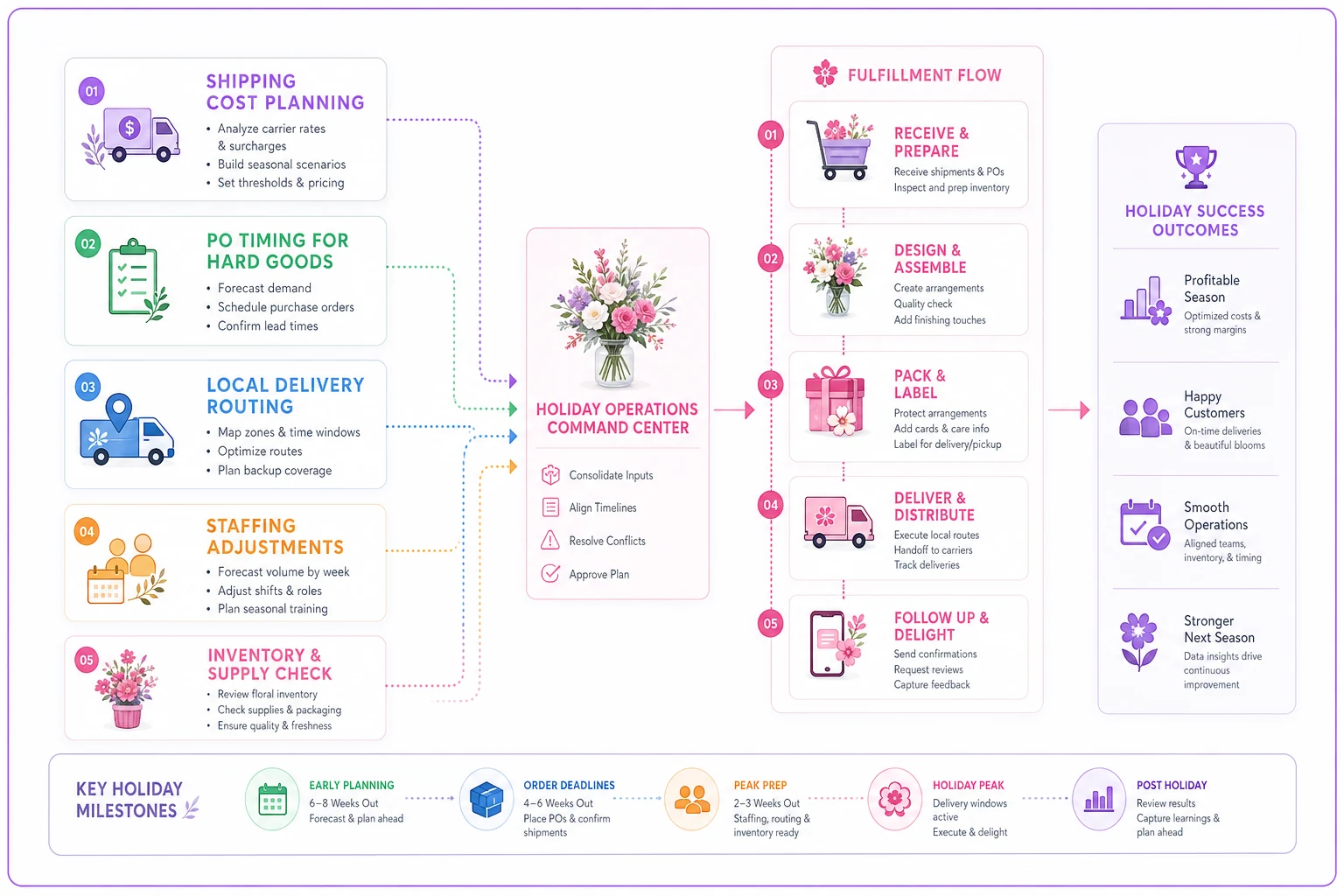
If you haven't already mapped out your full holiday operations, the surcharge changes are a good forcing function to do it now. Our peak-season operations playbook for florists walks through staffing, prebuilt SKUs, and supplier contingencies — and shipping cost planning slots directly into that same framework instead of living as a one-off spreadsheet nobody opens after October.
The shops that treat these as one connected plan — not six separate fires — are the ones that come out of December with their margins intact.
A quick real scenario
A two-person shop that does a healthy volume of shipped sympathy and gift orders ran flat $13.99 shipping year-round. During last year's peak, their real carrier cost on the average shipped box climbed past $16 once surcharges and additional-handling fees stacked. They were moving somewhere around 180–220 boxes through December.
The rough math on that: $2–$3 of hidden loss per box, across a couple hundred boxes, plus the boxes where oversized fees pushed the gap wider. Somewhere in the $600–$900 range of margin quietly gone — during their single most important sales stretch. Not catastrophic, but entirely avoidable.
This year they tiered shipping by weight, added a small seasonal delivery fee for the surcharge window, moved hard-goods POs to September, and set their system to auto-route local addresses to their own drivers. Nothing dramatic, no price shock to customers. They just stopped absorbing carrier increases they never actually agreed to. The result wasn't a revenue explosion — it was simply keeping the margin they'd already earned.
Your pre-October checklist
Run through this before the surcharge window opens:
-
Pull 60–90 days of shipped orders and cluster them by real carrier cost
-
Replace flat shipping with weight/zone tiers that reflect peak rates
-
Add a clearly labeled seasonal delivery fee for the Nov–Dec window only
-
Recheck your free-shipping threshold against peak ship costs
-
Move all non-perishable POs — vases, boxes, ribbon, foam — ahead of the ramp
-
Review whether perishable deliveries can be consolidated without hurting quality
-
Set local addresses to default to your own delivery instead of carrier shipping
-
Fold all of the above into your one holiday operations plan, not a separate doc
Use it.
The takeaway
Peak season surcharges for florists aren't the real threat — outdated shipping decisions are. The carriers publish these increases every year, and every year the shops that lose margin are the ones running last year's flat fees and free-shipping floors into a higher-cost holiday.
You've got the window right now to reprice, retime your POs, and route the local orders where they belong. The USPS announcement makes the October 4 start date concrete — that's your deadline. Do it before then, and the surcharges become a line item you planned for instead of a surprise you paid for.
Do it before then, and the surcharges become a line item you planned for instead of a surprise you paid for.
Ready to grow your flower shop business?
Join 500+ flower shops using Blomsly to save time, reduce errors, and delight customers with fresh blooms.