


Most florists don't adopt software too late. They adopt it in the wrong order. A shop will buy a routing platform before it has reliable addresses in its order data, or install an inventory system before anyone has agreed on what a "unit" even means for a bunch of ranunculus. The tool works fine. The shop still breaks. And then the owner concludes "tech doesn't work for a business like mine," which is the wrong lesson entirely.
The real issue is sequencing. Every operational capability has a readiness point — a moment where the manual version is straining enough that automation pays off, but where the underlying data and habits are solid enough that automation won't just accelerate your mistakes. An operations maturity model for florists is really a way of finding those moments on purpose instead of by accident.
What makes this harder for flower shops than, say, a print shop or a bakery, is perishability. Your inventory is losing value every hour. A mistake in a durable-goods business costs you a reorder. A mistake in a perishable business costs you the margin and the stem and sometimes the customer relationship. So the stakes on each stage transition are higher, and the pilots you run need to be structured to fail cheap.
The three stages, and what actually separates them
Here's the rough shape of the three stages:
| Stage | How decisions get made | What holds it together | Where it breaks |
|---|---|---|---|
| Manual | In the owner's head, real-time | Memory, phone calls, whiteboard | Owner absence, volume spikes, any handoff |
| Hybrid | Shared rules + human judgment | Spreadsheets, SOPs, one or two tools | Data entered inconsistently, sync gaps |
| Systematized | Rules and data drive routine calls; humans handle exceptions | Connected data model, defined roles | Over-automation of things that need judgment |
Worth noticing: a shop doesn't move through these stages uniformly. You can be systematized on delivery routing while still completely manual on inventory. That's normal and often correct. Maturity isn't a single dial — it's a set of dials, and the skill is knowing which one to turn next.
A typical example looks like this. A two-van shop has dialed in neighborhood batching — clear zones, cutoff times, a reliable way to sequence stops. But stem counts still live in a designer's head, so every Monday someone over-orders garden roses "to be safe," and every Thursday they're composting the overflow. That shop is systematized on delivery and manual on inventory. Buying more delivery tech won't help them. The dial that needs turning is the inventory one.
Why shops get stuck in hybrid forever
Hybrid is where most florists live, and a lot of them live there permanently — not because they can't advance, but because hybrid is comfortable enough to hide its own costs.
Never miss a bloom or a delivery.
Blomsly helps you manage orders, track stock, and schedule deliveries effortlessly.
- Unified order management
- Real-time inventory tracking
- Delivery scheduling & notifications
No credit card required
The pattern that shows up repeatedly: the shop builds a spreadsheet. The spreadsheet works. Then the shop grows, and the spreadsheet starts requiring a specific person to maintain it. Now you don't have a system — you have a dependency wearing a system's clothes. The owner thinks they've systematized because there's a document. In reality they've just moved the tribal knowledge from a person's head into a file that only that same person understands.
-
Entry drift. Two people enter the same thing differently. "Hydrangea - blue," "Blue Hydr.," "hydrangea (lg)." Now your reports are fiction.
-
Sync lag. The web store, the POS, and the wire service each think they own the truth, and none of them agree. This is the single most expensive hybrid failure in floral, and it's worth a deep read in the tech and data-integration playbook if you haven't mapped where your systems disagree.
-
Judgment overload. Every exception still routes to the owner. The spreadsheet handles the easy 80%, but the hard 20% — substitutions, VIP orders, delivery exceptions — all pile on one person.
None of these mean the shop should rush to systematize. They mean the shop should figure out which capability has outgrown hybrid, and move only that one.
Decision gates: how to know a capability is ready to advance
A decision gate is a specific, checkable condition that has to be true before you move a capability to the next stage. The point of gates is to stop you from adopting on vibes. "We're getting really busy" is a vibe. "We hit 40+ same-day orders on 9 of the last 12 Saturdays and dispatch is manually re-sequencing routes past cutoff" is a gate.
For each capability, write the gate as a measurable trigger plus a readiness check. The trigger says the pain is real. The readiness check says the data is clean enough to automate without amplifying errors.
Here's a worked example for delivery routing:
-
Volume trigger — You're consistently above roughly 25–35 deliveries a day, enough that manual sequencing eats more than an hour of someone's morning.
-
Error trigger — You've had at least a couple of late or missed deliveries in the last month traceable to routing, not traffic.
-
Data readiness check — At least ~95% of your orders have complete, deliverable addresses before dispatch, not corrected on the fly.
-
Process readiness check — You already have defined zones and cutoff times that people actually follow. If you don't, fix that manually first — the logic behind neighborhood batching works on paper before it works in software.
Only when all four are green do you pilot routing software. Adopt before the data readiness check is green and the software will confidently route a van to an address that doesn't exist. That's worse than manual, because manual at least involves a human going "wait, that's not a real street."
The mistake people make is treating the volume trigger as the only gate. Volume tells you the manual version hurts. Readiness tells you the automated version won't backfire. You need both.
The minimal data model you need before anything else
Here's the uncomfortable truth underneath this whole framework: you cannot systematize anything on top of messy data, and almost every florist's data is messy in the same four places. Before you chase any tool, you need a minimal, agreed-upon data model. Not an elaborate one — a minimal one.
Minimal means the fewest fields, consistently entered, that let a decision get made without asking a human. For a flower shop, the irreducible core is:
-
A real SKU structure — every stem, green, and accessory has one name, one unit definition, and one class (fast-perishable, slow-perishable, durable). If a stem has three spellings, you have no SKU.
-
Order records with structured fields — occasion, channel (web/walk-in/wire/phone), delivery date, deliverable address, and value. Structured means dropdowns and fields, not a free-text note.
-
A supplier record per vendor — what they carry, lead time, and fill-rate history. You can't run a supplier scorecard without this, and you can't forecast purchasing without the scorecard.
-
A single source of truth for availability — one place that says "we have X, committed Y, free Z." This is the field that prevents double-sells across channels.
That's it. Four things. Most shops want to skip straight to dashboards, but a dashboard built on inconsistent SKUs just gives you prettier lies. Get these four clean and roughly half your "we need software" problems turn out to be "we needed a shared vocabulary" problems.
One pattern worth flagging: the shops that systematize successfully almost always spend a boring week or two just cleaning names before they touch a new tool. The shops that fail skip that week because it isn't fun. The cleaning week is the actual work. The software is the easy part.
Low-risk pilot patterns for perishable fulfillment
Because floral mistakes cost perishable margin, you never want a big-bang rollout. You want pilots structured so that if they fail, they fail small, fast, and recoverably. A few patterns that work:
The single-zone pilot. Roll out a new routing or dispatch approach in one delivery zone only, for two to four weeks. One zone means a small blast radius, and you can compare it against the untouched zones as a control.
The single-SKU-class pilot. Systematize inventory for just your fast-perishable class first — the garden roses, the hydrangea, the things that die on you. That's where the money bleeds, so even a partial win pays for itself, and the slow-perishable and durable classes keep running manually while you learn.
The shadow-run. Run the new system alongside the manual one for a couple weeks without trusting it yet. Let the software propose the route or the reorder, but have your experienced person check it. You're not using it for decisions — you're measuring how often it agrees with your best human. When agreement hits the high 80s or 90s, you flip over.
The one-weekday pilot. Pick Tuesday. Systematize one process on Tuesdays only. Tuesdays are usually low-stakes, so a bad day is survivable, and you get a clean weekly cadence to iterate on.
Run the shadow-run for at least two full business cycles to catch weekly patterns.
A short real scenario
A single-location shop doing roughly 180–220 orders a week kept getting burned on same-day fulfillment. Their web store and POS disagreed on stem availability, so they'd oversell premium bouquets and then scramble to substitute — which annoyed exactly the customers who paid the most.
They didn't buy a big platform. They ran a shadow-run on their fast-perishable SKUs for three weeks: one agreed-upon availability number, updated at open and after the morning pull, with a daily reconcile. For the first week they just logged every time the "system" number and the "reality" number diverged. It diverged a lot — mostly from unlogged walk-in sales.
Fixing the entry habit, not the software, closed most of the gap. Oversell incidents on premium arrangements dropped from several a week to maybe one every couple of weeks, and the substitution scramble mostly disappeared. Total tooling cost for the pilot: basically nothing. The win came from the data model and the pilot structure, not a purchase.
When advancing a stage is actually a bad idea
Not every shop should systematize everything, and some shouldn't systematize much at all. A few honest cases:
Don't systematize a capability you haven't stabilized manually. If your zones change every week and nobody follows cutoff times, routing software will just automate chaos. Fix the manual version first. Software is a multiplier — it multiplies order and disorder.
Don't advance if the owner is the only one who'll maintain it. Moving from hybrid to systematized means other people operate the system. If the plan is "I'll just run it myself," you haven't systematized — you've bought yourself a second job.
Don't systematize a low-volume, high-judgment capability. Wedding and event design is largely bespoke. Trying to systematize the creative decisions there usually makes the work worse. Systematize the logistics around events — the packing, the timelines, the handoffs — and leave the judgment to people.
Who should probably stay hybrid on purpose: a one-or-two-person shop under about 100 orders a week with stable demand. At that scale, a good spreadsheet and clean habits outperform most software, and the overhead of maintaining a system isn't worth it. Maturity isn't about reaching the final stage. It's about being at the right stage for your volume and your team.
Putting it together as a sequence
The whole model comes down to running this loop, one capability at a time:
-
Pick the capability causing the most pain — usually the one generating the most owner interruptions or the most perishable waste.
-
Check its decision gate — is the manual pain real, and is the underlying data clean enough?
-
If the data isn't ready, fix the data first — the boring cleaning week.
-
Run a low-risk pilot — single zone, single SKU class, or a shadow-run.
-
Measure agreement and errors, not enthusiasm — flip to the system only when it reliably matches or beats your best human.
-
Stabilize, then pick the next capability.
Shops that follow something like this end up with a lopsided but healthy maturity profile — systematized where it pays, manual where judgment matters, and hybrid in the places still earning their way up. That lopsidedness is a feature, not a flaw.
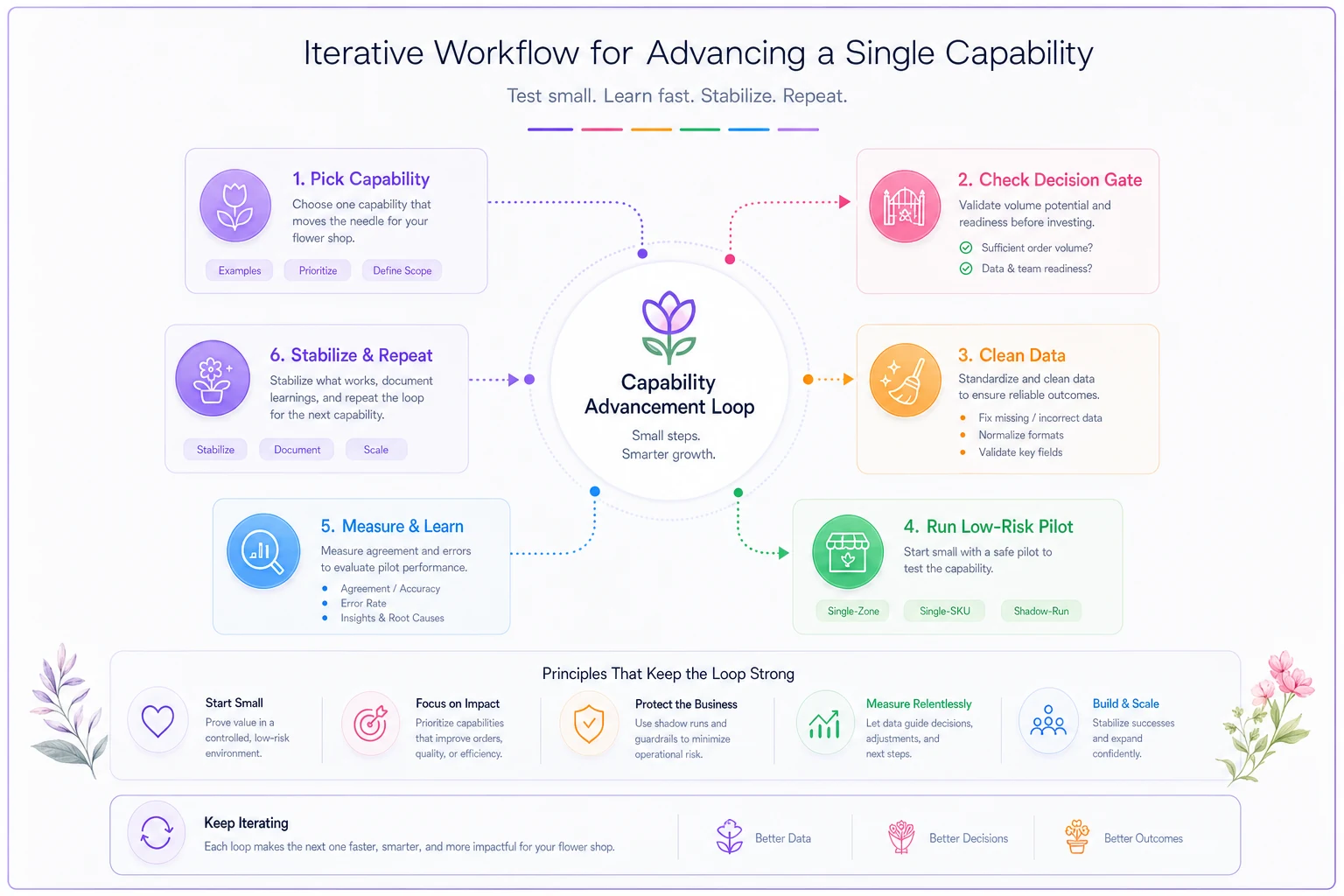
A simple visual of the sequence helps teams align on steps.
The florists who struggle with tech aren't behind on tools. They're out of order. They tried to systematize a capability before its gate was met, or built on a data model that couldn't hold weight. Get the sequence right — pain plus readiness, small pilots, clean data underneath — and each stage transition stops feeling like a gamble and starts feeling like the obvious next move it should have been all along.
Ready to grow your flower shop business?
Join 500+ flower shops using Blomsly to save time, reduce errors, and delight customers with fresh blooms.