

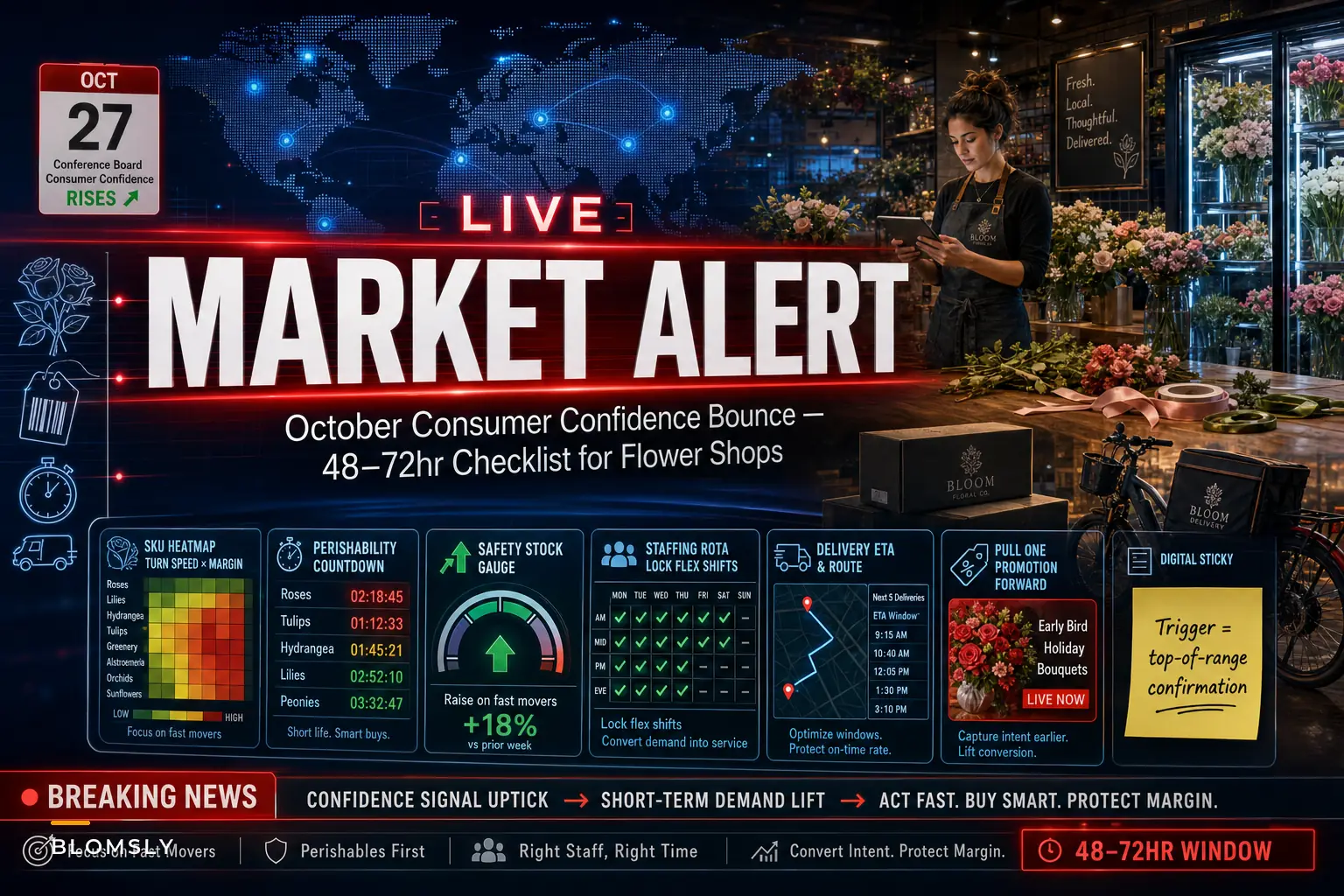

Most holiday forecasts for small flower shops get locked in sometime in early-to-mid October. Standing orders go out, temp hires get penciled in, and the big Dutch and farm POs get shaped around last year's numbers plus a gut-feel adjustment. Then a sentiment number lands at the end of the month and quietly makes half of those assumptions stale.
That's roughly what happened this year. The Conference Board reported that U.S. consumer confidence jumped in October 2026, with the index climbing to 91.7 — a sharper improvement than most expected heading into the peak buying stretch. Reuters framed it as a notable lift in sentiment weeks before the holidays, which is exactly the timing that makes it awkward for florists. The signal arrives after your plan is mostly built, but before the orders actually come in.
So this isn't a "watch the economy" piece. It's about what a last-minute positive demand signal should and shouldn't change when you've got maybe a few days before your reorder and staffing decisions harden for good.
What a confidence bump actually means for a flower shop (and what it doesn't)
A rising confidence index doesn't mean every line on your menu suddenly sells more. Sentiment improvements show up unevenly across a florist's book of business, and if you adjust everything by the same percentage you'll overbuy the slow stuff and still run short on fast movers.
The pattern worth internalizing: when people feel a little better about spending, the lift concentrates in discretionary gifting and "treat" purchases, not obligation purchases. Sympathy work, standing corporate contracts, and funeral orders don't really move with consumer mood — they're driven by events, not optimism. But the $85 "just because" arrangement, the upgraded centerpiece, the add-on candle or vase, the premium wrap — that's where a confidence bump actually lands.
What this means in practice:
-
Gift and self-treat SKUs are the most sensitive to a sentiment lift. Nudge these up.
-
Occasion-locked work (sympathy, weddings already booked, contracts) barely moves. Leave these alone.
-
Attachment and upsell items (vases, chocolates, premium ribbon, add-on stems) tend to rise faster than base arrangements, because better mood shows up as "yeah, add the extra."
-
Low-turn accessories are the trap. A confidence bump tempts people to stock more of everything, and these are exactly the items that'll still be sitting there in January.
If you take nothing else from this: a confidence bump is an argument to deepen stock on things that turn fast, not to broaden stock across things that don't.
The real problem this exposes: your forecast is probably a single number
The reason a late signal feels disruptive is that most small-shop holiday forecasts are built as one fixed figure. "We'll do about 15% over last year." That number has no give in it. When new information arrives, there's no mechanism to absorb it other than re-arguing the whole plan or ignoring it entirely. Most shops ignore it, because re-arguing is exhausting in late October.
Never miss a bloom or a delivery.
Blomsly helps you manage orders, track stock, and schedule deliveries effortlessly.
- Unified order management
- Real-time inventory tracking
- Delivery scheduling & notifications
No credit card required
The shops that handle signals like this well don't forecast a number — they forecast a range with triggers. Instead of "15% up," it's "10–20% up, and here's what we do at each end." That structure is what lets a mid-month confidence reading mean something operationally instead of just being interesting noise.
This is the same discipline behind treating forecasting as an ongoing system rather than a one-time guess. If you've built replenishment around order timing and blended spot buys the way we've laid out in our systems approach to demand forecasting and replenishment, a sentiment bump isn't a crisis — it's just an input that shifts you toward the upper end of a range you already planned for. If you haven't, it feels like being asked to redo everything from scratch.
A quick comparison: reacting badly vs. reacting well
Most florists fall into one of two camps when a signal like this comes in late. The difference usually isn't experience or resources — it's whether the plan was built with any flexibility baked in.
| Situation | The reactive shop | The range-based shop |
|---|---|---|
| Confidence number rises late | Panic-buys across the whole menu | Shifts to top of pre-set range on fast movers only |
| Fast-turn stems | Maybe adds a little, maybe not | Raises safety stock on 8–12 specific SKUs |
| Low-turn accessories | Buys "a bit more just in case" | Holds flat — these don't track sentiment |
| Staffing | Keeps original roster, scrambles later | Pre-books 1–2 flex shifts, confirms on-call temps |
| Delivery pricing | Doesn't revisit | Re-runs fee/batching math for higher volume |
| Promotions | No change | Pulls forward one early-holiday offer |
The reactive column isn't dumb — it's what you do when you don't have a structure to hang new information on. The whole point of a range is to turn a surprise into a lever you already know how to pull.
The 48–72 hour checklist
You don't have weeks. Below is what's worth doing in the next two or three days, in order of leverage.
Here's how the decision process flows from signal to action:
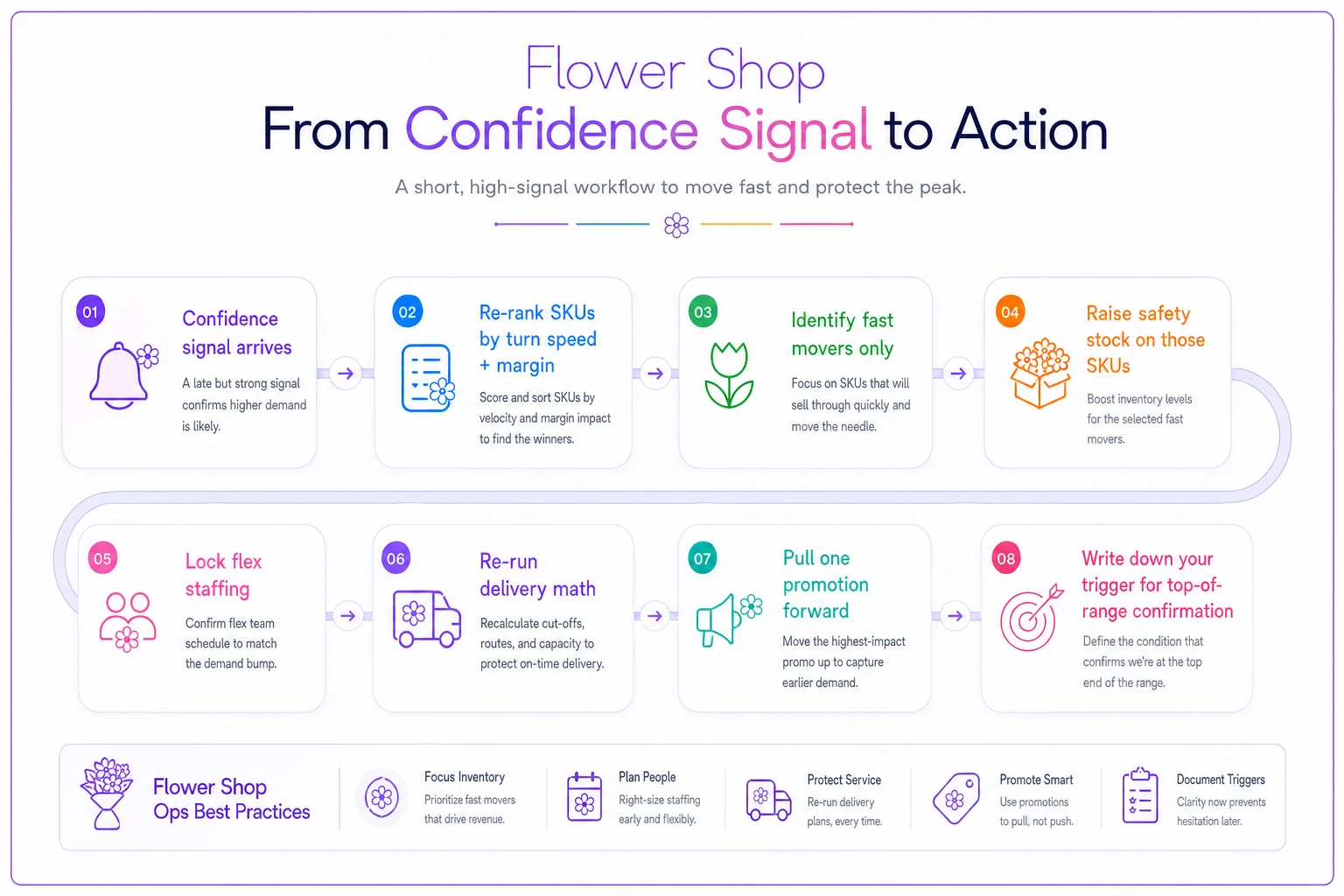
This sketch shows the short decision flow to act within 48–72 hours.
1. Re-rank your SKUs by turn speed and margin, not by what you like designing
Pull your last two peak seasons and your trailing 60 days. You want a short list of the stems and prebuilt arrangements that both sell fast and carry good margin. These are the only SKUs that justify a safety-stock bump off the back of a confidence signal.
Realistically this is 8–15 items for most small shops. If your list is longer than that, you're probably including things that feel important but don't actually turn.
2. Raise safety stock on fast movers — and only those
For each fast-turn SKU, nudge your reorder point toward the top of your planned range. A practical starting move: increase safety stock on those items by roughly 15–25% over your original peak plan, and leave everything else exactly where it was.
The discipline here is resisting the urge to touch the slow list. A sentiment bump does not rescue a low-turn accessory.
3. Protect yourself on perishability
Deepening stock on fast stems is lower risk than most florists assume, because they turn. But confirm two things before you commit: your supplier can actually fulfill the larger quantity at quality, and you have a defined salvage path if a batch comes in soft. Blend in a spot-order buffer rather than committing the whole increase to a single standing order — that's your insurance if demand lands at the low end of the range.
4. Lock in staffing flex, don't rebuild the roster
Don't redo your schedule. Instead:
-
Pre-book one or two flex shifts you can confirm or release with 48 hours' notice.
-
Re-confirm your on-call temp list actually exists and will answer the phone.
-
Identify who covers the design bench if volume runs high — a short backlog in design is where peak-season shops quietly lose promised delivery dates.
Flexibility beats a bigger fixed roster when the signal is still uncertain.
5. Re-run the delivery math if volume rises
Higher order volume changes your delivery economics in both directions. More orders per neighborhood means tighter batching and better per-stop cost — but only if your fee structure and cutoff times are set to encourage batching rather than scatter. Spend 20 minutes confirming your delivery fees still protect margin at higher volume, and that your zones are set to cluster, not sprawl.
6. Pull one promotion forward
If sentiment is up, early-holiday buyers are more willing than usual. Move one early offer — a pre-order incentive, an upgrade nudge at checkout, an add-on prompt — ahead of where you'd normally run it. The goal is capturing demand before order windows and delivery slots tighten, not discounting your way through peak.
7. Write down the trigger
Decide now: what number tells you to move to the top of your range, and what tells you to pull back? "If pre-orders are tracking X% ahead by date Y, confirm the flex shifts and the second spot order." Writing the trigger down is what stops you from re-litigating the decision at 9 p.m. during a rush.
A real scenario: the mid-sized neighborhood shop
A single-location shop doing somewhere around $18k–$22k in a strong December week had its peak plan locked by October 10 — standing orders placed, two temps lined up, same structure as last year plus a flat bump.
When the confidence reading came in late in the month, the owner didn't rebuild anything. She did three things over about two days: raised safety stock on her nine fastest-turning arrangements and her top add-on items, confirmed one on-call temp and one flex design shift, and moved her "order early, pick your delivery window" email up by roughly a week.
The outcome wasn't dramatic. Add-on attach rate ticked up noticeably because the stock was actually there when designers reached for it. She sold through the deepened fast-movers and had to spot-order twice more — which was the plan. The slow accessories she didn't overbuy weren't sitting in the cooler in January tying up cash and space.
The real win was in what she avoided: no panic buying across the whole menu, no scramble to find hands when the volume showed up.
When to ignore this entirely
A confidence signal is not a mandate. There are real cases where the right move is to do nothing.
Skip the adjustment if:
-
Your book is mostly sympathy, contracts, and pre-booked events. These don't track sentiment, and chasing a consumer-mood number will just add waste.
-
You're already supply-constrained. If your grower can't reliably hit your current quantities at quality, deepening stock on paper doesn't help — fix fill rate first.
-
Your cooler and bench are already at capacity for peak. A positive signal doesn't create more design hours or cold storage. Buying deeper than you can process is how good stems become shrink.
-
You don't have clean turn data. If you can't confidently separate your fast movers from your slow ones, a broad adjustment will do more harm than a flat plan.
The shops that get burned by signals like this are usually the ones that treat "demand might be higher" as "buy more of everything." That's not a forecast adjustment — that's optimism with a credit card.
The underlying lesson
A late-breaking confidence number is only useful if your plan was built to flex. The actual work here isn't reacting to one index reading — it's whether your forecasting is structured as a living range with pre-decided triggers, or a single number you defend until the orders prove you wrong.
Shops that treat forecasting as an ongoing system absorb signals like this in an afternoon. Shops that treat it as a once-a-year guess either overreact or ignore the information entirely, and both cost margin.
If this October's bump exposed that your plan has no give in it, the fix isn't a better guess for December. It's building the kind of range-and-trigger structure that makes the next signal, good or bad, something you can act on in 48 hours instead of something you have to dread.
Ready to grow your flower shop business?
Join 500+ flower shops using Blomsly to save time, reduce errors, and delight customers with fresh blooms.