

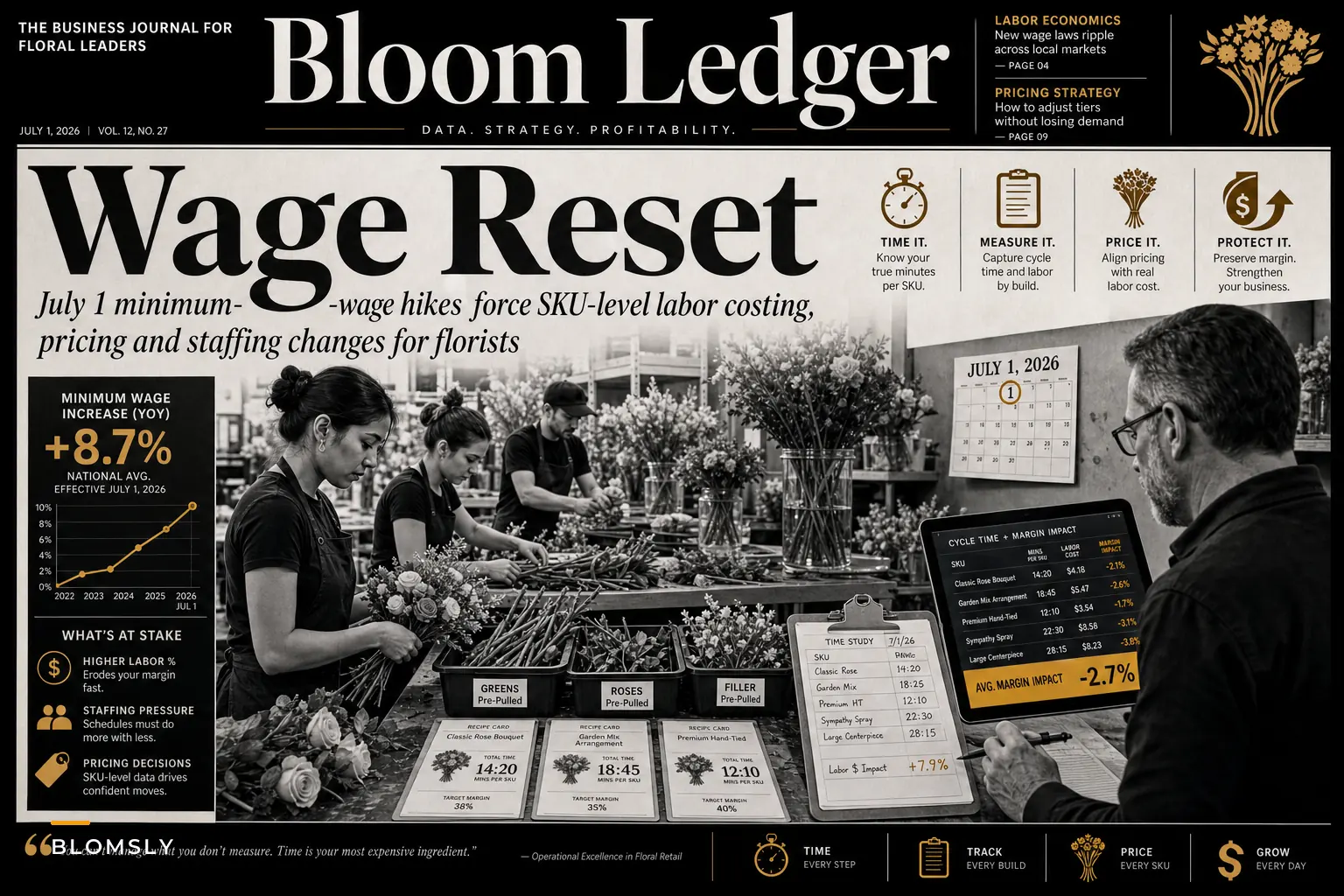

Starting July 1, 2026, flower shops in over 20 jurisdictions face new minimum wage rates—some jumping to $17 or even $18 per hour. According to Stateline's recent analysis, cities from Chicago to Portland are implementing increases that directly hit retail operations. If your shop operates in D.C., Oregon metro areas, or California cities, you're looking at immediate payroll adjustments that could add $2–4 per hour to base labor costs.
For flower shops, this isn't just a payroll update. Every bouquet assembled, every delivery run, every walk-in consultation now costs more. A $15-to-$17 jump means that same $45 arrangement that took 15 minutes to build just went from $3.75 in labor to $4.25. Multiply that across hundreds of daily SKUs and you're facing serious margin pressure fast.
Most florists already run tight margins—somewhere around 8–12% net. When labor represents 28–35% of gross revenue, even a modest wage increase can flip profitable months into losses if you don't adjust quickly.
Breaking down the real per-order impact
Take a typical mid-sized shop doing around 400 orders weekly with three full-time designers and two part-time drivers. Pre-July, at $15/hour, weekly design labor runs roughly $1,800 for 120 hours. Post-July at $17/hour, that same coverage costs $2,040—a $240 weekly increase, or close to $12,500 annually just for design staff.
What catches shops off-guard is the compound effect across the whole operation. Drivers cost more per route. Counter staff costs more during slow periods. Your Saturday event prep team suddenly represents a bigger line item than it used to. A shop doing $450K annually might see total labor costs jump from $135K to $148K—that's your entire Q4 profit margin gone.
The mistake I see constantly? Shops treat this as purely a pricing problem. They bump arrangement prices by $3–5 and call it done. Customers notice price increases immediately, though. They rarely notice operational improvements. You need both sides working together.
Immediate staffing roster adjustments
Your first move happens at the schedule level. Pull your last three months of hourly sales data and map it against your current staffing roster. Most shops discover they're overstaffed Tuesday mornings and understaffed Thursday afternoons—patterns that were tolerable at lower wage rates become expensive at higher ones.
Never miss a bloom or a delivery.
Blomsly helps you manage orders, track stock, and schedule deliveries effortlessly.
- Unified order management
- Real-time inventory tracking
- Delivery scheduling & notifications
No credit card required
Start with your slowest periods. That Tuesday 9am–noon block where you keep two designers "just in case"? At $17/hour, those six mostly-idle hours cost $102 weekly. Either consolidate to single coverage with clear escalation protocols, or shift those hours to prep work that actually drives revenue—pre-building everyday bouquets, processing incoming shipments, updating online inventory.
Cross-train at least one designer to handle the register and one driver to assist with order processing so slow periods are covered without extra hires.
Look at your peak coverage too. If Friday 2pm–6pm consistently sees eight orders per hour, you need enough hands to maintain quality without tipping into overtime. But staffing for peaks all day burns money. Consider split shifts—your strongest designer works 6am–10am for prep, then returns 2pm–6pm for the rush. It's more complex scheduling, but the labor efficiency gain often hits 15–20%.
Cross-training becomes critical at this point. Every employee who can only do one task represents inflexibility at premium wage rates. Your driver who can't process phone orders is dead weight during delivery downtime. Your designer who won't help at the register creates bottlenecks. At higher wages, single-function employees are a luxury most shops can't afford.
Reworking your pricing tiers with labor reality
Your labor cost per SKU just shifted, but not uniformly. That $35 "market bouquet" using seasonal stems takes 8 minutes to build. At $15/hour, labor was $2. At $17/hour, it's $2.27—a 13.5% increase on an item with maybe 40% gross margin. Meanwhile, your $125 premium arrangement takes 25 minutes but commands 65% gross margin, absorbing the wage increase much more easily.
Uniform price increases actually hurt your product mix. Raising everything 10% pushes budget shoppers away while underpricing premium work. Instead, build a labor-cost matrix for your top 20 SKUs. Calculate the actual per-item labor cost at your new wage rate, including non-design time like phone consultation, order processing, and delivery coordination.
| Tier | Notes |
|---|---|
| Budget tier (under $40): | These need the biggest percentage increases because margins were already thin. That $35 bouquet probably needs to hit $39–40. You'll lose some volume here—that's fine. It's better than selling at a loss. |
| Mid-tier ($40–75): | Moderate increases of $3–5 per arrangement. These customers show less price sensitivity, and you're protecting solid margin territory. |
| Premium tier ($75+): | Minimal or no increases. These high-margin orders help subsidize the rest of your operation. Protect this volume. |
Don't overlook delivery fees either. If your drivers just went from $14 to $16/hour, and average delivery time runs 25 minutes including return, your per-delivery labor cost rose from $5.83 to $6.67. Factor in vehicle costs and you probably need to bump delivery fees by $2–3, or tighten your free delivery threshold.
Assembly time standards that match new economics
Higher wages demand tighter operational standards. That casual "take your time, make it perfect" approach gets expensive fast. You need real assembly benchmarks that balance quality with efficiency.
Start by timing your current processes—not just the part where designers build arrangements, but the entire workflow. How long does it take to pull stems from the cooler? Stage materials? Clean up between orders? Package for delivery? Most shops discover their "10-minute bouquet" actually consumes 16–18 minutes of paid time once you account for everything around it.
There's a previous post covering detailed time-study methods for assembly standards, but the short version: track 20 builds of your five most common SKUs. Include everything from order receipt to ready-for-delivery. You'll almost certainly find massive variation—one designer finishes in 8 minutes, another takes 14 for identical specs.
-
Pre-pull common stem combinations during slow periods
-
Set up dedicated assembly stations with tools and supplies within arm's reach
-
Create recipe cards with exact stem counts, not vague descriptions
-
Implement quality checks that take 30 seconds, not 3 minutes
Here's a quick visual of the assembly workflow and time-study process to help teams align on where to measure and improve.
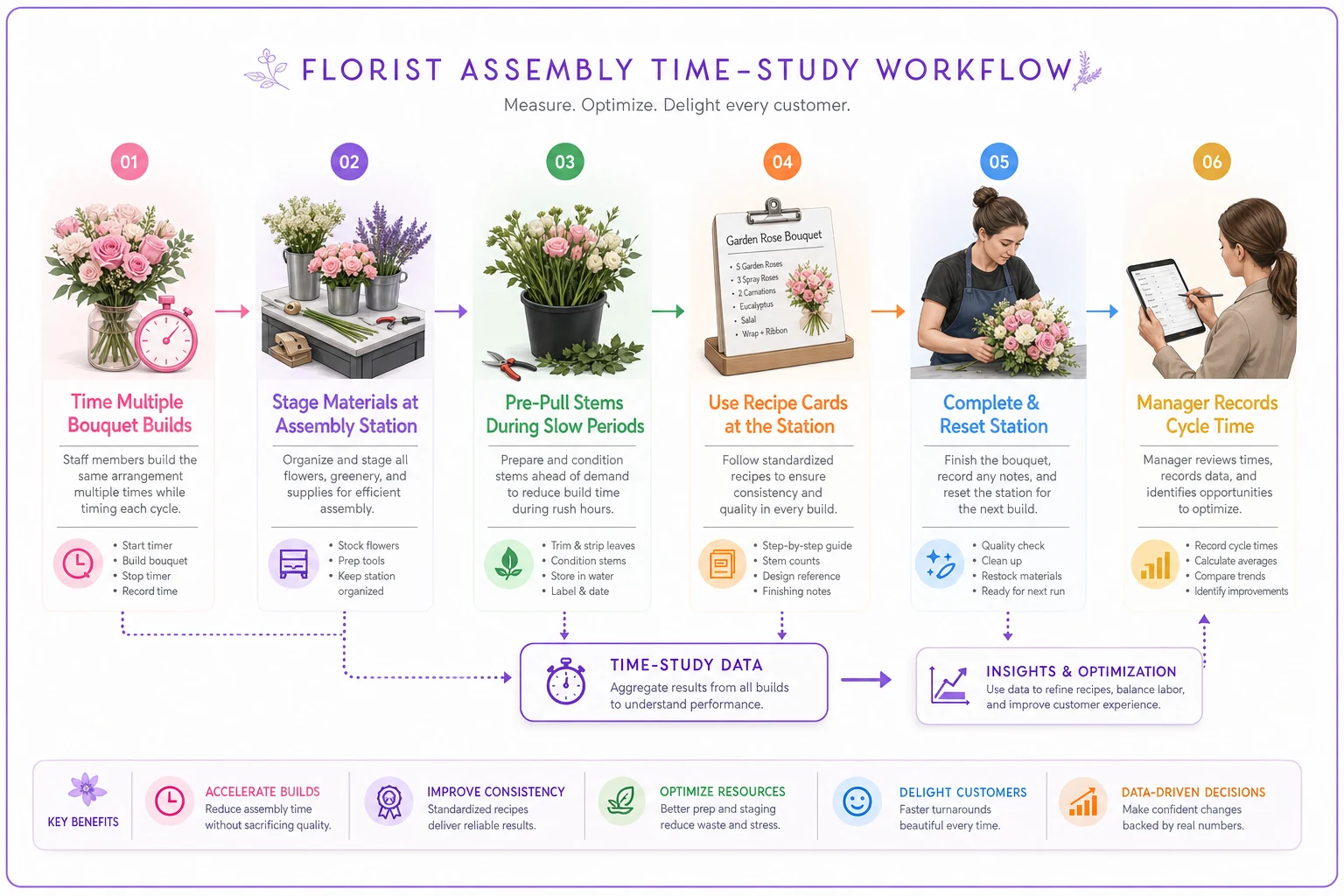
The goal isn't rushing through orders. It's cutting out the wasteful searching, backtracking, and in-the-moment decision-making that inflates assembly time. Even shaving 2 minutes per arrangement can save $150–200 weekly at new wage rates.
Operational fixes beyond just raising prices
Price increases alone won't solve this. Smart shops are rebuilding workflows to function efficiently at higher wage rates—not just working faster, but eliminating the structural waste baked into daily operations.
-
Batch processing becomes mandatory. Instead of building orders as they arrive, group similar arrangements together. Five "Sunrise Bouquets" built consecutively takes around 35 minutes total. Built separately throughout the day, they'd take closer to 50 minutes with repeated setup and cleanup. At $17/hour, that 15-minute difference is $4.25 in pure labor savings per batch.
-
Pre-built inventory for common orders. Every shop has their workhorses—the $45 mixed bouquet, the $60 roses, the $35 cash-and-carry special. Build these during Monday's slow hours when you're paying staff anyway. Store them properly in the cooler. When orders come in, you're pulling pre-made product instead of starting from scratch. This especially helps during Friday afternoon chaos when every minute matters.
-
Delivery route optimization gets serious. Random delivery runs destroy profitability at higher driver wages. Implement strict cut-off times and zone-based routing. Tuesday and Thursday for east-side deliveries. Monday, Wednesday, Friday for downtown. Customers adjust quickly when policies are clear and consistent. Consolidated routes often cut delivery labor costs by 25–30%.
-
Technology for order management. Manual order taking, handwritten delivery tags, and paper invoices burn expensive minutes. A proper POS system, even a basic one, eliminates redundant data entry. Orders flow directly to production queues. Delivery lists generate automatically. The time savings compound across every single order.
The time savings compound across every single order.
Software automation as a margin protector
This is where AI-powered operational software starts making real financial sense. When wages were lower, manual processes were annoying but manageable. At $17–18/hour, those same inefficiencies become profit killers.
Consider order intake. Phone orders averaging 4 minutes each cost over $1 in pure labor per call at higher wages. An online ordering system with smart product recommendations handles routine orders without any labor cost. For a shop taking 50 phone orders daily, that's $50 in labor just answering phones—around $1,500 monthly that could go straight to the bottom line.
Inventory management offers similar gains. Manual flower counts, handwritten waste logs, and guesswork ordering leads to both overstock and stockouts. AI-assisted platforms can track real usage patterns, predict demand based on historical data, and generate optimal order quantities—reducing waste while ensuring you don't lose sales from running out.
The real value comes from having integrated operations. When your POS connects to your inventory system, which feeds your delivery routing, which ties into your customer database—you're operating like a business two or three times your size without adding staff. Orders process more smoothly. Routes optimize automatically. Customer preferences get recorded and applied without anyone having to remember them.
None of this replaces your skilled designers or customer service. It eliminates the administrative load that consumes 20–30% of their paid time. At higher wage rates, recovering even half that time for actual revenue-generating work changes your economics considerably.
A worked example: mid-size shop transformation
Garden District Flowers in Portland, 2.5 designers, 1 driver, $380K annual revenue. When Oregon minimum wage hit $16.50, their monthly labor went from $11,500 to $12,400. Owner Maria had two weeks to respond.
First moves were schedule adjustments. She cut Tuesday morning coverage to one designer, saving 4 hours weekly. Shifted her driver to split shifts during peak delivery times, eliminating roughly 6 hours of downtime weekly. Those two changes alone recovered around $660 monthly.
Pricing came next. Budget arrangements under $40 increased by $4–5. Mid-range stayed mostly flat with $2 increases. Premium orders actually dropped slightly to protect volume. Delivery fees went from $8 to $10, with free delivery threshold rising from $50 to $65. Monthly revenue impact was approximately $2,100 more with only minor volume loss in the budget tier.
Operational improvements took longer but hit harder. Batch processing similar orders saved around 45 minutes daily. Pre-building common arrangements during slow periods eliminated rush-time chaos. Tighter delivery routing cut driver time by roughly 25%. Switching from full manual ordering to a basic digital system eliminated about 5 hours weekly of administrative work.
The combined effect: labor costs settled at $11,900 monthly (up $400 from original) while revenue grew to $34,500 monthly from $31,700. Net margin improved from 8.5% to 11.2%, despite higher wage rates.
Moving forward with July 1 changes
Shops that wait until after implementation to adjust will spend months playing catch-up while margins erode. Your action items need to start now:
This week: Pull your current staffing schedules and sales data. Calculate your true labor cost per hour, including payroll taxes and benefits. Map out which hours generate revenue and which are just coverage.
Next week: Run time studies on your top 10 SKUs. Include the entire workflow, not just assembly. Identify where time gets wasted and which processes vary most between employees.
Two weeks out: Build your new pricing matrix based on actual labor costs. Test customer response with gradual increases on budget items first. Announce delivery fee changes with clear explanation.
By June 15: Implement schedule changes and cross-training programs. Make sure everyone understands new efficiency standards without feeling rushed or pressured. Set up systems for batch processing and pre-building.
By June 25: Launch any technology or automation improvements. Even basic changes like digital order forms or simple routing software need time for staff to get comfortable and customers to adjust.
You can check which states and cities are affected through the DOL's state minimum wage directory and ADP's summary of July 1 changes.
The shops that do well after July 1 won't be the ones that simply raised prices and hoped for the best. They'll be the ones that used this moment to finally fix operational problems they'd been tolerating for years. Higher minimum wages for florist staffing don't have to mean lower profits—but only if you're willing to change how you operate.
The shops still doing everything the same way in August will be the ones complaining about margins. The ones who adapted will wonder why they didn't make these changes sooner.
The shops that do well after July 1 won't be the ones that simply raised prices and hoped for the best. They'll be the ones that used this moment to finally fix operational problems they'd been tolerating for years. Higher minimum wages for florist staffing don't have to mean lower profits—but only if you're willing to change how you operate.
Ready to grow your flower shop business?
Join 500+ flower shops using Blomsly to save time, reduce errors, and delight customers with fresh blooms.