

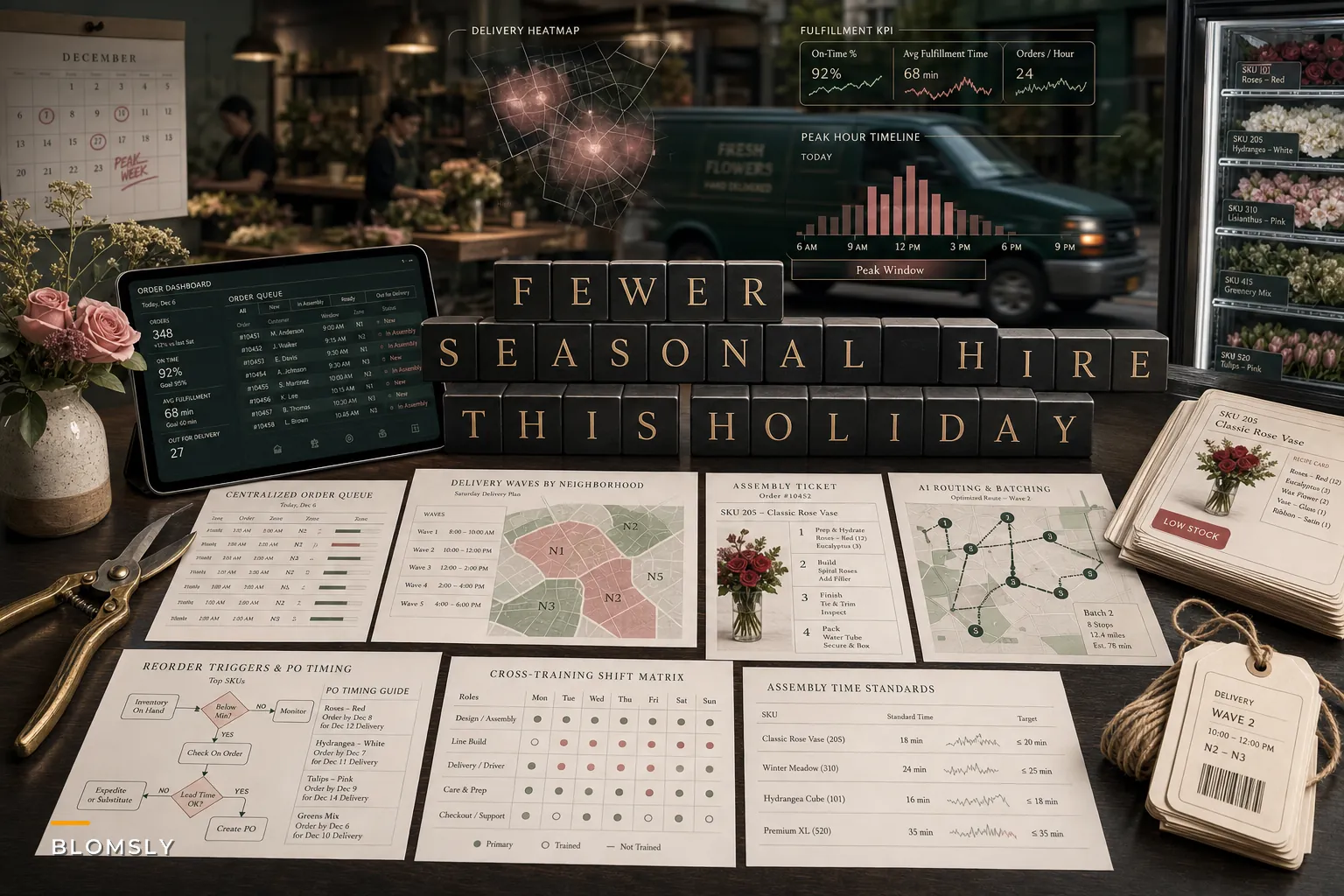

The 2026 holiday hiring picture just got more complicated for anyone running a small shop. Challenger, Gray & Christmas released their 2026 holiday hiring outlook on September 23, and the short version is that big retailers are planning leaner, more "surgical" seasonal hiring than last year — leaning on existing staff, automation, and on-demand labor pools instead of mass temp hiring.
For a flower shop, the headline itself isn't the problem. You were never competing with a national retailer's HR department. The problem is downstream. When the big players hire fewer temps and squeeze more out of existing staff, the local labor pool tightens — the exact pool you pull your seasonal driver and extra bench designer from. And when logistics providers run thinner crews, your delivery windows get less forgiving right when your volume peaks.
The real question isn't whether seasonal workers exist. It's whether your shop can run Valentine's week and the December rush with maybe one fewer hire than you planned, and delivery partners who have zero slack. That's the scenario worth preparing for now, not in December.
What the tighter labor pool actually exposes
Most shops don't want to look at this directly: seasonal hires have quietly been covering for a lack of system. The extra pair of hands in December papers over fuzzy processes the rest of the year. When you can't get that extra pair of hands, every gap shows up — a late delivery, a wrong order, a designer standing in the cooler trying to remember which recipe goes with the $65 "Winter Warmth" arrangement.
A tight labor market doesn't create new problems. It removes the buffer that was hiding your existing ones.
That reframe changes what you do with the next few weeks. You don't just recruit harder (though you should start early). You reduce how much labor each order actually needs. Those are two very different projects, and the second one is where small shops tend to win.
The seven moves, roughly in the order they pay off
Not every shop needs all seven.
Never miss a bloom or a delivery.
Blomsly helps you manage orders, track stock, and schedule deliveries effortlessly.
- Unified order management
- Real-time inventory tracking
- Delivery scheduling & notifications
No credit card required
But the sequence matters — the first few reduce how much labor you need, which makes whatever hiring you do manage far less stressful.
1. Cross-train before you recruit
The cheapest seasonal "hire" is a current employee who can do a second job well. Most small shops have a designer who's never processed a delivery run and a counter person who's never built a basic dozen-rose wrap. In a normal year, that siloing is fine. In a tight year it's a liability.
Pick the two or three bottleneck tasks — bouquet assembly, wrapping and packaging, and delivery staging are the usual ones — and make sure at least two people can handle each to an acceptable standard. "Acceptable" is the key word. You're not trying to make everyone a lead designer. You're trying to make sure that when your afternoon driver calls in sick on December 22nd, someone else can stage and route the run without the whole shop stopping.
Start cross-training on the simplest, highest-volume SKU first so coverage becomes meaningful quickly.
Shops that go through this process usually discover something else along the way: their assembly standards were never written down. The second person can't learn the task because it only ever lived in one person's head. Fixing that is half the value.
2. Lock your prebuilt SKUs early and keep the menu short
Decision time is labor you're paying for and not seeing on any invoice. Every time a designer has to figure out what goes into an arrangement, you lose a few minutes — and in a rush, those minutes stack into the reason your last few orders went out late.
Prebuilt holiday SKUs with fixed recipes, fixed stem counts, and fixed containers turn design decisions into assembly steps. The win isn't just speed. It's that a less-experienced seasonal helper can actually produce them. A locked recipe is trainable. "Make it festive" is not.
Keep the holiday menu deliberately short. Three price points per occasion is plenty for most small shops during peak. The longer the menu, the more sourcing complexity, cooler clutter, and decisions per order. If you want a fuller breakdown of how prebuilt SKUs and supplier contingencies fit together, the peak-season operations playbook for florists covers that in more detail.
3. Tighten safety stock and reorder rules for the SKUs that actually matter
When labor is thin, you can't afford to send someone on an emergency wholesaler run because you miscounted greens. A tighter year is a good reason to over-index on reorder discipline — but only for your top holiday movers.
Separate your SKUs into two buckets: the ones driving the bulk of holiday volume, and everything else. For the first bucket, raise safety stock slightly and set hard reorder triggers. For the second, run leaner and accept the occasional stockout — a customer can wait on a niche add-on, not on the arrangement that's the whole order.
The mistake is treating all perishables with the same caution. Padding safety stock across everything just converts a labor problem into a shrink problem.
4. Batch deliveries hard and publish your windows
Don't assume same-day or tight windows will be available when you need to lean on logistics partners. Build your schedule around delivery waves instead of promising arbitrary times.
A simple version: two or three fixed dispatch times per day during peak, with orders grouped by neighborhood into each wave. Customers get a window ("between 1 and 5 PM"), not a promise of a specific hour. This cuts drive time, reduces trips, and means one driver can cover far more ground — which is the whole point in a year where a second driver might not exist.
| Delivery approach | Drivers needed on a heavy day | Typical orders per driver | Risk when labor is short |
|---|---|---|---|
| On-demand, promise-specific-times | 2–3 | Lower | High — one no-show breaks the day |
| Neighborhood-batched waves | 1–2 | Higher | Lower — easier to absorb a gap |
| Mixed (batch + a few premium slots) | 1–2 + overflow | Medium | Moderate, manageable |
The batched model isn't just cheaper. It's more resilient, which is exactly what you're buying this year.
5. Start recruiting now — and recruit differently
If the local pool is smaller and more competitive, the shops that lock in help early win. Posting in late November, after the big retailers have already pulled candidates, is how you end up short.
A few things that actually move the needle for small shops competing against larger employers:
-
Offer shorter, defined commitments. "Three weeks, Dec 10–31, set schedule" beats a vague "seasonal" posting for people who can't commit to open-ended hours.
-
Lean on your existing network first. Past seasonal hires, family of staff, culinary or art students who want short gigs. Referrals beat cold postings almost every time.
-
Be honest about the work. Standing, cold cooler, repetitive wrapping. The people who show up anyway are the ones who stay.
-
Pay a small completion bonus for finishing the full committed stretch. It reduces the mid-season walk-off that wrecks your schedule.
6. Write down the one-day onboarding before you need it
A seasonal helper you can't train quickly is barely help at all. In a tight year you may be onboarding someone a day or two before your busiest stretch, so the onboarding has to be ruthless about what matters.
A workable one-day structure:
-
Hour 1 Shop safety, where everything lives, cooler rules, the pick-path. Nothing else.
-
Hours 2–3 One prebuilt SKU, start to finish, repeated until it's consistent. Not the whole menu — one.
-
Hour 4 Wrapping and packaging standard, because this is where quality visibly slips.
-
Afternoon Shadow a delivery staging run, then do one supervised.
-
End of day A two-item competency check — can they build that SKU and stage a run correctly? If yes, they're useful tomorrow.
Shops that onboard well teach narrow and deep, not wide and shallow. One SKU done right beats a tour of ten they'll never remember once the rush hits.
7. Use streamlined workflows to absorb the gap you can't hire away
This is where tooling earns its place — not as a magic fix, but as a way to stop burning labor on coordination overhead. A surprising amount of small-shop labor during peak gets spent on things that aren't flower work: re-reading order notes, chasing which arrangement goes to which address, re-confirming delivery windows, figuring out what still needs to go out.
Operational software that centralizes orders, auto-groups deliveries by zone, and keeps assembly instructions attached to each ticket quietly removes a lot of that friction. AI-assisted routing that batches the day's stops, or automation that flags when a top SKU is approaching its reorder trigger, means fewer decisions sitting on your most experienced person's shoulders. In a year where that person can't be cloned, taking low-value decisions off their plate is effectively adding capacity without adding payroll.
Here's a quick visual of how that workflow could look.
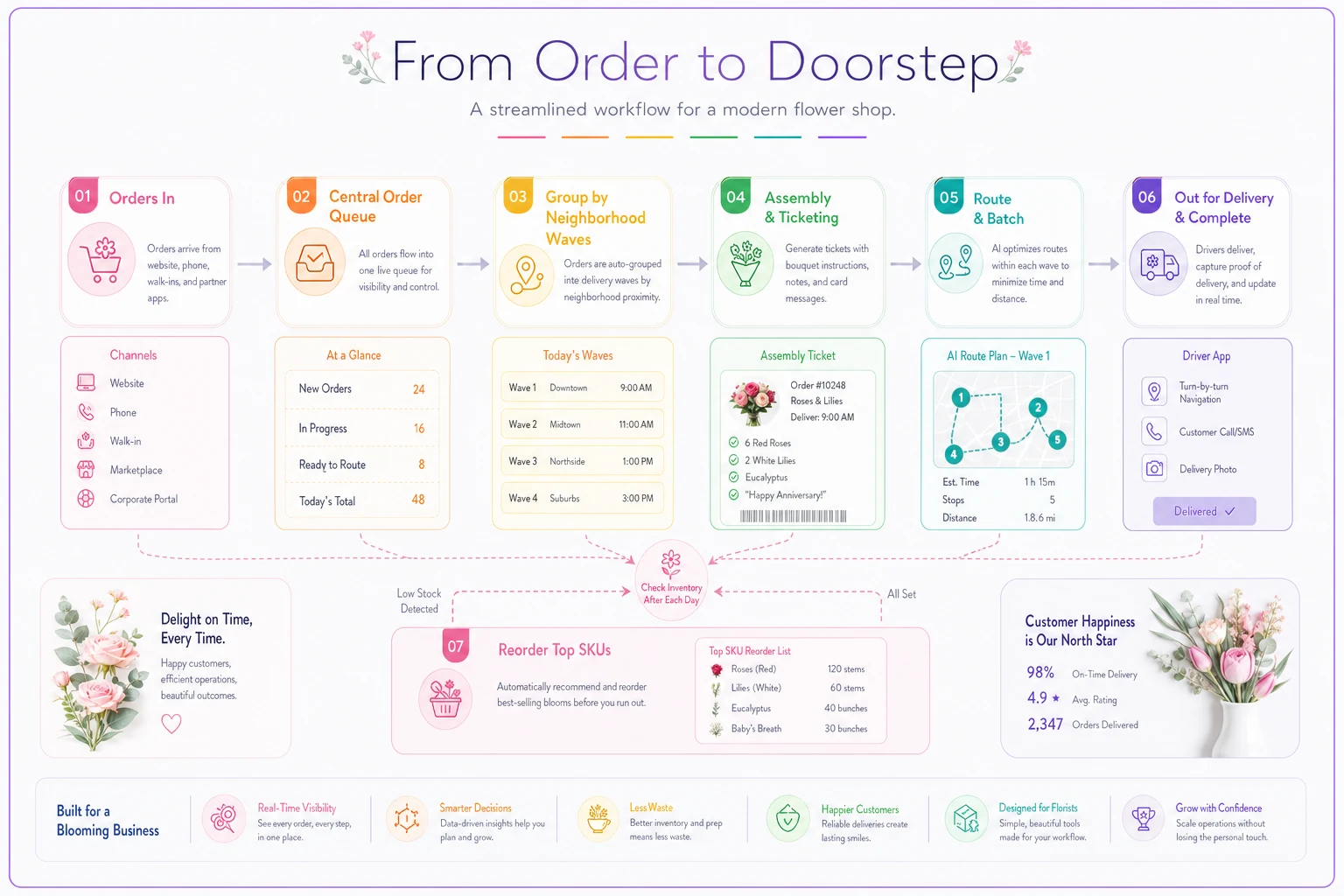
The point isn't to automate the craft. It's to automate the friction around the craft so your short-handed team spends its hours on flowers, not on figuring out what to do next.
A realistic scenario
Take a two-designer shop that normally brings on two seasonal hires for December and a part-time holiday driver. This year they secured only one seasonal hire, and their usual delivery partner pushed back on tight same-day windows.
Instead of scrambling, they did the unglamorous prep work. Cut the holiday menu to nine SKUs across three occasions, each with a locked recipe. Cross-trained their counter person on basic assembly and delivery staging. Switched to two fixed dispatch waves with neighborhood batching and published 4-hour windows on the site.
The result wasn't dramatic — it rarely is. But the single seasonal hire was productive by day two instead of day five, because there was one SKU to master instead of a sprawling menu. Delivery trips dropped by roughly a third because of batching, which meant one driver covered what used to take one-and-a-half. The two experienced designers spent their time actually designing instead of answering "where does this one go?" all afternoon. On a brutal week, that was the difference between late orders and on-time ones.
When these moves don't apply
A couple of honest caveats. If your shop's whole brand is bespoke, same-day, we-say-yes-to-anything service, hard batching and a nine-SKU menu will fight your positioning — you'll want a lighter version that keeps a few premium flexible slots. And if you genuinely have a reliable seasonal labor pool and logistics partners with slack, some of this is over-engineering for your situation.
The one thing that applies broadly: shops that treat a thin labor year as a reason to tighten their systems come out of it stronger, because those systems don't disappear in January. The buffer you build by needing less labor per order is a buffer you keep year-round. A hard hiring season just forces the work you probably should have done anyway.
The one thing that applies broadly: shops that treat a thin labor year as a reason to tighten their systems come out of it stronger, because those systems don't disappear in January. The buffer you build by needing less labor per order is a buffer you keep year-round. A hard hiring season just forces the work you probably should have done anyway.
Ready to grow your flower shop business?
Join 500+ flower shops using Blomsly to save time, reduce errors, and delight customers with fresh blooms.