

Most shrink doesn't start in your cooler. It starts at the back door, in the five minutes where boxes come off the truck and somebody signs for them without really looking. By the time a designer pulls a bunch of roses that won't open on day three, the truck is long gone, the invoice is paid, and your supplier has zero reason to think anything went wrong on their end.
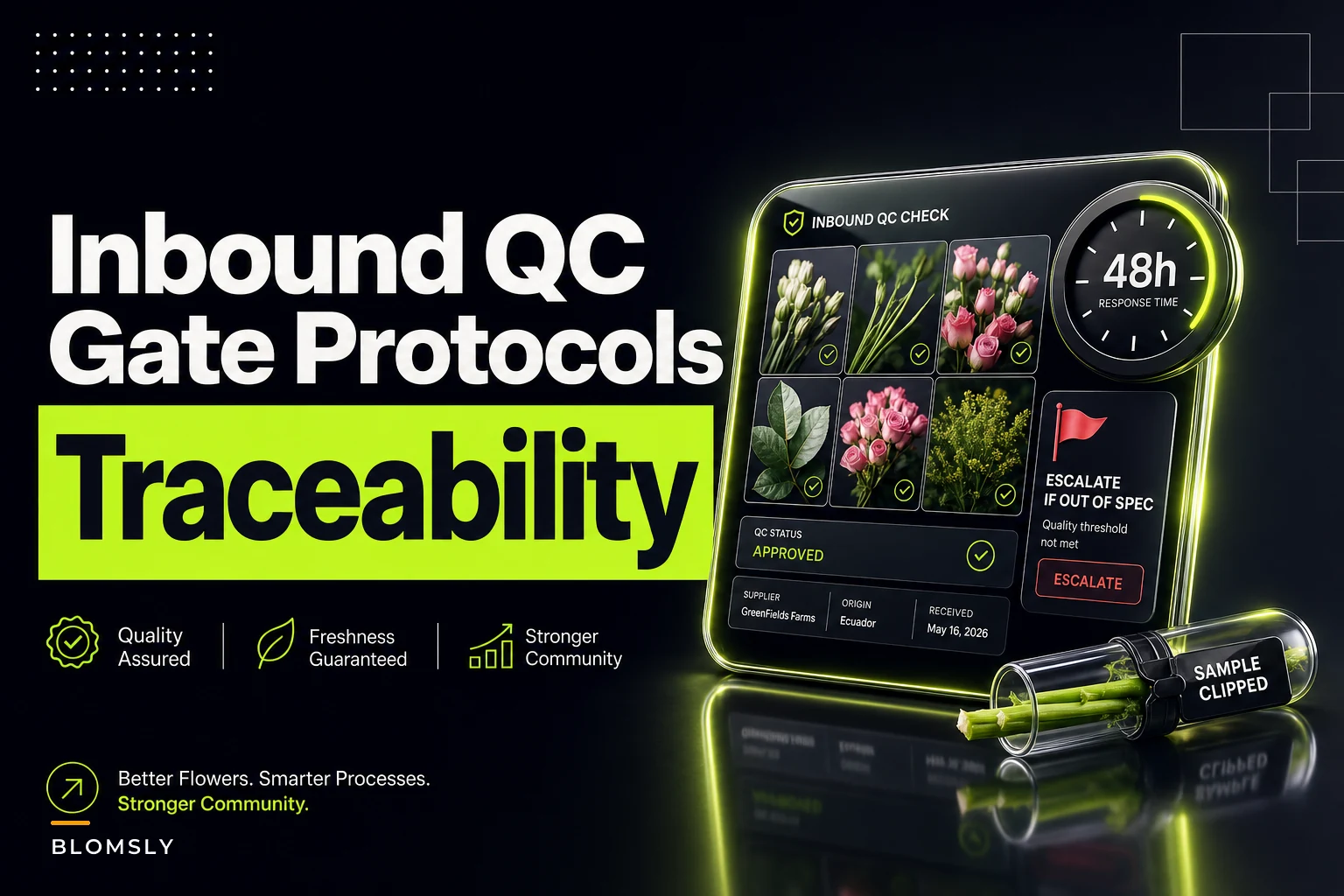
This is about closing that gap. Not with vague "check your flowers" advice, but with an actual floral inbound quality checklist that runs the same way every morning, a 48-hour re-check that catches slow failures, a photo protocol that gives your complaints teeth, and escalation emails that feed a supplier scorecard instead of dying in your inbox.
The real problem: arrivals get inspected by whoever's standing closest
Here's how it usually plays out in a 2–4 person shop. The truck shows up during the morning rush. Someone's on the phone with a customer, someone's finishing a sympathy arrangement, and the newest person on the team happens to be near the door. They sign the manifest, stack the boxes, and get back to what they were doing. Nobody opens anything until a designer needs those stems hours later.
The inspection, if it happens at all, is a quick glance: "looks fine." But "looks fine" at 7am tells you almost nothing about what that product does over the next 72 hours. A hydrangea can look perfectly turgid on arrival and collapse by the next afternoon. Roses can arrive tight and gorgeous and then blow open all at once because they were cut too mature. Bacterial contamination doesn't show up until stems start smelling and leaves yellow.
The pattern that keeps coming up: shops don't have a bad inspection, they have no defined inspection. No single person responsible, no checklist, no record of what came in looking like. So when quality fails, there's nothing to point to.
Why "looks fine" costs you more than you think
The money here is quiet, which is exactly why it gets ignored. A florist spending roughly $3k–$5k a month on fresh product typically eats somewhere between 3% and 8% of that in preventable arrival-related loss—stems that were already compromised when they walked in the door but got paid for anyway.
Never miss a bloom or a delivery.
Blomsly helps you manage orders, track stock, and schedule deliveries effortlessly.
- Unified order management
- Real-time inventory tracking
- Delivery scheduling & notifications
No credit card required
That's roughly $150–$300 a month in product you paid full price for and threw away. And that's before counting the arrangement that went out looking tired, the customer who didn't reorder, or the designer time wasted stripping and re-processing a bunch that should've been rejected on sight.
The deeper cost is informational. Without an arrival record, you can't tell the difference between:
-
A supplier who's genuinely slipping on quality
-
A cold chain problem during transit
-
Your own cooler and processing habits
-
One bad box vs. a pattern
You end up blaming the wrong thing. Shops have switched suppliers over quality complaints that turned out to be a hydration-timing issue in their own back room. The inbound gate exists partly to tell you where the failure is happening.
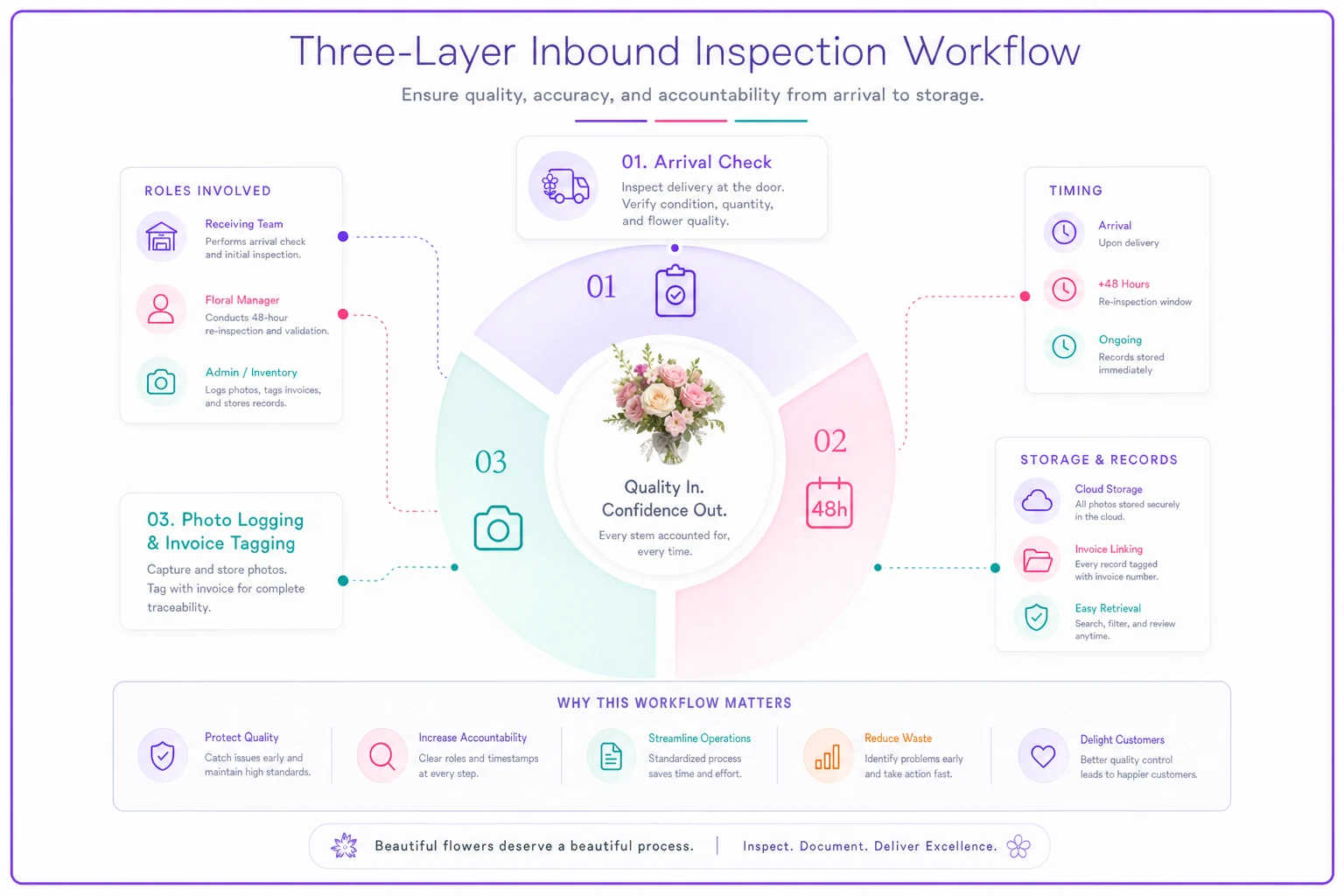
The three-layer inspection: arrival, 48-hour, and the photo log
The system has three moving parts. Each one catches a different kind of failure.
Layer 1 — Arrival check (at the door, every delivery). This catches obvious, immediate problems: wrong product, short counts, visible damage, heat exposure, crushed heads.
Layer 2 — 48-hour follow-up (the slow-failure catch). This catches the stuff that looks fine on arrival but fails fast: premature blown roses, hydrangea wilt, botrytis spots appearing, stems that won't drink.
Layer 3 — Photo log (the evidence layer). Every rejection or flag gets photographed with the invoice number and date. This is what turns "I think the roses were bad" into a documented claim your supplier can't wave off.
A simple visual flow of the three-layer inspection process.
The reason all three matter: suppliers push back hardest when you report problems late with no proof. The 48-hour window plus photos removes their two favorite excuses—"you should've caught that on delivery" and "we have no record of any defect."
Layer 1: the arrival check, step by step
This should take one trained person about 4–7 minutes per delivery. Assign it to a named role, not "whoever's near the door." If the usual person is out, there's a backup—but it's always a specific human who owns the gate that day.
-
Match the manifest before anything else. Count boxes against the packing list. Confirm product, variety, grade, and stem count line by line. Short counts and substitutions are the most common issue and the easiest to prove right at the door.
-
Check the temperature and transit signs. Feel the boxes. Warm boxes, condensation inside the liner, or wilted product on top usually means a cold-chain break. Note it immediately.
-
Open and inspect the top and a random middle bunch. Don't just check what's visible. Pull a bunch from the middle of the box. Suppliers who pad the top layer get caught here.
-
Grade the heads and stems. Look for crushed or bruised heads, broken necks, excessive guard-petal damage on roses, yellowing foliage, and botrytis (gray fuzzy spots). For bud product, check maturity—too tight won't open, too open won't last.
-
Smell the water line. A sour or rotten smell on the stem ends signals bacterial load and a short vase life no matter how good the heads look.
-
Make the accept / flag / reject call. Accept clean product. Flag borderline product for the 48-hour re-check. Reject anything clearly unsellable before you sign.
-
Log it. Record what arrived, what you flagged, what you rejected, with the invoice number. Photograph anything flagged or rejected.
Train people to note exceptions on the manifest before signing to preserve your claim.
The one mistake that undoes all of this: signing the delivery manifest clean and then finding problems. Once you've signed without noting exceptions, you've weakened every claim that follows. Train people to note exceptions on the manifest itself—"2 bunches roses rejected, crushed heads, photographed"—before they sign.
Layer 2: the 48-hour follow-up inspection
This is the step almost nobody does, and it's where the real quality intelligence lives. Set a recurring task to re-inspect flagged product (and a sample of accepted product) about 48 hours after arrival.
What you're looking for:
-
Roses that blew fully open—a sign they were cut too mature
-
Hydrangea, peonies, or other thirsty stems that wilted despite proper processing
-
Botrytis that wasn't visible on arrival but has since bloomed
-
Stems that simply never hydrated
-
Vase life that's clearly going to fall short of what you paid for
Tie each 48-hour finding back to the arrival invoice. Over a few weeks this builds a pattern you can actually read: Supplier A's roses fail the 48-hour check 1 in 20 times; Supplier B fails 1 in 6. That's not a feeling anymore. That's a number you can put in a negotiation.
A quick note on the difference between a one-off and a pattern:
| Signal | One-off (likely transit/handling) | Pattern (likely supplier) |
|---|---|---|
| Crushed heads on top layer only | Yes | Rare |
| Short count on a single line | Yes | If repeated across weeks, flag it |
| Premature blown roses, one box | Maybe | If 3+ deliveries in a row, escalate |
| Sour water / bacterial smell repeatedly | Rare | Yes—processing or source water issue |
| Consistent sub-grade heads | No | Yes |
That table matters because it stops you from blowing up a supplier relationship over a single bad box—and stops you from tolerating a real pattern because each individual incident felt "minor."
Layer 3: the photo-sampling protocol
Photos only help if they're consistent. A blurry shot with no context proves nothing. Keep the protocol simple so it actually gets followed:
-
One wide shot of the full box or affected bunch
-
One close-up of the specific defect (crushed head, botrytis, blown rose, broken neck)
-
One shot of the invoice/packing slip in the same frame or same photo batch
-
Written note of invoice number, variety, and defect in the file name or caption
Three photos and a line of text. The invoice-in-frame step is the one people skip, and it's the most important—it links the defect to a specific order so your supplier can't claim it came from a different shipment.
Store these somewhere searchable by supplier and date, not buried in someone's phone camera roll. The whole point is being able to pull "every rose defect from Supplier B in the last 60 days" in under a minute when you're on the phone with your rep.
Templated escalation emails that actually get resolved
Most quality complaints fail not because the supplier is unreasonable, but because the complaint is vague, emotional, and undated. "Your flowers have been bad lately" is easy to ignore. A dated, photographed, invoice-referenced claim is not.
Use two templates: a first-report email for individual incidents, and an escalation email when a pattern crosses your threshold.
First-report template (single incident): > Subject: Quality claim — Invoice #[number], delivery [date] > > Hi [rep name], > > Logging a quality issue from today's delivery, invoice #[number]. > > - Product: [variety / grade] > - Issue: [crushed heads / blown on arrival / botrytis / short count] > - Quantity affected: [X bunches / Y stems] > - Photos attached (defect + invoice) > > We've documented this on arrival and noted the exception on the signed manifest. Please advise on credit or replacement. Thanks.
Escalation template (pattern across deliveries): > Subject: Recurring quality issue — [variety] — [date range] > > Hi [rep name], > > This is the [third] delivery in [date range] with the same issue on [variety]. Summary below, photos and invoices attached for each: > > - [Date] Inv #[number]: [defect], [qty] > - [Date] Inv #[number]: [defect], [qty] > - [Date] Inv #[number]: [defect], [qty] > > This is now a pattern rather than a one-off, and it's affecting our fulfillment. We'd like to set up a call to discuss resolution and what changes on your end going forward. Appreciate it.
Feeding it all into a supplier scorecard
Every arrival rejection, 48-hour failure, short count, and escalation is a data point. Individually, each one feels minor. Tracked over time, they become the backbone of a real supplier evaluation. If you haven't built one yet, this inbound gate is exactly the data source it needs—here's how to build a floral supplier scorecard that improves fill rates and quality from the records this process generates.
A few metrics worth pulling straight from the inbound log:
-
Arrival defect rate (defective bunches ÷ total bunches received)
-
48-hour failure rate (slow failures ÷ accepted product)
-
Short/substitution rate (lines missing or swapped ÷ total lines)
-
Claim resolution time (how fast credits actually land)
When you can show a supplier their numbers next to a competitor's, the negotiation changes entirely. And the arrival rejections you do catch are a direct dent in your throwaway pile—this gate is one of the highest-leverage moves in any florist waste-reduction effort to recover margin from unsold blooms, because rejected-at-the-door product never becomes shrink you paid for.
A real scenario: the slow-failure roses
A small shop running roughly $4k a month in fresh product kept losing red roses to premature blooming—gorgeous on arrival, wide open and shedding by day three. They'd complained to their supplier twice over the phone, got brushed off both times ("they looked fine when they left us"), and were close to switching vendors.
Instead they ran the 48-hour check for three weeks with photos. The pattern was clear: roses from this supplier failed the re-check about 1 in 5 times, concentrated in one specific farm source. They sent the escalation email with three dated incidents and twelve photos attached.
The result wasn't dramatic. The supplier switched their sourcing for that variety, issued credits on the documented incidents—somewhere around $180 total—and the 48-hour failure rate dropped to roughly 1 in 20 over the following month. The shop kept the supplier, stopped losing the roses, and now had a scorecard entry proving the vendor could perform when pushed.
The flowers didn't get better because the florist asked nicely. They got better because the florist showed up with a paper trail.
When this is worth the effort—and when it isn't
This full three-layer system makes sense if you're buying fresh product several times a week, running more than a thousand or so dollars a week through the back door, and quality complaints are affecting real arrangements and real customers. At that volume, the few minutes per delivery pay for themselves fast in avoided shrink and recovered credits.
It's probably overkill if you order once a week in small quantities and your supplier is already rock-solid. In that case, run the arrival check and skip the formal 48-hour logging until you see a problem worth tracking. Don't build bureaucracy you don't need.
One caution: this only works if one named person owns the gate each day and the logging is genuinely fast. The moment inspection becomes "everyone's job," it becomes nobody's. The moment logging takes ten minutes, it stops happening. Keep it tight, keep it owned, keep the photos consistent.
The whole point isn't to turn your back door into an inspection checkpoint for its own sake. It's that the five minutes where product crosses your threshold is the one moment you have real leverage over quality—before you've signed, before you've paid, and before a bad stem becomes your problem instead of your supplier's.
Ready to grow your flower shop business?
Join 500+ flower shops using Blomsly to save time, reduce errors, and delight customers with fresh blooms.