



The July CPI print came in softer than feared — 0.1% month-over-month — but the year-over-year read around 3.4% shows inflation is stickier than many forecasts expected. See the CNBC coverage: https://www.cnbc.com/2026/08/12/cpi-inflation-report-july-2026.html This matters for flower shops because invoices arrive weekly and small input moves compound quickly.
Inflation hits floral ops from multiple directions: stems tick up at wholesale, foam/boxes/ribbon climb, delivery fuel stays high, and wages don't slide back. By the time lower margins show in the bank account, you've often sold weeks of product at old prices.
This guide focuses on practical actions that actually move margin inside a floral operation — where the real leaks hide and what to do first.
The margin problem isn't the price increase — it's the lag
Most shops don't lose money because their prices are wrong; they lose money because their prices are old. The lag between rising input cost and updated menu pricing is where margin quietly disappears.
Example: a standard hand-tied uses ~22–26 stems plus greens, wrap, and packaging. An 8–10¢ per-stem increase plus 30–40¢ more in greens/wrap adds roughly $2.50–$3.00 cost per bouquet. Selling 40/week at that leak equals about $100–$120 lost weekly on one SKU.
The core problem the CPI exposes is operational: most shops lack a fast, repeatable way to re-cost menu SKUs when inputs move. Prices get set seasonally or less, and owners react late when pain becomes obvious.
Re-cost your top SKUs first, not your whole menu
Redoing an entire catalog at once wastes time and lets bread-and-butter SKUs keep losing money. Focus on the ~15–20 SKUs that drive most revenue: everyday bouquets, key sympathy standards, subscription tiers, and your most popular occasion builds.
Never miss a bloom or a delivery.
Blomsly helps you manage orders, track stock, and schedule deliveries effortlessly.
- Unified order management
- Real-time inventory tracking
- Delivery scheduling & notifications
No credit card required
If you haven't mapped profit per SKU against seasonal cost swings, start there. Our profit-per-SKU matrix approach guides fast adjustments: what a florist pricing strategy really needs.
| SKU type | Cost sensitivity | Re-cost priority | Why |
|---|---|---|---|
| Everyday hand-tied bouquet | High (volume) | First | Small cost creep × high volume = biggest leak |
| Sympathy/funeral standards | Medium–High | First | Time-sensitive, price-inelastic, high stem count |
| Subscription tier | High (recurring) | Second | Locked-in pricing erodes fastest under inflation |
| Occasion builds (birthday, anniversary) | Medium | Second | Steady sellers, moderate volume |
| Custom/one-off designs | Low | Last | Priced per-order anyway, easy to adjust live |
| Seasonal/holiday specials | Medium | As-needed | Repriced each season regardless |
Recurring SKUs are the sneaky drains. A subscription sold months ago can be delivering yesterday's margin at today's costs every week — those deserve priority.
The delivery fee conversation you keep avoiding
Delivery often hides the largest, quietest losses. A flat fee treats a 4-mile downtown drop and a 14-mile suburban run the same, even though one can cost $6–8 and the other $18–22 once fuel, time, and re-attempts are counted.
-
Zone your delivery fees by distance band (e.g., near / mid / far) to reflect trip cost differences.
-
Recalculate your free-delivery threshold so qualifying orders actually cover average delivery costs.
-
Add a small same-day or peak-window premium to cover routing chaos and rush labor.
-
Track failed-delivery and re-attempt rates; each re-attempt is a full-cost trip with no added revenue.
The aim isn't to nickel-and-dime customers; it's to stop quietly subsidizing long trips and rush work so delivery isn't eating profit on every far-map order.
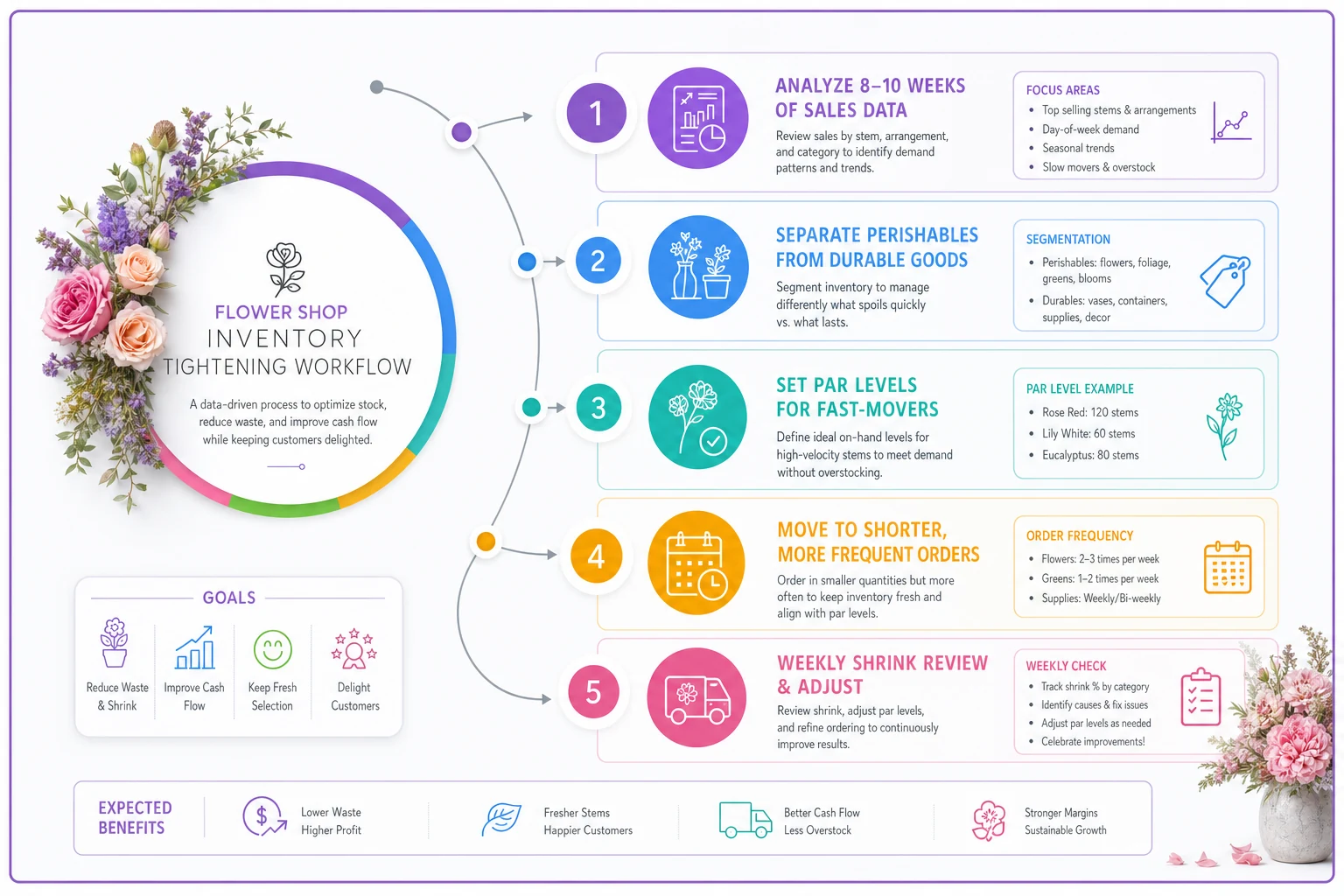
Tighten inventory before you touch a single price
When input prices rise, waste becomes costlier. Over-ordering "just in case" ties up cash and increases shrink on perishable stems bought at higher prices. Tightening safety stock discipline recovers margin without customer friction.
-
Pull the last 8–10 weeks of sales by SKU to measure actual pull-through.
-
Separate high-perishability stems from durable greens and accessories for different cadences.
-
Set par levels per fast-mover based on demand plus a modest buffer, not guesswork.
-
Shift perishables to shorter, more frequent orders rather than large, infrequent buys.
-
Review shrink weekly to catch bad ordering patterns before they repeat.
Many shops recover a notable portion of apparent cost increases simply by reducing waste and tightening pars before raising prices. This margin is invisible to customers and immediate to capture.
A real scenario: a two-van shop tightens up
A mid-sized shop with two vans and $40k–$45k monthly volume found everyday-bouquet margins down 4–5 points after rising invoices. They re-costed the top 18 SKUs and nudged prices up 6–9% with minimal customer pushback.
They rezoned delivery into three distance bands, raised the free-delivery threshold, moved two perishable categories to twice-weekly ordering, and trimmed standing orders on slow movers.
Over two months the combined changes recovered roughly $2,000–$2,800 monthly through recaptured pricing, reduced delivery loss, and lower shrink — no new customers or capital outlay required.
Where the re-costing work actually breaks down
The math for re-costing is straightforward; the maintenance is the hard part. One-time re-costs are manageable, but keeping SKU costs, par levels, and delivery economics current as invoices shift is what fails when things get busy.
When ordering, inventory, and sales data live in separate systems (POS, supplier portal, spreadsheets), re-costing becomes manual and slow. Platforms that connect purchasing to sales history let you spot slipping SKUs without monthly spreadsheet rebuilds.
Tools help, but discipline comes first. A maintained spreadsheet is better than unused software — pick a workflow you will actually run weekly.
Choosing an inventory approach for a 1–5 person shop:
-
Start with spreadsheet reorder points if a single owner-operator manages buying on a tight budget, then move to cloud tracking as headcount grows.
-
Manual paper lists
keep a laminated clipboard in the cooler and log discarded stems with a mandatory reason code.
-
Spreadsheet reorder points
use data validation to reduce typos and follow order quantity rules for perishable florals.
-
Cloud tracking
choose software with expiration alerts and digital discard logging; see ChecklistGuro's guide: https://checklistguro.comHow to Increase Your Efficiency with Flower Shop Management Software
Reorder Point = (Average Daily Stem Usage × Supplier Lead Time Days) + Perishable Safety Stock
In plain English: the reorder point triggers your next wholesale order before cooler buckets run empty.
Example: selling 25 white roses daily with a 2-day supplier window and a 15-stem safety cushion: (25 × 2) + 15 = 65 stems — reorder when on-hand reaches 65.
When on-hand falls to the trigger level, place the replenishment order so fresh blooms arrive before older stock runs out without over-buying fragile flowers.
When to raise prices — and when to hold
Not every input move deserves a price change. Apply simple guardrails so pricing decisions are consistent and data-driven.
Raise prices when:
-
Cost increases appear across multiple invoices consistently, not a one-week spike.
-
Top SKUs have slipped below your target margin based on re-costing.
-
You haven't adjusted prices in a full season or longer and persistent inflation is present.
Hold or wait when:
-
The supply shock looks temporary (a single holiday crunch) rather than persistent.
-
You still have waste and par slack you haven't tightened yet.
-
You're mid-season on a major occasion where sudden changes confuse regular customers.
Don't touch pricing at all if you don't actually know cost-to-build per SKU yet — raising prices blindly is guessing in another direction. Get the numbers first, then move.
Sticky inflation needs a faster operational response, not drama. The shops that protect margin are the ones who close the gap between cost and price quickly, tighten inventory before raising prices, and stop letting delivery quietly eat profit.
Practical next steps: re-cost your top SKUs, zone delivery, tighten pars, and check these numbers weekly instead of quarterly. The July CPI is a reminder that costs already moved — the question is how long you keep charging like they didn't.
Ready to grow your flower shop business?
Join 500+ flower shops using Blomsly to save time, reduce errors, and delight customers with fresh blooms.