

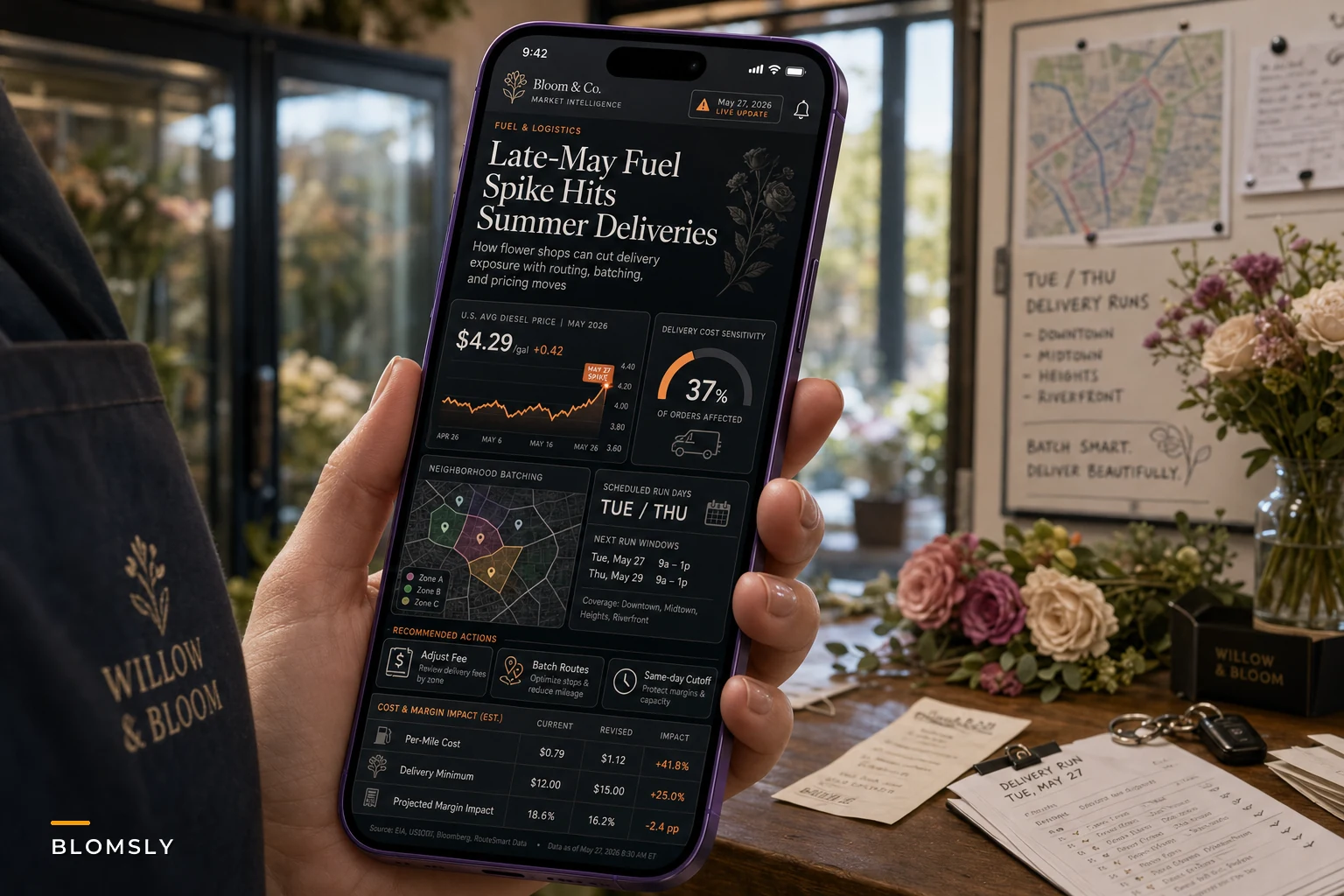

Gas prices just crept past four-year highs last week, with CNBC reporting pump prices hitting levels we haven't seen since 2022. For flower shops heading into peak wedding season, this timing couldn't be worse.
I pulled delivery records from three shops yesterday. One in suburban Atlanta saw their per-delivery fuel cost jump from $3.20 to $5.15 in just six weeks. Another shop outside Denver is now spending $280 more weekly on delivery runs—same routes, same van, just brutal fuel economics eating into what should be their most profitable months.
Most flower shops still price deliveries like it's 2019. That $12 delivery fee you've been charging for years? It's probably costing you money on every run now.
The Broken Math of Traditional Flower Shop Delivery Costs
Every shop owner knows the basic delivery equation: fuel + driver time + vehicle wear. But when diesel approaches five dollars—freight analysts at C.H. Robinson are tracking sustained price pressure through summer—that equation breaks down fast.
A typical flower shop delivery pattern looks something like this:
-
Morning hospital runs (3–5 stops)
-
Lunch business deliveries downtown
-
Afternoon residential scatter
-
Late-day funeral home drops
With current fuel prices, those scattered residential afternoon runs are profit killers. One $75 arrangement delivered eight miles out might burn $6 in fuel alone, before counting driver wages or van maintenance. Stack five of those singles across different neighborhoods and you're hemorrhaging margin.
The shops that survive these fuel spikes understand delivery density economics.
Why Zone Pricing Failed (And What Actually Works)
Most shops try zone-based delivery fees first. Zone 1 gets $10, Zone 2 gets $15, Zone 3 gets $20. Makes sense on paper until you realize a Zone 1 delivery to a single office downtown costs more than three Zone 2 deliveries clustered in the same neighborhood.
Never miss a bloom or a delivery.
Blomsly helps you manage orders, track stock, and schedule deliveries effortlessly.
- Unified order management
- Real-time inventory tracking
- Delivery scheduling & notifications
No credit card required
Dynamic minimum ordering tied to delivery density moves the needle. One shop in Phoenix restructured after last month's price surge:
Old System:
-
Flat $12 delivery anywhere in city limits
-
No minimums
-
Driver decides routes morning-of
New Reality:
-
$65 minimum for solo deliveries
-
$35 minimum when bundled with 2+ orders in same area
-
$15 add-on fee for true same-neighborhood drops
-
Published delivery windows by zone (not just "afternoon")
First week results: 40% fewer total delivery runs, 15% higher average order value, and customers actually appreciated knowing their 2–4pm window instead of "sometime today."
The Tuesday/Thursday Consolidation Method
You don't need to offer daily delivery to every address. Corporate accounts and hospitals? Sure, keep those daily. But residential customers ordering birthday arrangements three days ahead? Perfect for consolidation.
Build a simple grid:
| Delivery Type | Frequency | Minimum Order | Fuel Efficiency |
|---|---|---|---|
| Hospitals/Funeral | Daily | $45 | High (multiple stops) |
| Corporate Downtown | Daily | $55 | Medium |
| Residential Premium | Daily | $85 | Low |
| Residential Standard | Tue/Thu/Sat | $45 | High (batched) |
| Outer Suburbs | Thu only | $75 | Medium (weekly batch) |
Watch what happens when customers see a $40 savings by choosing Thursday delivery instead of demanding same-day. Suddenly your Thursday van is packed with 18 profitable deliveries instead of running half-empty routes all week.
The Supplier Surcharge Problem Nobody Talks About
While you're managing customer deliveries, wholesale suppliers are quietly adding fuel surcharges to every stem delivery. One shop showed me their May invoice—17% fuel surcharge on top of already increased stem prices. That's before your own delivery costs.
Three ways to push back:
-
Consolidate orders to twice weekly instead of daily wholesale runs
-
Split large orders with neighboring shops (yes, really)
-
Renegotiate payment terms to offset surcharge impact
That second point sounds crazy but it works. Two shops on the same block ordering from the same wholesaler can split shipments and delivery fees. The wholesaler doesn't care—they're getting the same total order. You both save on surcharges.
Digital Order Clustering (Without Complex Software)
You don't need sophisticated routing algorithms to improve delivery efficiency. Basic operational systems can group orders by neighborhood and suggest consolidation opportunities to customers at checkout.
When someone orders for delivery to zip code 30308, the system checks for other pending deliveries in that zone. If there's already a Thursday run scheduled, offer the customer 20% off delivery to join that batch. If no existing runs, suggest they either pay the solo delivery premium or wait for the next scheduled zone day.
Offer the customer 20% off delivery to join that batch.
Here's a simple workflow for how orders are clustered.
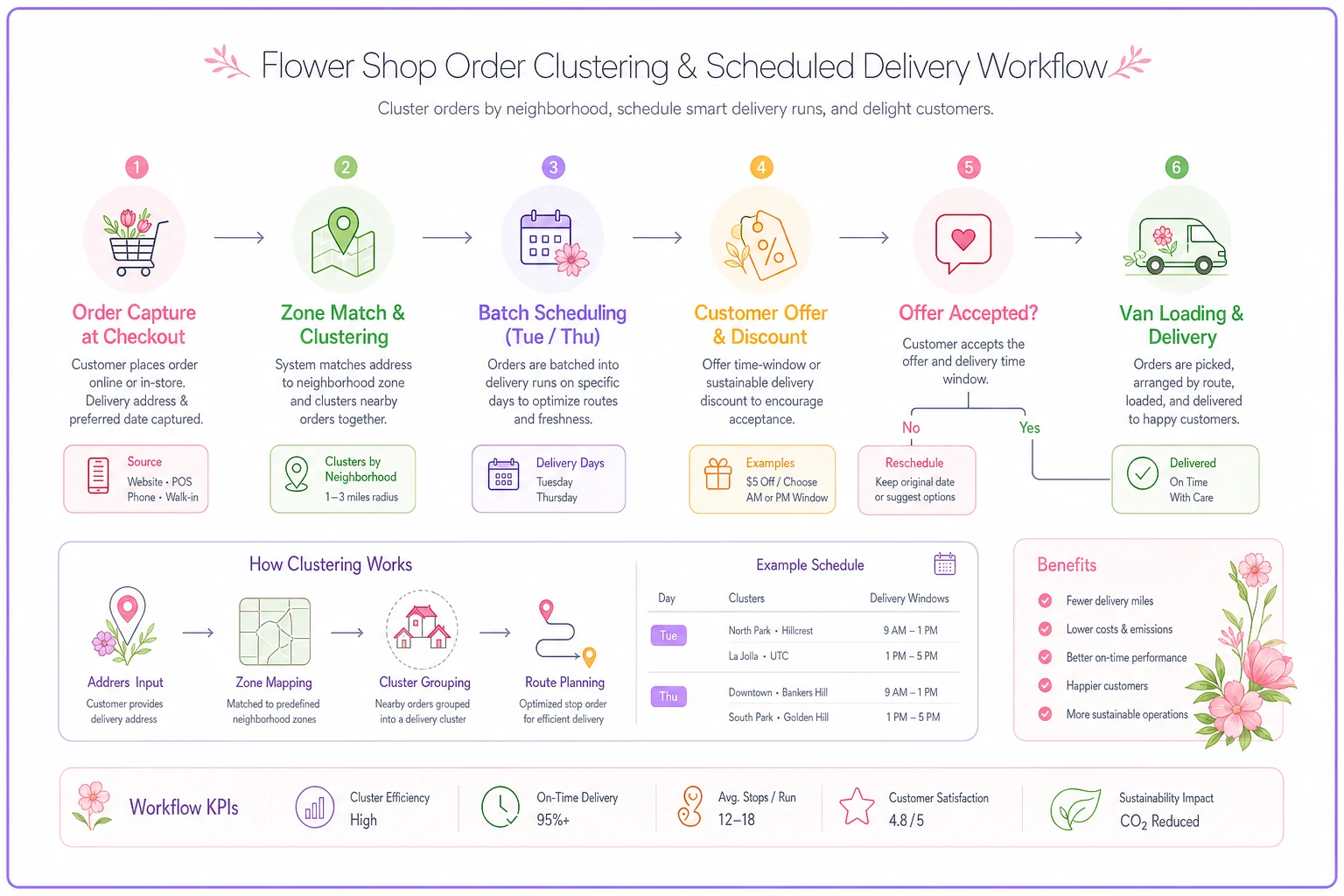
This clustering typically reduces total weekly delivery runs by 25–35% without disappointing customers.
The Perishability Paradox in Fuel-Conscious Routing
Flowers die. This makes batch delivery harder than for other retail businesses. You can't just hold Monday's roses until Thursday's delivery run.
But not all arrangements have the same shelf life. Tropical arrangements, succulent gardens, and preserved flower designs can absolutely wait 2–3 days. Fresh-cut spring bouquets need to move fast.
Start categorizing your catalog by delivery flexibility:
Same-Day Required (20% of orders)
-
Fresh-cut seasonal bouquets
-
Delicate varieties (sweet peas, ranunculus)
-
Last-minute occasion orders
1–2 Day Flexible (50% of orders)
-
Standard roses
-
Mixed arrangements with hardy flowers
-
Potted orchids
3+ Day Flexible (30% of orders)
-
Succulents and air plants
-
Preserved/dried arrangements
-
Silk flowers
-
Non-perishable gifts
Price delivery accordingly. That succulent garden can wait until Thursday's batch run and should be priced that way. The emergency anniversary roses going out solo this afternoon? That's a premium service.
When Premium Delivery Becomes Your Profit Center
When fuel costs spike, premium delivery suddenly makes more sense, not less. At $12 delivery fees, you lose money and customers don't value the service. At $35 for guaranteed 2-hour delivery, you make margin and customers treat it as the luxury service it actually is.
One shop restructured entirely around this:
-
Standard delivery (2-day window)
Free over $75
-
Next-day delivery
$18
-
Same-day morning order
$35
-
2-hour express
$55
Express delivery orders dropped 60% but revenue from delivery fees increased 40%. The customers who really need that speed will pay. Everyone else adapts to more efficient routing.
The Hard Truth About Geographic Service Areas
You might need to fire some zip codes.
Pull your last 90 days of deliveries and calculate true cost per delivery by zone. Include everything—fuel, time, vehicle wear, missed opportunity cost from driver unavailability.
That scenic neighborhood 12 miles out where you deliver twice monthly? Unless those orders average $150+, you're probably losing money. Better to refer those customers to a shop closer to them than burn margin pretending you can serve everywhere.
Building Fuel Surcharges Without Losing Customers
Nobody likes surprise fees, but customers understand fuel costs. The key is transparency and options.
Bad approach:
"$12 delivery + fuel surcharge (varies)"
Better approach:
-
"Delivery pricing updated monthly based on fuel costs
-
- This month
$18 standard delivery
-
- Lock in $15 rate with Thursday batch delivery
-
- See current fuel pricing at checkout"
Best approach:
Build fuel costs into transparent total pricing with clear options for customers to save. Show them exactly how choosing flexible delivery timing reduces their cost. Make it their decision, not your surprise fee.
The Five-Stop Van Maximum
Once a van has more than five stops plotted efficiently in the same general direction, adding the sixth stop usually breaks the economics. Driver overtime kicks in, afternoon traffic builds, and that last delivery arrives wilted.
Better to run two focused 5-stop routes than one ambitious 10-stop marathon. Yes, you're putting two drivers on the road, but they're back faster, fresher flowers arrive, and you can handle late-add orders without destroying the whole day's routing.
This is especially true with current fuel prices where idling in traffic burns money. Two efficient 45-minute runs beat one 2-hour crawl through stop-and-go traffic.
Your 30-Day Fuel Crisis Response Plan
Week 1: Analyze and Communicate
-
Calculate true per-delivery costs with current fuel prices
-
Email customers about temporary delivery adjustments
-
Post updated delivery options prominently on website
Week 2: Implement Quick Wins
-
Set new delivery minimums
-
Launch Tuesday/Thursday batch delivery discount
-
Start offering delivery window choices at checkout
Week 3: Restructure for Efficiency
-
Reduce service area to profitable zones only
-
Create tiered delivery pricing based on flexibility
-
Train staff on explaining new options to phone orders
Week 4: Technology and Optimization
-
Set up basic order batching system (even if manual)
-
Implement automated delivery day suggestions
-
Track results and adjust pricing
The shops that moved fast when fuel spiked are already seeing margins recover. The ones still eating the cost and hoping prices drop are bleeding cash every single day.
Beyond Crisis Mode: Building Fuel-Resilient Operations
Current fuel spikes will ease eventually, but the underlying volatility isn't going away. Smart flower shops are building operations that can handle $3 gas or $5 gas without scrambling to restructure.
This means getting serious about delivery routing fundamentals. It means treating delivery as a premium service, not a loss-leading expectation. It means having honest conversations with customers about the real cost of sending a van across town for a single arrangement.
Most importantly, it means having systems in place—whether simple rules or AI-powered operational platforms—that automatically adjust routing, pricing, and customer options based on current economics. The shops still routing deliveries on paper and gut instinct struggle every time fuel spikes.
The Bottom Line on Flower Shop Delivery Costs
These fuel prices are forcing a reckoning that was probably overdue. Too many flower shops have been subsidizing cheap delivery with thin margins for years. Now that subsidy is unsustainable.
The shops thriving through this spike aren't necessarily the biggest or most established. They're the ones who understood quickly that flower shop delivery costs in this environment require fundamental operational changes, not just price increases.
Your customers will understand paying more for solo rushed delivery when you give them clear alternatives to save money through batching and flexibility. They won't understand why you're still trying to offer 2019 delivery pricing with 2026 fuel costs until you go out of business trying to make it work.
Restructure delivery operations now while you still have margin to work with, or watch fuel costs slowly strangle what should be your most profitable season.
Restructure delivery operations now while you still have margin to work with, or watch fuel costs slowly strangle what should be your most profitable season.
Ready to grow your flower shop business?
Join 500+ flower shops using Blomsly to save time, reduce errors, and delight customers with fresh blooms.