

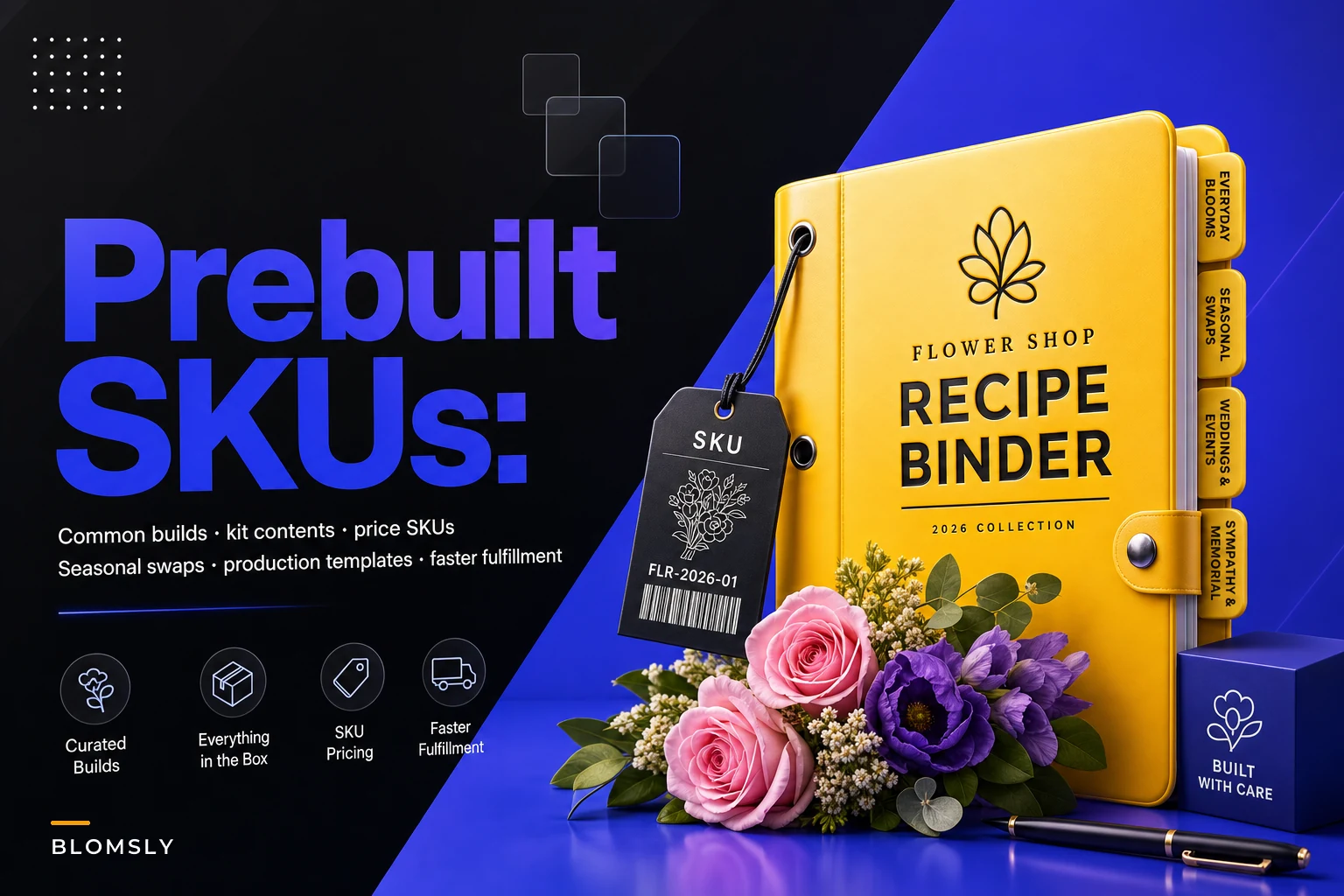

Most flower shops don't have a design problem. They have a decision problem. Every time an order hits the bench without a defined recipe, your best designer stops and thinks — what container, how many focal stems, which greens, does this look "full enough" for the price point? Multiply that pause by 40 orders on a busy Friday and you've burned an hour or more just deciding, not building.
The fix isn't more talent. It's fewer decisions. When you lock in a set of floral package SKUs — prebuilt recipes with fixed contents, fixed pricing, and fixed production steps — you turn design from a judgment call into an assembly task. That's the difference between a shop that panics on Valentine's week and one that just runs the line.
This post walks through how to identify which builds you actually repeat, how to spec the contents so anyone can execute them, how to price the SKUs so they protect margin, and how to rotate them seasonally without rebuilding your whole catalog every quarter.
Start by finding what you already build over and over
Before you design a single package, pull your last 90 days of orders and look at what's actually leaving the door. Almost every shop discovers the same thing: roughly 15–20 build types cover somewhere north of 80% of volume. The rest is custom work, and custom work isn't what you're trying to systematize here.
Look at the order history and group builds by three things at once: occasion, price point, and physical form. A "sympathy standing spray at $150" is a different SKU than a "sympathy vase at $75," even though both are sympathy. What you're hunting for are the clusters — the combinations that show up again and again.
-
Everyday hand-tied bouquets in three sizes (small/medium/large)
-
Vased arrangements in two or three price tiers
-
Sympathy pieces (vase, basket, standing spray)
-
Get-well and new-baby designs
-
Roses (dozen, half-dozen, mixed premium)
-
A rotating "designer's choice" that flexes with what's fresh
The mistake here is trying to SKU everything. If a build shows up twice a year, it doesn't need a recipe card — it needs a designer's judgment. Reserve standardization for the volume, not the exceptions. One shop had built formal specs for 60 arrangements, and half of them had sold fewer than five units all year. That's not a system, that's a filing project nobody maintains.
Design the kit contents so a new hire can build it
A package SKU is only useful if it removes the guesswork. That means the recipe has to be specific enough that someone who's been on the bench for two weeks can pull it off without asking, "how many?"
Never miss a bloom or a delivery.
Blomsly helps you manage orders, track stock, and schedule deliveries effortlessly.
- Unified order management
- Real-time inventory tracking
- Delivery scheduling & notifications
No credit card required
Here's what a real kit spec needs, and where most shops get lazy:
Container — exact vessel, not "a vase." SKU-042 uses the 6" clear cube, period. If you're out, the substitution is written on the card, not decided on the fly.
Focal stems — count and type. "5 standard roses" not "some roses." If seasonal availability forces a swap, the card lists the approved alternates in priority order.
Secondary / filler — spray roses, alstroemeria, whatever carries the mid-layer. Count matters here because this is where designers unconsciously overstuff and eat your margin.
Greens — number of stems and variety. Greens feel free, but at scale they aren't.
Mechanics & accessories — foam block size, ribbon, care card, pick. The small stuff that gets forgotten and then somebody's running back to the cooler.
Target finished dimensions — height and width. This is the quality gate. If the finished piece is supposed to be 14" tall and it's coming off the bench at 10", something got skipped.
A sample kit list for a mid-tier vased arrangement might read:
| Component | Spec | Count |
|---|---|---|
| Container | 6" clear rose bowl | 1 |
| Focal | Standard rose, red | 6 |
| Secondary | Spray rose, white | 5 stems |
| Texture | Alstroemeria | 4 stems |
| Greens | Italian ruscus | 3 stems |
| Filler | Wax flower | 2 stems |
| Finish | Care card + branded pick | 1 each |
| Target size | 12"H × 11"W | — |
The insight most owners miss: writing the count down isn't about making it look organized. It's about making your cost predictable. When every SKU-051 uses exactly the same stems, you know your COGS to the dollar, and you can order against actual consumption instead of guessing. That connects directly to demand planning and replenishment — but it starts with the recipe being real, not "roughly this."
Price the SKUs so they protect margin, not just cover cost
Once the contents are fixed, pricing gets a lot easier — and a lot more honest. You know the stem cost, you know the container, you know roughly how long it takes to build. The SKU carries a price that's defensible instead of vibes-based.
The trap is pricing each package individually and ending up with a ladder that doesn't make sense to customers. If your small is $55, your medium should feel like a real step up in value, and your large should feel like an upgrade worth paying for — not a random $20 jump. Build the tiers so the perceived difference matches the price difference. Usually that means the step-up SKU adds visible focal stems, not just more greenery.
A clean everyday ladder often looks like:
-
Small — 3 focal, tighter build, entry price
-
Medium — 5 focal, the "standard" most people land on
-
Large — 7–9 focal, the upgrade you actually want to sell
Price the medium as your anchor. It should be the one you're happy to make all day, the one with the margin you designed the whole system around. The small exists so nobody feels priced out. The large exists to capture the customer who wants to spend more — and roughly a third of them will, if you make the upgrade look worth it.
One pattern worth watching: designers left to their own judgment tend to over-deliver on the small and under-deliver on the large, because they're mentally averaging. A locked SKU stops that. The small stays lean, the large stays generous, and your margin per build stops drifting.
Rotate seasonal kits without rebuilding your whole catalog
A lot of shops overcomplicate this. You don't need a new set of SKUs every season. You need a stable core and a swappable seasonal layer.
The core SKUs — dozen roses, everyday medium vase, sympathy standard — barely change. What rotates is the "designer's choice" line and the seasonal accents: the palette, the specialty focal, the container that reads "fall" versus "spring."
The clean way to handle this is to build seasonal SKUs as variants of your core recipes. The mechanics stay identical. Only the plug-in stems and container change.
A practical rotation process:
-
Six weeks before the season, pick 3–5 seasonal SKUs you'll run.
-
Map each one onto an existing core recipe so the build steps don't change — only the ingredients.
-
Confirm the seasonal stems with your supplier before you print the cards, so you're not speccing something you can't get.
-
Print the seasonal recipe cards and physically swap them into the bench binder.
-
Retire the previous season's cards so nobody accidentally builds October's arrangement in April.
-
After the season ends, note which seasonal SKUs actually sold and keep the winners in the rotation library.
Keep a running "seasonal library" so you're not designing from scratch every year. Last fall's harvest palette that sold well? It's already spec'd. Next fall you pull it, verify pricing against current stem cost, adjust, and go. Year two of doing this is dramatically less work than year one.
Where the recipe cards actually live matters
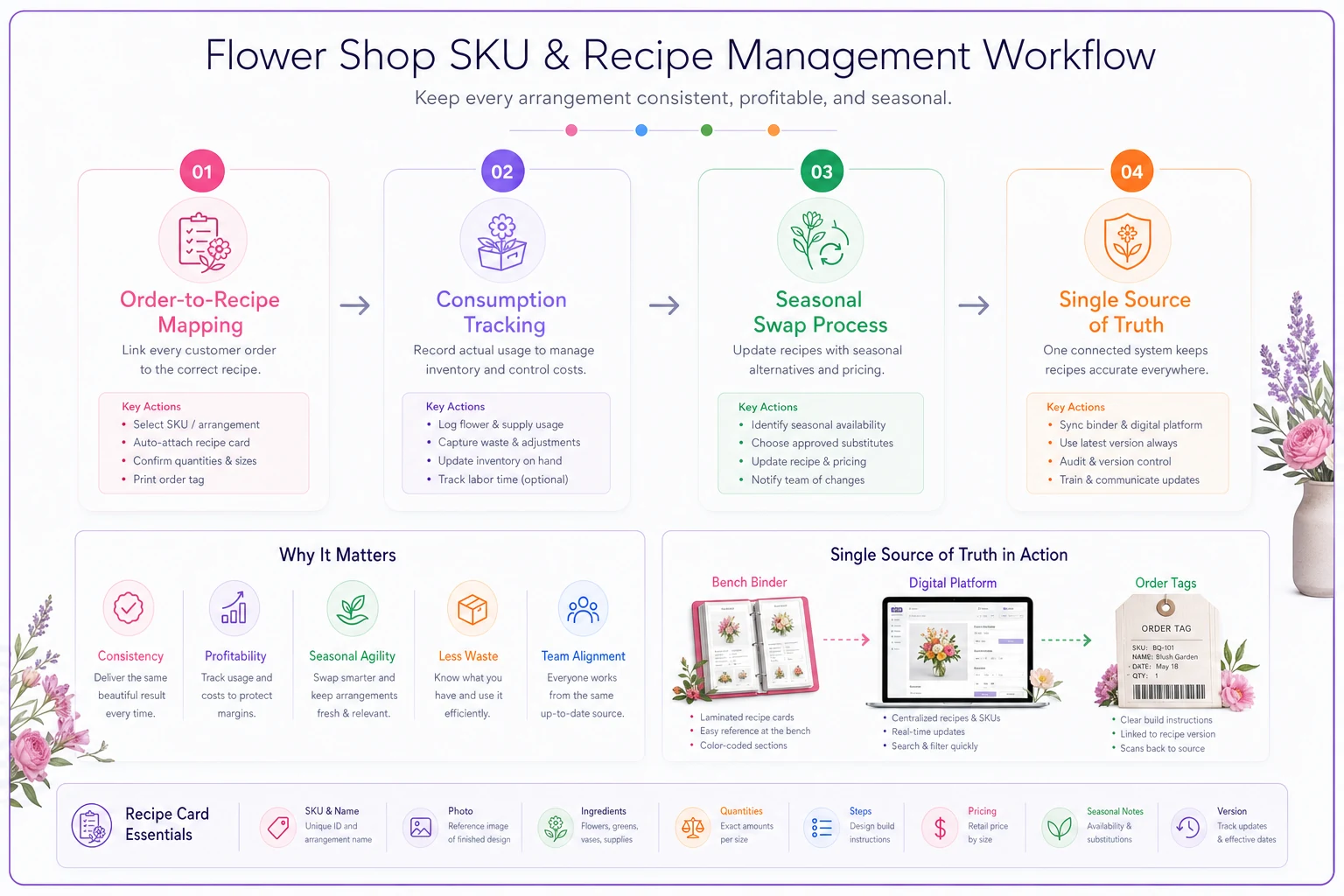
Printed cards in a binder work — until the binder walks off, or the counts change and half the cards are stale. Keeping your SKU specs in a shared workflow or AI-assisted operational platform earns its keep here, not as a gimmick but as a single source of truth.
When your recipes live in the same system your team uses to process orders, a few practical things happen. Stem counts stay tied to actual cost, so when rose prices jump you can see which SKUs got squeezed. Order tags can map straight to a build recipe, so the person on the bench sees the exact spec on the ticket instead of hunting for a card. When you rotate seasonal kits, you update one place and the whole shop is working from the current version.
The automation piece that quietly matters most is consumption tracking. If every SKU has a fixed bill of materials, the system can total projected stem usage from open orders — so ordering becomes math instead of a Friday-night gut check. That means you stop over-buying spray roses and under-buying the focal you actually run out of.
Tag orders with SKU codes so bench staff see the exact spec on the ticket.
None of this replaces a good designer's eye. It just stops your best people from spending their day re-deciding things that were already decided.
A quick real scenario
A two-designer neighborhood shop was drowning every Friday. Roughly 35–45 daily orders in peak weeks, and the lead designer was the bottleneck because everything routed through her for "how should this look" calls. Build times were all over the place — a medium vase might take 8 minutes or 15 depending on who was on the bench and how the day was going.
They spec'd 14 SKUs covering their real volume, wrote counts on cards, and set a firm three-tier ladder for everyday work. Nothing exotic.
Inside a month, the medium vase build settled into a consistent 7–8 minute range regardless of who was building it. The lead designer stopped fielding constant "is this okay" questions and got back to actual design work and the custom pieces that command a real premium. Stem waste dropped noticeably because filler over-stuffing stopped — they weren't burning through spray roses on arrangements that were already full. Nobody saw a dramatic revenue explosion, but the Friday chaos turned into a Friday that just ran, and that alone was worth it.
When this makes sense — and when it doesn't
This makes sense when your order volume is high enough that repeated builds dominate your day, when you're training new bench staff and need consistency, or when your margin keeps mysteriously slipping and you suspect over-delivery is the culprit.
This is a bad idea when you're a small, fully-custom studio doing bespoke event work where every piece is genuinely different. Forcing SKUs onto a business built around one-off artistry just adds paperwork nobody follows.
Who should hold off: shops still figuring out what they even sell. If your product mix is changing month to month, spec'ing rigid SKUs is premature. Get a few months of clean order history first, then systematize the patterns that emerge.
The real payoff
Prebuilt floral package SKUs aren't about making your shop feel corporate. They're about protecting the two things that actually run out on a busy day — your designers' focus and your margin. Every decision you make once, in advance, is a decision your team doesn't make forty times under pressure.
Start small. Pull your order history, find the fifteen or so builds that carry your volume, and write real counts on real cards. Get the core stable before you touch seasonal rotation. Once the line runs on recipes instead of judgment calls, you'll wonder how you ever built each Friday from scratch.
Start small. Pull your order history, find the fifteen or so builds that carry your volume, and write real counts on real cards. Get the core stable before you touch seasonal rotation. Once the line runs on recipes instead of judgment calls, you'll wonder how you ever built each Friday from scratch.
Ready to grow your flower shop business?
Join 500+ flower shops using Blomsly to save time, reduce errors, and delight customers with fresh blooms.